

298
BEHAVIOR OF PILES SUPPORTING OFFSHORE STRUCTURES
Equation (11.5) can be solved using a digital computer (Reese and Van Impe,
2001, p. 29); however, nondimensional methods can sometimes be employed to
yield an acceptable solution for cases where El is constant and there is no
axial load. Both methods of solution give ail the necessary design information
including the moment, deflection, and shear at desired lengths along the pile.
The methods described herein hâve received wide acceptance and are used in
many design offices around the world.
Response of Soil
For convenience in solving équation (11.5), a sécant modulus of soil reaction,
Epy, can be used, which is defined by
= ?
(11.6)
The value of p from the last équation can be substituted into équation (11.5)
and a solution obtained for the values of y with respect to points along the pile.
Because Epy is a nonlinear function, équation (11.5) can be solved by itération
using procedures developed for piles in a variety of soils and rock (Reese and
Van Impe, 2001, p. 49). The recommendations are based principally on the
results of full-scale experiments which are augmented with theory to the extent
possible. Reese and Van Impe (2001, p. 259) showed the comparison of results
from experiments with results from analysis for a sizable number of cases. The
validity of the analytical method has been well established within a reasonable
degree of accuracy.
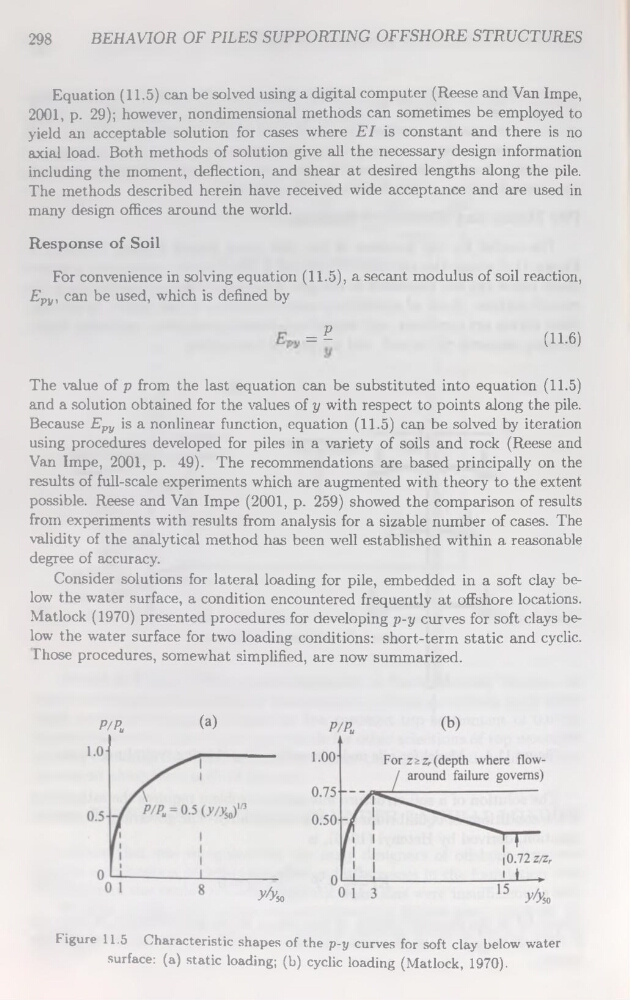
Consider solutions for latéral loading for pile, embedded in a soft clay below the water surface, a condition encountered frequently at offshore locations.
Matlock (1970) presented procedures for developing p-y curves for soft clays below the water surface for two loading conditions: short-term static and cyclic.
Those procedures, somewhat simplified, are now summarized.
P/Pu
(a)
^50
Figure 11.5 Characteristic shapes of the p-y curves for soft clay below water
surface: (a) static loading; (b) cyclic loading (Matlock, 1970).
BEHAVIOR OF PILES SUPPORTING OFFSHORE STRUCTURES
Equation (11.5) can be solved using a digital computer (Reese and Van Impe,
2001, p. 29); however, nondimensional methods can sometimes be employed to
yield an acceptable solution for cases where El is constant and there is no
axial load. Both methods of solution give ail the necessary design information
including the moment, deflection, and shear at desired lengths along the pile.
The methods described herein hâve received wide acceptance and are used in
many design offices around the world.
Response of Soil
For convenience in solving équation (11.5), a sécant modulus of soil reaction,
Epy, can be used, which is defined by
= ?
(11.6)
The value of p from the last équation can be substituted into équation (11.5)
and a solution obtained for the values of y with respect to points along the pile.
Because Epy is a nonlinear function, équation (11.5) can be solved by itération
using procedures developed for piles in a variety of soils and rock (Reese and
Van Impe, 2001, p. 49). The recommendations are based principally on the
results of full-scale experiments which are augmented with theory to the extent
possible. Reese and Van Impe (2001, p. 259) showed the comparison of results
from experiments with results from analysis for a sizable number of cases. The
validity of the analytical method has been well established within a reasonable
degree of accuracy.
Consider solutions for latéral loading for pile, embedded in a soft clay below the water surface, a condition encountered frequently at offshore locations.
Matlock (1970) presented procedures for developing p-y curves for soft clays below the water surface for two loading conditions: short-term static and cyclic.
Those procedures, somewhat simplified, are now summarized.
P/Pu
(a)
^50
Figure 11.5 Characteristic shapes of the p-y curves for soft clay below water
surface: (a) static loading; (b) cyclic loading (Matlock, 1970).