

SINGLE PILES UNDER LATERAL LOADING
299
Short-Term Static Loading
The following step-by-step procedure for short-term static loading is based
on the curve shown in Figure 11.5a.
1. Obtain the best possible estimate of the variation of shear strength and
effective unit weight with depth. Also obtain the value of e50, the stain corresponding to one-half the maximum principal stress différence. If no values are
available, use a typical value given in Table 11.2 (Skempton, 1951).
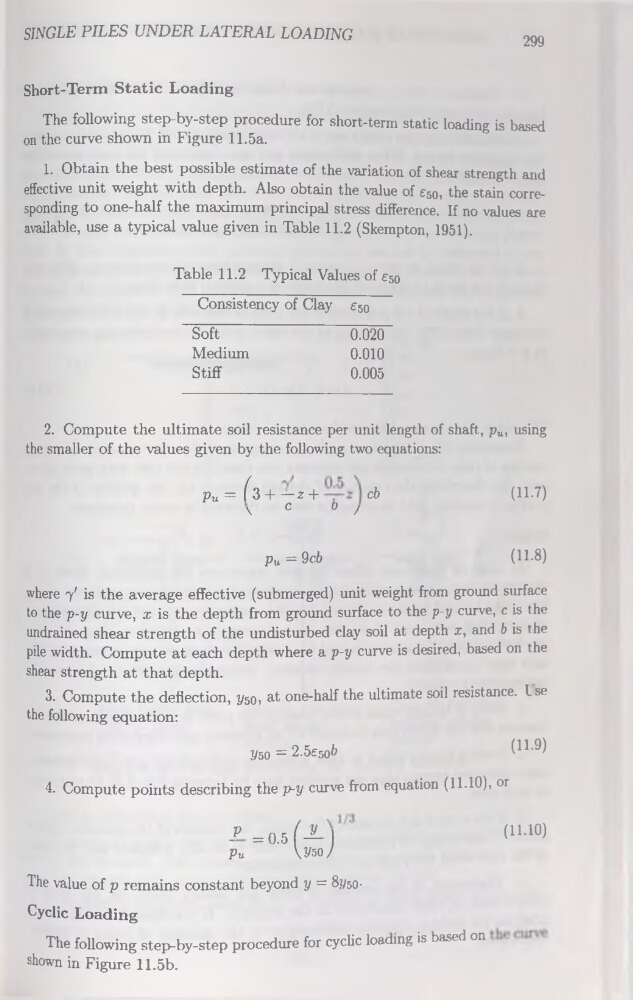
Table 11.2 Typical Values of e50
Consistency of Clay £50
Soft
0.020
Medium
0.010
Stiff
0.005
2. Compute the ultimate soil résistance per unit length of shaft, pu, using
the smaller of the values given by the following two équations:
(11-7)
Pu = 9cfe
(H-8)
where y' is the average effective (submerged) unit weight from ground surface
to the p-y curve, x is the depth from ground surface to the p-y curve, c is the
undrained shear strength of the undisturbed clay soil at depth x, and & is the
pile width. Compute at each depth where a p-y curve is desired, based on the
shear strength at that depth.
3. Compute the defiection, j/50, at one-half the ultimate soil résistance. Ise
the following équation:
J/50 = 2.5650^
(11-9)
4.
Compute points describing the p-y curve from équation (11.10), or
(11.10)
The value of p remains constant beyond y = fy/soCyclic Loading
The following step-by-step procedure for cyclic loading is based on
shown in Figure 11.5b.
299
Short-Term Static Loading
The following step-by-step procedure for short-term static loading is based
on the curve shown in Figure 11.5a.
1. Obtain the best possible estimate of the variation of shear strength and
effective unit weight with depth. Also obtain the value of e50, the stain corresponding to one-half the maximum principal stress différence. If no values are
available, use a typical value given in Table 11.2 (Skempton, 1951).
Table 11.2 Typical Values of e50
Consistency of Clay £50
Soft
0.020
Medium
0.010
Stiff
0.005
2. Compute the ultimate soil résistance per unit length of shaft, pu, using
the smaller of the values given by the following two équations:
(11-7)
Pu = 9cfe
(H-8)
where y' is the average effective (submerged) unit weight from ground surface
to the p-y curve, x is the depth from ground surface to the p-y curve, c is the
undrained shear strength of the undisturbed clay soil at depth x, and & is the
pile width. Compute at each depth where a p-y curve is desired, based on the
shear strength at that depth.
3. Compute the defiection, j/50, at one-half the ultimate soil résistance. Ise
the following équation:
J/50 = 2.5650^
(11-9)
4.
Compute points describing the p-y curve from équation (11.10), or
(11.10)
The value of p remains constant beyond y = fy/soCyclic Loading
The following step-by-step procedure for cyclic loading is based on
shown in Figure 11.5b.