

SINGLE PILES UNDER LATERAL LOADING
297
A research program was undertaken, supported principally by the petroleum
industry, and the method described in this chapter was developed. Although
additional research is needed, particularly in improving the prédiction of soil
response, the method présents an acceptable approach to a complex problem and
is currently in use in the design of foundations for offshore platforms (American
Petroleum Institute, 1993; Det Norske Veritas, 1977).
Pile Model and Method of Solution
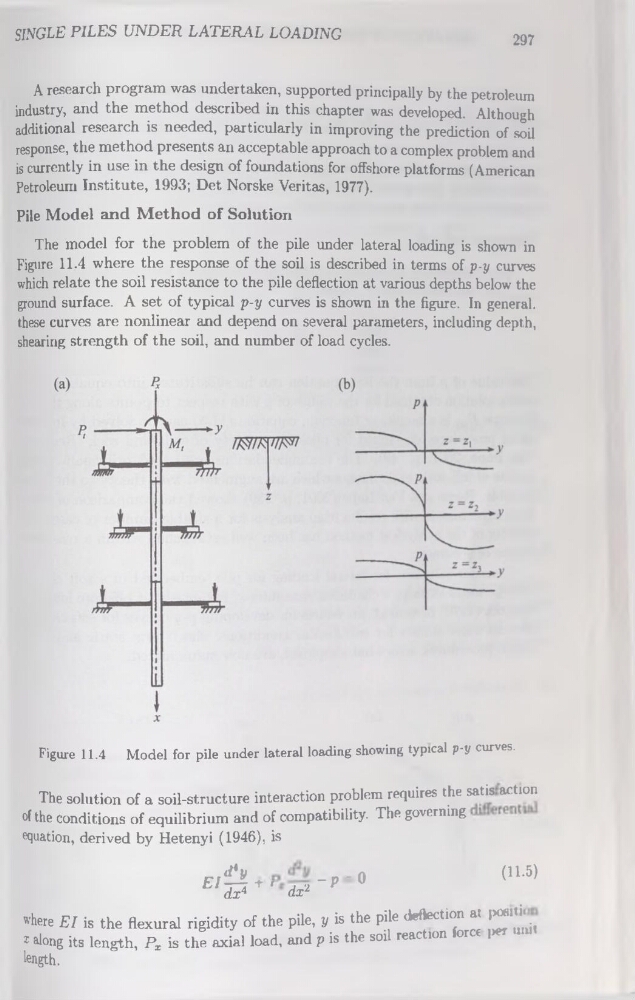
The model for the problem of the pile under latéral loading is shown in
Figure 11.4 where the response of the soil is described in terms of p-p curves
which relate the soil résistance to the pile deflection at varions depths below the
ground surface. A set of typical p-y curves is shown in the figure. In general,
these curves are nonlinear and dépend on several parameters, including depth,
shearing strength of the soil, and number of load cycles.
Figure 11.4 Model for pile under latéral loading showing typical p-y curves.
The solution of a soil-structure interaction problem requires the satis action
of the conditions of equilibrium and of compatibility. The governing
équation, derived by Hetenyi (1946), is
EI^- +
- P = 0
Lldx4
‘ dx 2 F
(11-5)
the pile détection at JXWÛ
the soil reaction force per unit
where El is the flexural rigidity of the pile, y is
1 along its length, Px is the axial load, and p is
length.
297
A research program was undertaken, supported principally by the petroleum
industry, and the method described in this chapter was developed. Although
additional research is needed, particularly in improving the prédiction of soil
response, the method présents an acceptable approach to a complex problem and
is currently in use in the design of foundations for offshore platforms (American
Petroleum Institute, 1993; Det Norske Veritas, 1977).
Pile Model and Method of Solution
The model for the problem of the pile under latéral loading is shown in
Figure 11.4 where the response of the soil is described in terms of p-p curves
which relate the soil résistance to the pile deflection at varions depths below the
ground surface. A set of typical p-y curves is shown in the figure. In general,
these curves are nonlinear and dépend on several parameters, including depth,
shearing strength of the soil, and number of load cycles.
Figure 11.4 Model for pile under latéral loading showing typical p-y curves.
The solution of a soil-structure interaction problem requires the satis action
of the conditions of equilibrium and of compatibility. The governing
équation, derived by Hetenyi (1946), is
EI^- +
- P = 0
Lldx4
‘ dx 2 F
(11-5)
the pile détection at JXWÛ
the soil reaction force per unit
where El is the flexural rigidity of the pile, y is
1 along its length, Px is the axial load, and p is
length.