

problems
285
weight in water. Set up the déterminant from which the transverse bending
frequencies can be calculated and from this dérivé the transcendental équation.
Discuss briefly how one could obtain a computer-aided solution for the consecutive roots of this équation. How are these roots related to the frequencies
Wn?
Weight,
mg = P0
String: m, t
P = Pq + /Jcoso)/
(b)
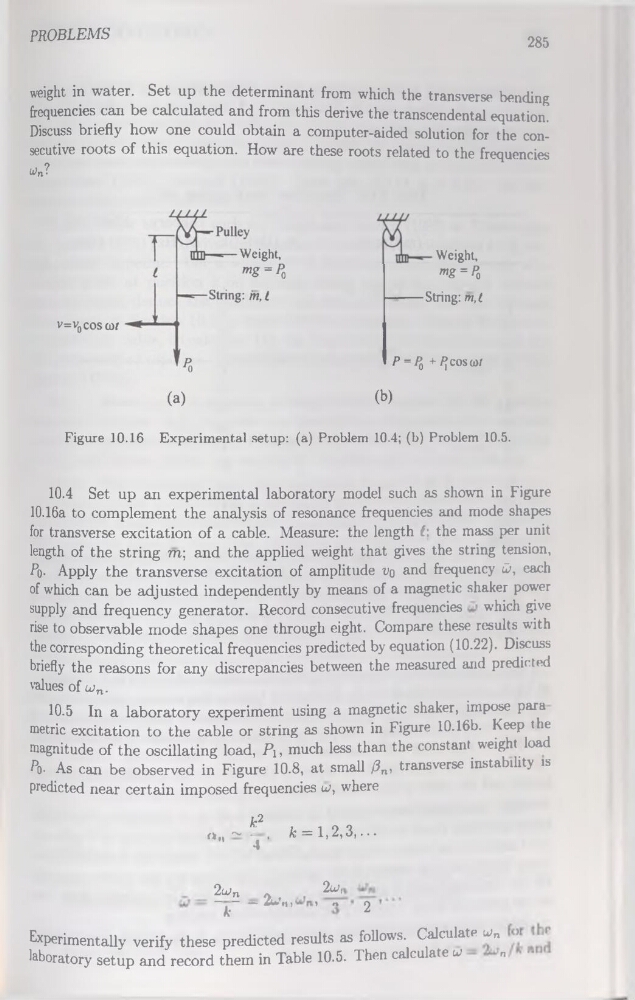
Figure 10.16 Experimental setup: (a) Problem 10.4; (b) Problem 10.5.
10.4 Set up an experimental laboratory model such as shown in Figure
10.16a to complément the analysis of résonance frequencies and mode shapes
for transverse excitation of a cable. Measure: the length (: the mass per unit
length of the string m; and the applied weight that gives the string tension,
Po- Apply the transverse excitation of amplitude vq and frequency ü», each
of which can be adjusted independently by means of a magnetic shaker power
supply and frequency generator. Record consecutive frequencies which give
rise to observable mode shapes one through eight. Compare these results with
the corresponding theoretical frequencies predicted by équation (10.22). Discuss
briefly the reasons for any discrepancies between the measured and predicted
values of a>n.
10.5 In a laboratory experiment using a magnetic shaker, impose para
metric excitation to the cable or string as shown in Figure 10.16b. Keep the
magnitude of the oscillating load, Plt much less than the constant weight load
Po- As can be observed in Figure 10.8, at small 0n, transverse instabihty is
predicted near certain imposed frequencies i^, where
k2
n..--. fc = l,2,3,...
4
2cun
~k~
2lUi
— 2u'„ > , »
2
Experimentally verify these predicted results as follows. Calculate un
laboratory setup and record them in Table 10.5. Then calculate u>
n
285
weight in water. Set up the déterminant from which the transverse bending
frequencies can be calculated and from this dérivé the transcendental équation.
Discuss briefly how one could obtain a computer-aided solution for the consecutive roots of this équation. How are these roots related to the frequencies
Wn?
Weight,
mg = P0
String: m, t
P = Pq + /Jcoso)/
(b)
Figure 10.16 Experimental setup: (a) Problem 10.4; (b) Problem 10.5.
10.4 Set up an experimental laboratory model such as shown in Figure
10.16a to complément the analysis of résonance frequencies and mode shapes
for transverse excitation of a cable. Measure: the length (: the mass per unit
length of the string m; and the applied weight that gives the string tension,
Po- Apply the transverse excitation of amplitude vq and frequency ü», each
of which can be adjusted independently by means of a magnetic shaker power
supply and frequency generator. Record consecutive frequencies which give
rise to observable mode shapes one through eight. Compare these results with
the corresponding theoretical frequencies predicted by équation (10.22). Discuss
briefly the reasons for any discrepancies between the measured and predicted
values of a>n.
10.5 In a laboratory experiment using a magnetic shaker, impose para
metric excitation to the cable or string as shown in Figure 10.16b. Keep the
magnitude of the oscillating load, Plt much less than the constant weight load
Po- As can be observed in Figure 10.8, at small 0n, transverse instabihty is
predicted near certain imposed frequencies i^, where
k2
n..--. fc = l,2,3,...
4
2cun
~k~
2lUi
— 2u'„ > , »
2
Experimentally verify these predicted results as follows. Calculate un
laboratory setup and record them in Table 10.5. Then calculate u>
n