

286
CONTINUOUS SYSTEMS
compare these with the corresponding experimental values of w where transverse
unstable motion is observed for the stated (n, k) combinations. Discuss briefly
reasons for any discrepancies.
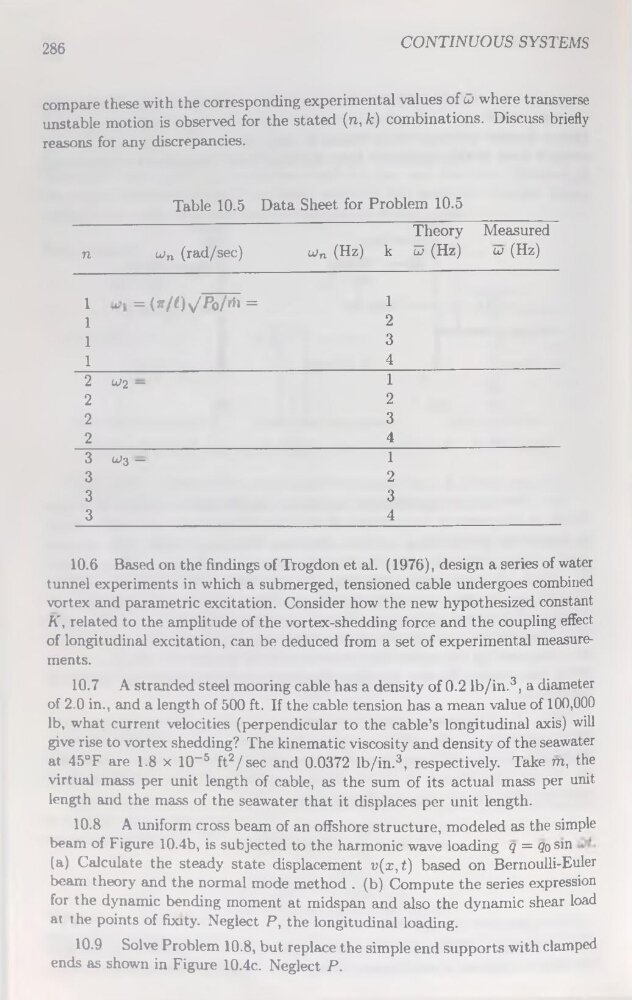
Table 10.5 Data Sheet for Problem 10.5
Theory Measured
n
cun (rad/sec)
wn (Hz) k üj (Hz)
w (Hz)
1
= (ir/fJ^/Po/rh =
1
1
2
1
3
2
4
2 W2 —
1
2
2
2
3
2______________________________________ 4
3 ÜJ3 —
1
3
2
3
3
3
4
10.6 Based on the findings of Trogdon et al. (1976), design a sériés of water
tunnel experiments in which a submerged, tensioned cable undergoes combiner!
vortex and parametric excitation. Consider how the new hypothesized constant
K, related to the amplitude of the vortex-shedding force and the coupling effect
of longitudinal excitation, can be deduced from a set of experimental measurements.
10.7 A stranded Steel mooring cable has a density of 0.2 lb/in.3, a diameter
of 2.0 in., and a length of 500 ft. If the cable tension has a mean value of 100,000
1b, what current velocities (perpendicular to the cable’s longitudinal axis) will
give rise to vortex shedding? The kinematic viscosity and density of the seawater
at 45°F are 1.8 x 10~5 ft2/sec and 0.0372 lb/in.3, respectively. Take m, the
virtual mass per unit length of cable, as the sum of its actual mass per unit
length and the mass of the seawater that it displaces per unit length.
10.8 A uniform cross beam of an offshore structure, modeled as the simple
beam of Figure 10.4b, is subjected to the harmonie wave loading q = qo s’n
(a) Calculate the steady State displacement v(z,t) based on Bernoulli-Euler
beam theory and the normal mode method . (b) Compute the sériés expression
for the dynamic bending moment at midspan and also the dynamic shear load
at the points of fixity. Neglect P, the longitudinal loading.
10.9 Solve Problem 10.8, but replace the simple end supports with clamped
ends as shown in Figure 10.4c. Neglect P.
CONTINUOUS SYSTEMS
compare these with the corresponding experimental values of w where transverse
unstable motion is observed for the stated (n, k) combinations. Discuss briefly
reasons for any discrepancies.
Table 10.5 Data Sheet for Problem 10.5
Theory Measured
n
cun (rad/sec)
wn (Hz) k üj (Hz)
w (Hz)
1
= (ir/fJ^/Po/rh =
1
1
2
1
3
2
4
2 W2 —
1
2
2
2
3
2______________________________________ 4
3 ÜJ3 —
1
3
2
3
3
3
4
10.6 Based on the findings of Trogdon et al. (1976), design a sériés of water
tunnel experiments in which a submerged, tensioned cable undergoes combiner!
vortex and parametric excitation. Consider how the new hypothesized constant
K, related to the amplitude of the vortex-shedding force and the coupling effect
of longitudinal excitation, can be deduced from a set of experimental measurements.
10.7 A stranded Steel mooring cable has a density of 0.2 lb/in.3, a diameter
of 2.0 in., and a length of 500 ft. If the cable tension has a mean value of 100,000
1b, what current velocities (perpendicular to the cable’s longitudinal axis) will
give rise to vortex shedding? The kinematic viscosity and density of the seawater
at 45°F are 1.8 x 10~5 ft2/sec and 0.0372 lb/in.3, respectively. Take m, the
virtual mass per unit length of cable, as the sum of its actual mass per unit
length and the mass of the seawater that it displaces per unit length.
10.8 A uniform cross beam of an offshore structure, modeled as the simple
beam of Figure 10.4b, is subjected to the harmonie wave loading q = qo s’n
(a) Calculate the steady State displacement v(z,t) based on Bernoulli-Euler
beam theory and the normal mode method . (b) Compute the sériés expression
for the dynamic bending moment at midspan and also the dynamic shear load
at the points of fixity. Neglect P, the longitudinal loading.
10.9 Solve Problem 10.8, but replace the simple end supports with clamped
ends as shown in Figure 10.4c. Neglect P.