

284
CONTINUOUS SYSTEMS
in some cases by imposing a relatively fast deployment rate. However, these exploratory studies indicate that subséquent anchoring to the sea floor of the end
ballast and of selected points along the pipeline using cable stays is needed
to maintain dynamic stability if a barge wave excitation, based on a PiersonMoskowitz wave spectrum, continues even for just ten minutes. However, if
the barge rotational restraint is chosen carefully and possibly changed during
deployment, stable pipelines can be achieved for longer times.
PROBLEMS
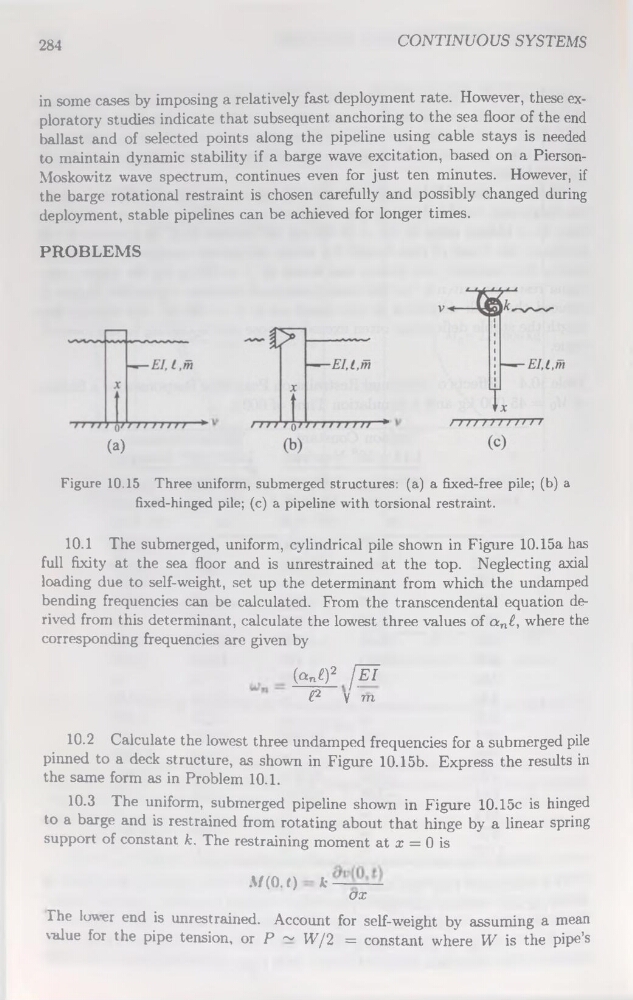
Figure 10.15 Three uniform, submerged structures: (a) a fixed-free pile; (b) a
fixed-hinged pile; (c) a pipeline with torsional restraint.
10.1 The submerged, uniform, cylindrical pile shown in Figure 10.15a has
full fixity at the sea floor and is unrestrained at the top. Neglecting axial
loading due to self-weight, set up the déterminant from which the undamped
bending frequencies can be calculated. From the transcendental équation derived from this déterminant, calculate the lowest three values of anC where the
corresponding frequencies are given by
(Qn^)2 [Ëï
I2
V m
10.2 Calculate the lowest three undamped frequencies for a submerged pile
pinned to a deck structure, as shown in Figure 10.15b. Express the results in
the same form as in Problem 10.1.
10.3 The uniform, submerged pipeline shown in Figure 10.15c is hinged
to a barge and is restrained from rotating about that hinge by a linear spring
support of constant k. The restraining moment at x = 0 is
.W(0. t) « k
ox
The lower end is unrestrained. Account for self-weight by assuming a mean
value for the pipe tension, or P ~ W/2 = constant where W is the pipe’s
CONTINUOUS SYSTEMS
in some cases by imposing a relatively fast deployment rate. However, these exploratory studies indicate that subséquent anchoring to the sea floor of the end
ballast and of selected points along the pipeline using cable stays is needed
to maintain dynamic stability if a barge wave excitation, based on a PiersonMoskowitz wave spectrum, continues even for just ten minutes. However, if
the barge rotational restraint is chosen carefully and possibly changed during
deployment, stable pipelines can be achieved for longer times.
PROBLEMS
Figure 10.15 Three uniform, submerged structures: (a) a fixed-free pile; (b) a
fixed-hinged pile; (c) a pipeline with torsional restraint.
10.1 The submerged, uniform, cylindrical pile shown in Figure 10.15a has
full fixity at the sea floor and is unrestrained at the top. Neglecting axial
loading due to self-weight, set up the déterminant from which the undamped
bending frequencies can be calculated. From the transcendental équation derived from this déterminant, calculate the lowest three values of anC where the
corresponding frequencies are given by
(Qn^)2 [Ëï
I2
V m
10.2 Calculate the lowest three undamped frequencies for a submerged pile
pinned to a deck structure, as shown in Figure 10.15b. Express the results in
the same form as in Problem 10.1.
10.3 The uniform, submerged pipeline shown in Figure 10.15c is hinged
to a barge and is restrained from rotating about that hinge by a linear spring
support of constant k. The restraining moment at x = 0 is
.W(0. t) « k
ox
The lower end is unrestrained. Account for self-weight by assuming a mean
value for the pipe tension, or P ~ W/2 = constant where W is the pipe’s