

BEAM RESPONSES
267
Xn” - a„xn = o
(10.73)
where the frequency parameters are
9 -
4 _
ai ~
i=m,n
(10.74)
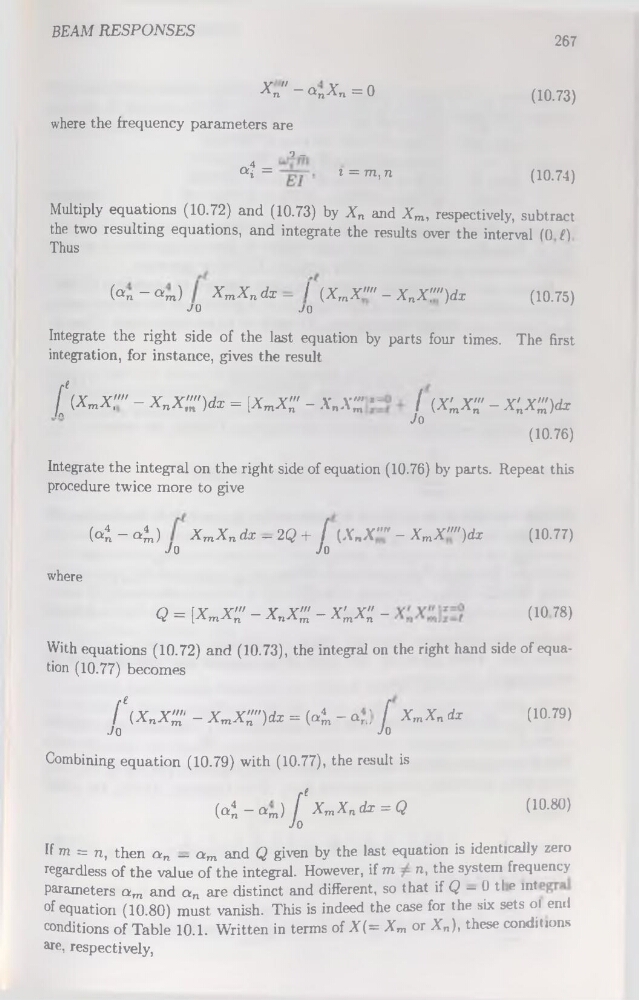
Multiply équations (10.72) and (10.73) by Xn and Xm, respectively, subtract
the two resulting équations, and integrate the results over the interval (0 f)
Thus
(an~am)
XmXndx — I (XmX"" - XnX'.'")dx
(10.75)
JO JO
Integrate the right side of the last équation by parts four times. The first
intégration, for instance, gives the resuit
I\xmX'.'" - XnX^')dx = [XX - XX’'i (XX - XX)dx
Jo
(10.76)
Integrate the intégral on the right side of équation (10.76) by parts. Repeat this
procedure twice more to give
(a4 n - a^)
XmXndx — 2Q+ / (X.X”" - XmX"')dx
(10.77)
Jo
Jo
where
Q = [XX - XX - X'X -
(10 78)
With équations (10.72) and (10.73), the intégral on the right hand side of équation (10.77) becomes
l\xX - XX')dx = « - a„) I xmxn dx
(10.79)
Jo
JO
Combining équation (10.79) with (10.77), the resuit is
(aXm) [l XmXndx = Q
(10.80)
Jo
If Tn = n, then an — am and Q given by the last équation is identically zéro
regardless of the value of the intégral. However, if m n, the System frequency
parameters am and an are distinct and different, so that if Q — 0 tl e Int
of équation (10.80) must vanish. This is indeed the case for the six sets ot end
conditions of Table 10.1. Written in terms of X(= Xm or Xn), these conditions
are, respectively,
267
Xn” - a„xn = o
(10.73)
where the frequency parameters are
9 -
4 _
ai ~
i=m,n
(10.74)
Multiply équations (10.72) and (10.73) by Xn and Xm, respectively, subtract
the two resulting équations, and integrate the results over the interval (0 f)
Thus
(an~am)
XmXndx — I (XmX"" - XnX'.'")dx
(10.75)
JO JO
Integrate the right side of the last équation by parts four times. The first
intégration, for instance, gives the resuit
I\xmX'.'" - XnX^')dx = [XX - XX’'i (XX - XX)dx
Jo
(10.76)
Integrate the intégral on the right side of équation (10.76) by parts. Repeat this
procedure twice more to give
(a4 n - a^)
XmXndx — 2Q+ / (X.X”" - XmX"')dx
(10.77)
Jo
Jo
where
Q = [XX - XX - X'X -
(10 78)
With équations (10.72) and (10.73), the intégral on the right hand side of équation (10.77) becomes
l\xX - XX')dx = « - a„) I xmxn dx
(10.79)
Jo
JO
Combining équation (10.79) with (10.77), the resuit is
(aXm) [l XmXndx = Q
(10.80)
Jo
If Tn = n, then an — am and Q given by the last équation is identically zéro
regardless of the value of the intégral. However, if m n, the System frequency
parameters am and an are distinct and different, so that if Q — 0 tl e Int
of équation (10.80) must vanish. This is indeed the case for the six sets ot end
conditions of Table 10.1. Written in terms of X(= Xm or Xn), these conditions
are, respectively,