

268
CONTINUOUS SYSTEMS
c-c
X(0) = X'(0) = X(t) = X'(f) = 0
c-ss
X(0) = X'(0) = X(t) = X"(£) = 0
SS-SS X(0) = X"(0) = X(£) = X"(£) = 0
C-F
X(0) = X'(0) = X"(£) = X"'(£) = 0
SS-F
X(0) = X"(0) = X"(£) = X"'(£) = 0
F-F
X"(0) = X"'(0) = X"(£) = X'"(£) = 0
(10.81)
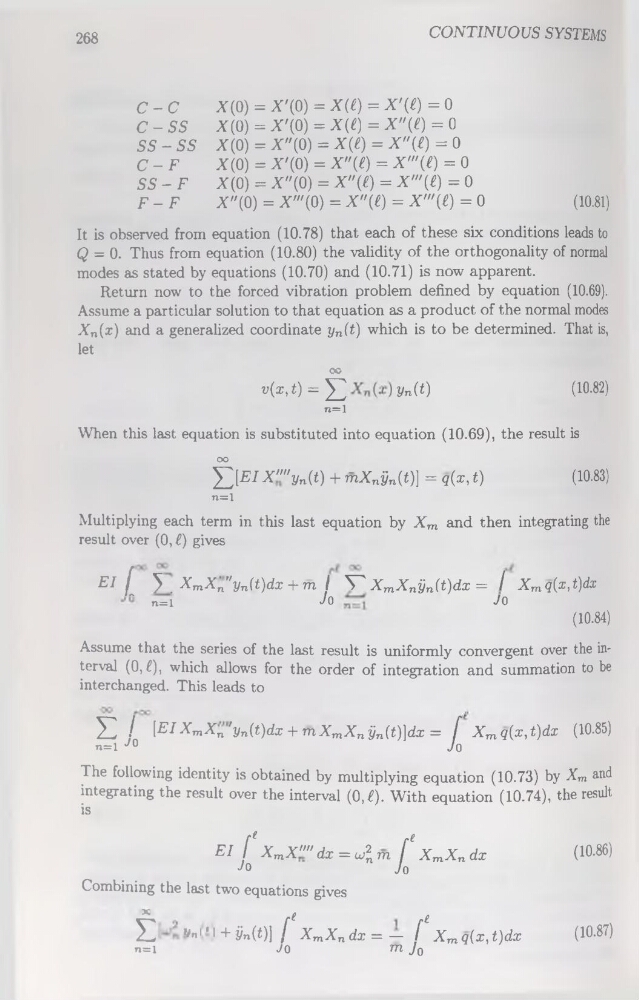
It is observed from équation (10.78) that each of these six conditions leads to
Q = 0. Thus from équation (10.80) the validity of the orthogonality of normal
modes as stated by équations (10.70) and (10.71) is now apparent.
Return now to the forced vibration problem defined by équation (10.69).
Assume a particular solution to that équation as a product of the normal modes
Xn(x) and a generalized coordinate yn(t) which is to be determined. That is,
let
OO
v(x, t) = 52
yn(t)
(10.82)
n=l
When this last équation is substituted into équation (10.69), the resuit is
OO
£[E7 X""j,n(t) + mXnÿn(t)] = ç(x, t)
(10.83)
n=l
Multiplying each term in this last équation by Xm and then integrating the
resuit over (0, £) gives
EI [ 5 , XmX'n"yn(t)dx + m / X" XmXnÿn(t)dx = I Xmq(x,t]ds
n=l
J0
JO
(10.84)
Assume that the sériés of the last resuit is uniformly convergent over the interval (0, £), which allows for the order of intégration and summation to be
interchanged. This leads to
52 / [El XmX„'yn(t)dx+ mXmXnÿn(t)]dx = [ Xmq{x,t)dx (10.85)
n=i Jo
Jo
The following identity is obtained by multiplying équation (10.73) by Xm and
integrating the resuit over the interval (0,£). With équation (10.74), the resuit
is
El f XmX"'' dx = cj2 nm [‘ XmXn dx
(10-86)
Jo
Jo
Combining the last two équations gives
x
t
t
52 ''h1 '1 + ÿn(t)] [ XmXndx = — f Xmq(x,t)dx
(10.87)
n=l
JO
m Jg
CONTINUOUS SYSTEMS
c-c
X(0) = X'(0) = X(t) = X'(f) = 0
c-ss
X(0) = X'(0) = X(t) = X"(£) = 0
SS-SS X(0) = X"(0) = X(£) = X"(£) = 0
C-F
X(0) = X'(0) = X"(£) = X"'(£) = 0
SS-F
X(0) = X"(0) = X"(£) = X"'(£) = 0
F-F
X"(0) = X"'(0) = X"(£) = X'"(£) = 0
(10.81)
It is observed from équation (10.78) that each of these six conditions leads to
Q = 0. Thus from équation (10.80) the validity of the orthogonality of normal
modes as stated by équations (10.70) and (10.71) is now apparent.
Return now to the forced vibration problem defined by équation (10.69).
Assume a particular solution to that équation as a product of the normal modes
Xn(x) and a generalized coordinate yn(t) which is to be determined. That is,
let
OO
v(x, t) = 52
yn(t)
(10.82)
n=l
When this last équation is substituted into équation (10.69), the resuit is
OO
£[E7 X""j,n(t) + mXnÿn(t)] = ç(x, t)
(10.83)
n=l
Multiplying each term in this last équation by Xm and then integrating the
resuit over (0, £) gives
EI [ 5 , XmX'n"yn(t)dx + m / X" XmXnÿn(t)dx = I Xmq(x,t]ds
n=l
J0
JO
(10.84)
Assume that the sériés of the last resuit is uniformly convergent over the interval (0, £), which allows for the order of intégration and summation to be
interchanged. This leads to
52 / [El XmX„'yn(t)dx+ mXmXnÿn(t)]dx = [ Xmq{x,t)dx (10.85)
n=i Jo
Jo
The following identity is obtained by multiplying équation (10.73) by Xm and
integrating the resuit over the interval (0,£). With équation (10.74), the resuit
is
El f XmX"'' dx = cj2 nm [‘ XmXn dx
(10-86)
Jo
Jo
Combining the last two équations gives
x
t
t
52 ''h1 '1 + ÿn(t)] [ XmXndx = — f Xmq(x,t)dx
(10.87)
n=l
JO
m Jg