

CABLE RESPONSES
259
This resuit shows that for n _ 1, the fundamental frequency for the most
constrained case is 2.25 times higher than that for the least constrained case.
This factor decreases rapidly as n increases, where the factor is approximately
1.2 for n — 5 and 1.1 for n = 10.
10.2 CABLE RESPONSES
TYansverse motion or motion perpendicular to the longitudinal axis of a submerged cable is caused by three main types of excitation: vortex shedding in
a constant current stream leading to cable galloping; transverse end excitation
due to the motion of the platform, tower, ship, or buoy to which the cable is
attached; and longitudinal or parametric end excitation, also imparted by the
cable-supported structure. Experiments on cable responses to coupled vortex
and parametric excitation were reported by Trogdon et al. (1976), but such
analytical studies are sparse. The subjects of this section are transverse and
parametric end excitation, as depicted in Figure 10.1.
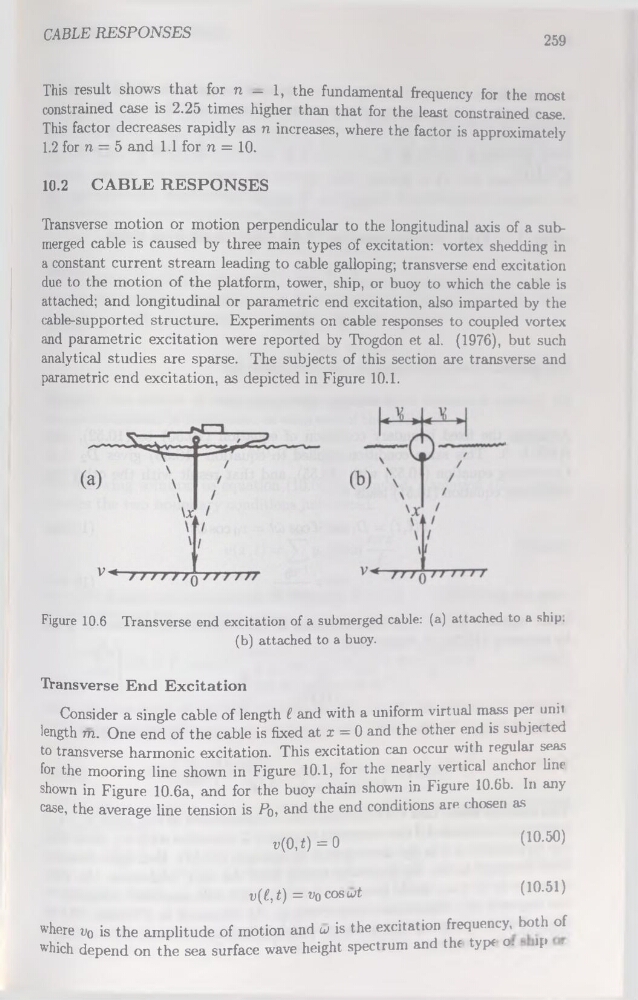
Figure 10.6 Transverse end excitation of a submerged cable: (a) attached to a ship.
(b) attached to a buoy.
Transverse End Excitation
Consider a single cable of length £ and with a uniform virtual mass per unit
length m. One end of the cable is fixed at x = 0 and the other end is subjected
to transverse harmonie excitation. This excitation can occur with regular seas
for the mooring line shown in Figure 10.1, for the nearly vertical anchor line
shown in Figure 10.6a, and for the buoy chain shown in Figure 10.6b. In any
case, the average line tension is Pq, and the end conditions are chosen as
v(0,t) =0
v(£,t) = vocosut
(10.50)
(10.51)
where zjq is the amplitude of motion and a) is the excitation frequency, both of
which dépend on the sea surface wave height spectrum and the type o. ip •
259
This resuit shows that for n _ 1, the fundamental frequency for the most
constrained case is 2.25 times higher than that for the least constrained case.
This factor decreases rapidly as n increases, where the factor is approximately
1.2 for n — 5 and 1.1 for n = 10.
10.2 CABLE RESPONSES
TYansverse motion or motion perpendicular to the longitudinal axis of a submerged cable is caused by three main types of excitation: vortex shedding in
a constant current stream leading to cable galloping; transverse end excitation
due to the motion of the platform, tower, ship, or buoy to which the cable is
attached; and longitudinal or parametric end excitation, also imparted by the
cable-supported structure. Experiments on cable responses to coupled vortex
and parametric excitation were reported by Trogdon et al. (1976), but such
analytical studies are sparse. The subjects of this section are transverse and
parametric end excitation, as depicted in Figure 10.1.
Figure 10.6 Transverse end excitation of a submerged cable: (a) attached to a ship.
(b) attached to a buoy.
Transverse End Excitation
Consider a single cable of length £ and with a uniform virtual mass per unit
length m. One end of the cable is fixed at x = 0 and the other end is subjected
to transverse harmonie excitation. This excitation can occur with regular seas
for the mooring line shown in Figure 10.1, for the nearly vertical anchor line
shown in Figure 10.6a, and for the buoy chain shown in Figure 10.6b. In any
case, the average line tension is Pq, and the end conditions are chosen as
v(0,t) =0
v(£,t) = vocosut
(10.50)
(10.51)
where zjq is the amplitude of motion and a) is the excitation frequency, both of
which dépend on the sea surface wave height spectrum and the type o. ip •