

258
CONTINUOUS SYSTEMS
From these last results, the déterminant of the coefficients of Di,D2,D3, and
is formed, expanded, and set equal to zéro. The simple resuit is
(cos ct^)(cosh olE) — 1
(10.44)
It is easily verified that »! = 4.730 is the first nonzero root of équation (10.44)
and that this is just 0.37 percent lower than the approximate value given for
n = 1 given by
= (n + 0.5)tt
(10.45)
For n = 2,3,... , équation (10.45) yields successive roots of équation (10.44)
which are even more accurate than this. Thus the upper bound frequencies for
this problem are given by équation (10.29) with (10.45), or
■n-2 I FI
= (n I-0.5)2-,/- , n=l,2,...
(10.46)
t2 V m
The corresponding mode shapes for this fixed end beam are found by consecutively eliminating the arbitrary constants D2.D3 and D4 from équations
(10.43) and writing the resuit in terms of D\ only. For the nth mode, let D\
= Cn, and the resuit is
Xn(x) = Cn [sin anx — sinhonT + /3n (cos anx — cosh onx)]
(10.47)
where an is given by équation (10.45) and
n
COsh
- COS
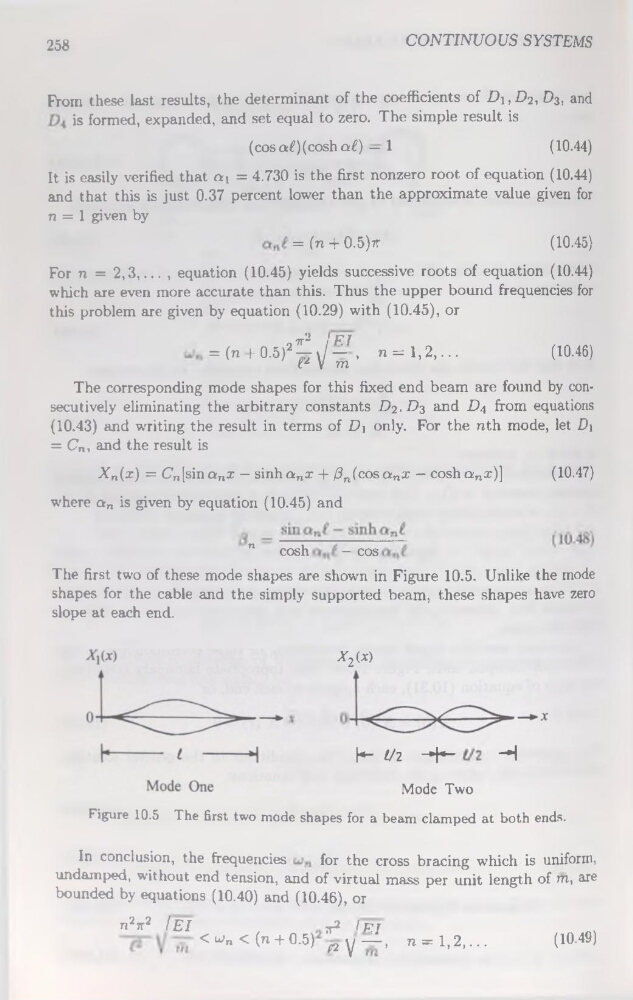
The first two of these mode shapes are showrn in Figure 10.5. Unlike the mode
shapes for the cable and the simply supported beam, these shapes hâve zéro
slope at each end.
Figure 10.5 The first two mode shapes for a beam clamped at both ends.
X2(x)
h- 1/2 -4*H
Mode Two
In conclusion, the frequencies
for the cross bracing which is uniform,
undamped, without end tension, and of virtual mass per unit length of m, are
bounded by équations (10.40) and (10.46), or
n27T2 lEI
^2 /py
<“-<(«+0-5) «y—, n = l,2,...
(10.49)
CONTINUOUS SYSTEMS
From these last results, the déterminant of the coefficients of Di,D2,D3, and
is formed, expanded, and set equal to zéro. The simple resuit is
(cos ct^)(cosh olE) — 1
(10.44)
It is easily verified that »! = 4.730 is the first nonzero root of équation (10.44)
and that this is just 0.37 percent lower than the approximate value given for
n = 1 given by
= (n + 0.5)tt
(10.45)
For n = 2,3,... , équation (10.45) yields successive roots of équation (10.44)
which are even more accurate than this. Thus the upper bound frequencies for
this problem are given by équation (10.29) with (10.45), or
■n-2 I FI
= (n I-0.5)2-,/- , n=l,2,...
(10.46)
t2 V m
The corresponding mode shapes for this fixed end beam are found by consecutively eliminating the arbitrary constants D2.D3 and D4 from équations
(10.43) and writing the resuit in terms of D\ only. For the nth mode, let D\
= Cn, and the resuit is
Xn(x) = Cn [sin anx — sinhonT + /3n (cos anx — cosh onx)]
(10.47)
where an is given by équation (10.45) and
n
COsh
- COS
The first two of these mode shapes are showrn in Figure 10.5. Unlike the mode
shapes for the cable and the simply supported beam, these shapes hâve zéro
slope at each end.
Figure 10.5 The first two mode shapes for a beam clamped at both ends.
X2(x)
h- 1/2 -4*H
Mode Two
In conclusion, the frequencies
for the cross bracing which is uniform,
undamped, without end tension, and of virtual mass per unit length of m, are
bounded by équations (10.40) and (10.46), or
n27T2 lEI
^2 /py
<“-<(«+0-5) «y—, n = l,2,...
(10.49)