

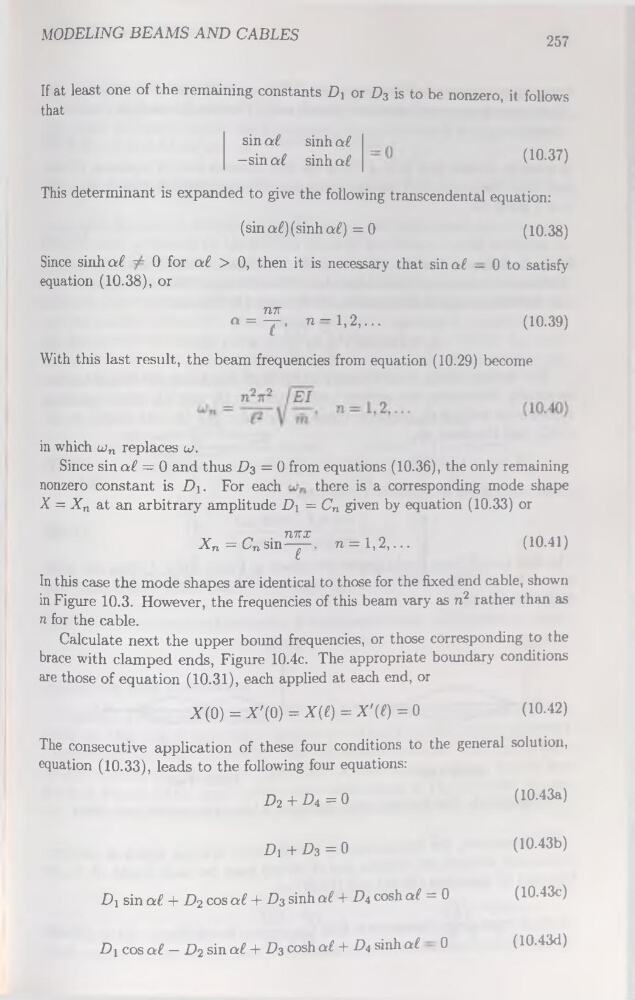
MODELING BEAMS AND CABLES
257
If at least one of the remaining constants D] or D3 is to be nonzero, it follows
that
sin at
sinh al
—sin al sinh al
(10.37)
This déterminant is expanded to give the following transcendental équation:
(sin al) (sinh al) = 0
(10.38)
Since sinh al
0 for al > 0, then it is necessary that sin al — 0 to satisfy
équation (10.38), or
nrr
a = y, n —1,2,...
(10.39)
With this last resuit, the beam frequencies from équation (10.29) become
in which u>n replaces w.
Since sin al = 0 and thus D3 = 0 from équations (10.36), the only remaining
nonzero constant is Di. For each
there is a corresponding mode shape
X = Xn at an arbitrary amplitude Di = Cn given by équation (10.33) or
X„ = Cnsin^. n = l,2,...
(10.41)
In this case the mode shapes are identical to those for the fixed end cable, shown
in Figure 10.3. However, the frequencies of this beam vary as n2 rather than as
n for the cable.
Calculate next the upper bound frequencies, or those corresponding to the
brace with clamped ends, Figure 10.4c. The appropriate boundary conditions
are those of équation (10.31), each applied at each end, or
X(0) = X'(0) = X(l) = X'(t) = 0
(10-42)
The consecutive application of these four conditions to the general solution,
équation (10.33), leads to the following four équations:
D2 + D4 = 0
(10.43a)
Di + D3 = 0
(10.43b)
Di sin al + D2 cos at + D3 sinh al + D4 cosh at = 0
(10.43c)
Dj cos at — D? sin al + D3 cosh at + D4 sinh at 0
(10.43d)
257
If at least one of the remaining constants D] or D3 is to be nonzero, it follows
that
sin at
sinh al
—sin al sinh al
(10.37)
This déterminant is expanded to give the following transcendental équation:
(sin al) (sinh al) = 0
(10.38)
Since sinh al
0 for al > 0, then it is necessary that sin al — 0 to satisfy
équation (10.38), or
nrr
a = y, n —1,2,...
(10.39)
With this last resuit, the beam frequencies from équation (10.29) become
in which u>n replaces w.
Since sin al = 0 and thus D3 = 0 from équations (10.36), the only remaining
nonzero constant is Di. For each
there is a corresponding mode shape
X = Xn at an arbitrary amplitude Di = Cn given by équation (10.33) or
X„ = Cnsin^. n = l,2,...
(10.41)
In this case the mode shapes are identical to those for the fixed end cable, shown
in Figure 10.3. However, the frequencies of this beam vary as n2 rather than as
n for the cable.
Calculate next the upper bound frequencies, or those corresponding to the
brace with clamped ends, Figure 10.4c. The appropriate boundary conditions
are those of équation (10.31), each applied at each end, or
X(0) = X'(0) = X(l) = X'(t) = 0
(10-42)
The consecutive application of these four conditions to the general solution,
équation (10.33), leads to the following four équations:
D2 + D4 = 0
(10.43a)
Di + D3 = 0
(10.43b)
Di sin al + D2 cos at + D3 sinh al + D4 cosh at = 0
(10.43c)
Dj cos at — D? sin al + D3 cosh at + D4 sinh at 0
(10.43d)