

MODELING BEAMS AND CABLES
253
from équation (10.11) as
d2v
_ d2v
(10.13)
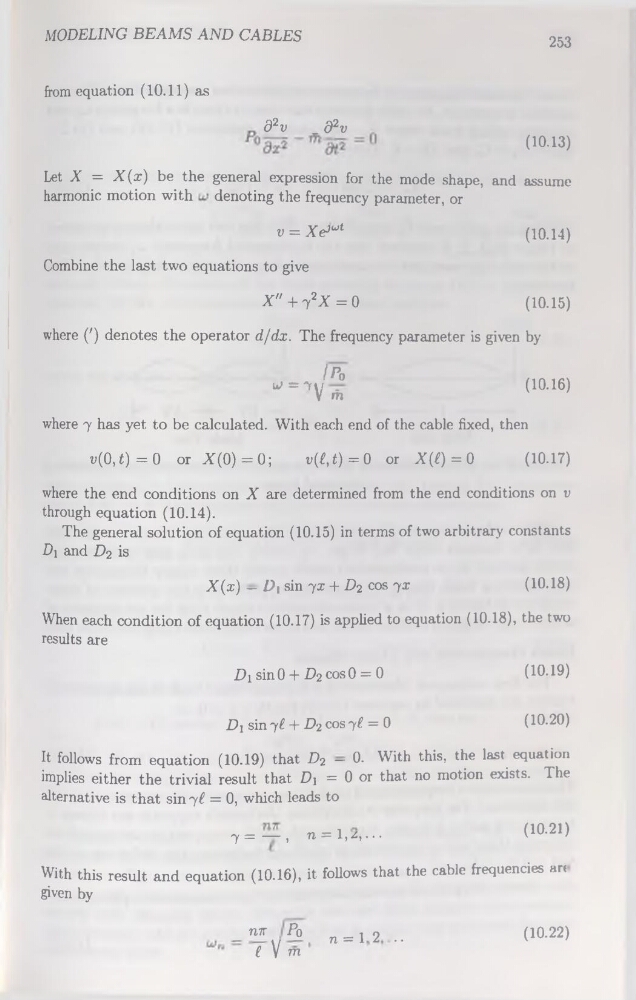
Let X = X(x) be the general expression for the mode shape, and assume
harmonie motion with denoting the frequency parameter, or
Combine the last two équations to give
v = Xe?ut
(10.14)
where (') dénotés the operator d/dx. The frequency parameter is given by
X" + 72X = 0
(10.15)
where 7 has yet to be calculated. With each end of the cable fixed, then
/Po
U'=7V*
(10.16)
v(0,t)=0 or X(0) = 0;
v(£,t)=0 or X(£) = 0
(10.17)
where the end conditions on X are determined from the end conditions on v
through équation (10.14).
The general solution of équation (10.15) in terms of two arbitrary constants
Di and D2 is
X(z) - D\ sin 71 + £>2 cos 71
(10.18)
When each condition of équation (10.17) is applied to équation (10.18), the two
results are
Di sin 0 + D2 cos 0 = 0
(10.19)
Di sin 7^ + D2 cos yi = 0
(10.20)
It follows from équation (10.19) that D? — 0. With this, the last équation
implies either the trivial resuit that Dy = 0 or that no motion exists. The
alternative is that sin 7^ = 0, which leads to
7 = — ,
n = l,z,...
(10.21)
With this resuit and équation (10.16), it follows that the cable frequencies an
given by
nrr
Po
n = 1 2 ..
l V m
(10.22)
253
from équation (10.11) as
d2v
_ d2v
(10.13)
Let X = X(x) be the general expression for the mode shape, and assume
harmonie motion with denoting the frequency parameter, or
Combine the last two équations to give
v = Xe?ut
(10.14)
where (') dénotés the operator d/dx. The frequency parameter is given by
X" + 72X = 0
(10.15)
where 7 has yet to be calculated. With each end of the cable fixed, then
/Po
U'=7V*
(10.16)
v(0,t)=0 or X(0) = 0;
v(£,t)=0 or X(£) = 0
(10.17)
where the end conditions on X are determined from the end conditions on v
through équation (10.14).
The general solution of équation (10.15) in terms of two arbitrary constants
Di and D2 is
X(z) - D\ sin 71 + £>2 cos 71
(10.18)
When each condition of équation (10.17) is applied to équation (10.18), the two
results are
Di sin 0 + D2 cos 0 = 0
(10.19)
Di sin 7^ + D2 cos yi = 0
(10.20)
It follows from équation (10.19) that D? — 0. With this, the last équation
implies either the trivial resuit that Dy = 0 or that no motion exists. The
alternative is that sin 7^ = 0, which leads to
7 = — ,
n = l,z,...
(10.21)
With this resuit and équation (10.16), it follows that the cable frequencies an
given by
nrr
Po
n = 1 2 ..
l V m
(10.22)