

252
CONTINUOUS SYSTEMS
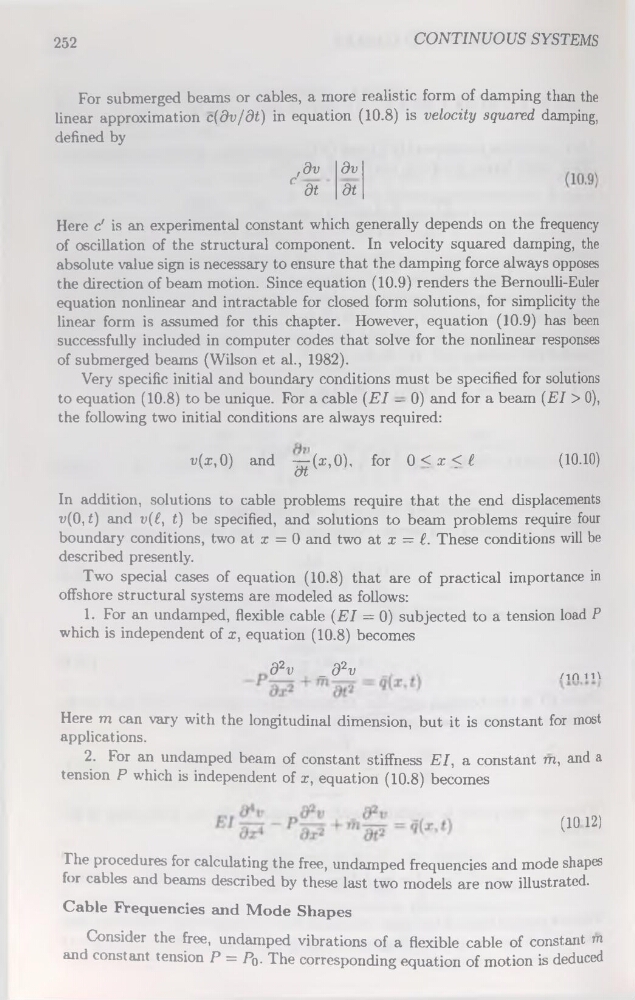
For submerged beams or cables, a more realistic form of damping than the
linear approximation c(dv/dt') in équation (10.8) is velocity squared damping,
defined by
tdv dv
C dt
dt
Here d is an experimental constant which generally dépends on the frequency
of oscillation of the structural component. In velocity squared damping, the
absolute value sign is necessary to ensure that the damping force always opposes
the direction of beam motion. Since équation (10.9) renders the Bernoulli-Euler
équation nonlinear and intractable for closed form solutions, for simplicity the
linear form is assumed for this chapter. However, équation (10.9) has been
successfully included in computer codes that solve for the nonlinear responses
of submerged beams (Wilson et al., 1982).
Very spécifie initial and boundary conditions must be specified for solutions
to équation (10.8) to be unique. For a cable (El — 0) and for a beam (El > 0),
the following two initial conditions are always required:
u(x,0) and —(x,0), for 0 < x < t
(10.10)
dt
'
’
In addition, solutions to cable problems require that the end displacements
v(0, t) and v(£, t) be specified, and solutions to beam problems require four
boundary conditions, two at x = 0 and two at x = t. These conditions will be
described presently.
Two spécial cases of équation (10.8) that are of practical importance in
offshore structural Systems are modeled as follows:
1. For an undamped, flexible cable (El = 0) subjected to a tension load P
which is independent of x, équation (10.8) becomes
d2v
_d2v
/min
Here m can vary with the longitudinal dimension, but it is constant for most
applications.
2. For an undamped beam of constant stiffness El, a constant m, and a
tension P which is independent of x, équation (10.8) becomes
(W12)
The procedures for calculating the free, undamped frequencies and mode shapes
for cables and beams described by these last two models are now illustrated.
Cable Frequencies and Mode Shapes
Consider the free, undamped vibrations of a flexible cable of constant m
and constant tension P = Po. The corresponding équation of motion is deduced
CONTINUOUS SYSTEMS
For submerged beams or cables, a more realistic form of damping than the
linear approximation c(dv/dt') in équation (10.8) is velocity squared damping,
defined by
tdv dv
C dt
dt
Here d is an experimental constant which generally dépends on the frequency
of oscillation of the structural component. In velocity squared damping, the
absolute value sign is necessary to ensure that the damping force always opposes
the direction of beam motion. Since équation (10.9) renders the Bernoulli-Euler
équation nonlinear and intractable for closed form solutions, for simplicity the
linear form is assumed for this chapter. However, équation (10.9) has been
successfully included in computer codes that solve for the nonlinear responses
of submerged beams (Wilson et al., 1982).
Very spécifie initial and boundary conditions must be specified for solutions
to équation (10.8) to be unique. For a cable (El — 0) and for a beam (El > 0),
the following two initial conditions are always required:
u(x,0) and —(x,0), for 0 < x < t
(10.10)
dt
'
’
In addition, solutions to cable problems require that the end displacements
v(0, t) and v(£, t) be specified, and solutions to beam problems require four
boundary conditions, two at x = 0 and two at x = t. These conditions will be
described presently.
Two spécial cases of équation (10.8) that are of practical importance in
offshore structural Systems are modeled as follows:
1. For an undamped, flexible cable (El = 0) subjected to a tension load P
which is independent of x, équation (10.8) becomes
d2v
_d2v
/min
Here m can vary with the longitudinal dimension, but it is constant for most
applications.
2. For an undamped beam of constant stiffness El, a constant m, and a
tension P which is independent of x, équation (10.8) becomes
(W12)
The procedures for calculating the free, undamped frequencies and mode shapes
for cables and beams described by these last two models are now illustrated.
Cable Frequencies and Mode Shapes
Consider the free, undamped vibrations of a flexible cable of constant m
and constant tension P = Po. The corresponding équation of motion is deduced