

230
APPLICATIONS OF MULTI-DEGREE OF FREEDOM ANALYSIS
= 3017 sinon- + 173.2 sin2u>r kg' 1/2N
(9.22b)
The undamped and damped frequencies are
wi = 2.7060 rad/s; u>dl = 2.7026 rad/s
(9.23a)
uj2 = 11.090 rad/s; udl = 11.076 rad/s
(9.23b)
With these results, jq = yi(t) and y2 — JfeW were computed by numerical intégration of équation (8.96) at each of the following times t = 0.2, 0.4, 0.6,... , 30.0
s. For each of these times, the structural displacements £, and £2 were caL
culated using the transformation of équation (8.99), or equivalently équation
(8.91). That is
£i(t) = tuVi + æi2î/2 = 4.45 x 10~4yi + 1.24 x 10~4t/2 m
(9.24a)
£2(t) = z2iVi + x22yi = 1-52 x 10 4?/i - 5.44 x 10 4î/2 m
(9.24b)
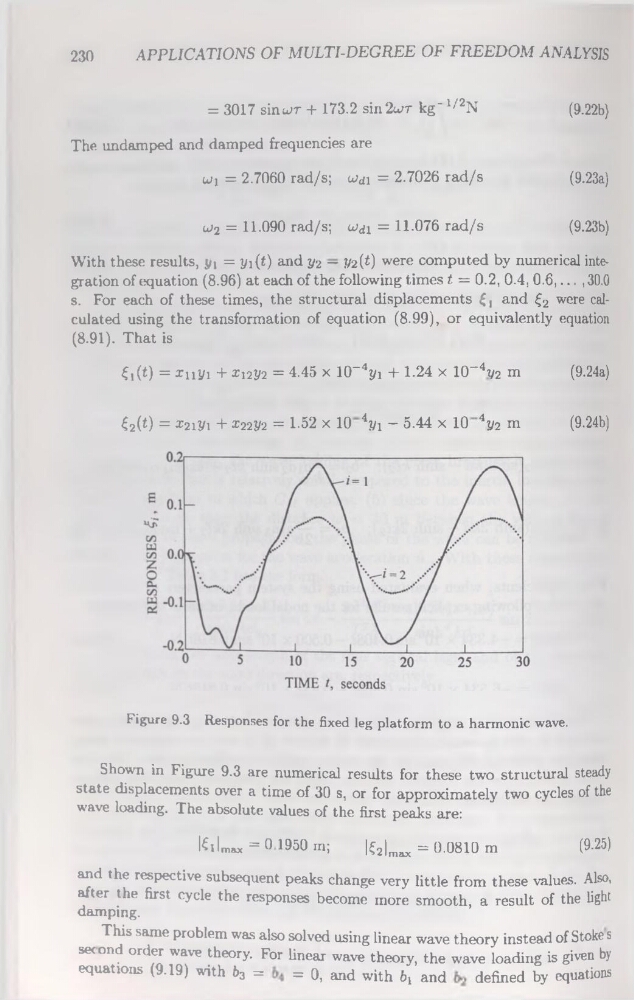
Figure 9.3 Responses for the fixed leg platform to a harmonie wave.
Shown in Figure 9.3 are numerical results for these two structural steady
State displacements over a time of 30 s, or for approximately two cycles of the
wave loading. The absolute values of the first peaks are:
l^iLax = 01950 m;
|£2|max = 0.0810 m
(9.25)
and the respective subséquent peaks change very little from these values. Also,
after the first cycle the responses become more smooth, a resuit of the light
damping.
This same problem was also solved using linear wave theory instead of Stoke s
se< ond order wave theory. For linear wave theory, the wave loading is given by
équations (9.19) with b3 =
= 0, and with bx and
defined by équations
APPLICATIONS OF MULTI-DEGREE OF FREEDOM ANALYSIS
= 3017 sinon- + 173.2 sin2u>r kg' 1/2N
(9.22b)
The undamped and damped frequencies are
wi = 2.7060 rad/s; u>dl = 2.7026 rad/s
(9.23a)
uj2 = 11.090 rad/s; udl = 11.076 rad/s
(9.23b)
With these results, jq = yi(t) and y2 — JfeW were computed by numerical intégration of équation (8.96) at each of the following times t = 0.2, 0.4, 0.6,... , 30.0
s. For each of these times, the structural displacements £, and £2 were caL
culated using the transformation of équation (8.99), or equivalently équation
(8.91). That is
£i(t) = tuVi + æi2î/2 = 4.45 x 10~4yi + 1.24 x 10~4t/2 m
(9.24a)
£2(t) = z2iVi + x22yi = 1-52 x 10 4?/i - 5.44 x 10 4î/2 m
(9.24b)
Figure 9.3 Responses for the fixed leg platform to a harmonie wave.
Shown in Figure 9.3 are numerical results for these two structural steady
State displacements over a time of 30 s, or for approximately two cycles of the
wave loading. The absolute values of the first peaks are:
l^iLax = 01950 m;
|£2|max = 0.0810 m
(9.25)
and the respective subséquent peaks change very little from these values. Also,
after the first cycle the responses become more smooth, a resuit of the light
damping.
This same problem was also solved using linear wave theory instead of Stoke s
se< ond order wave theory. For linear wave theory, the wave loading is given by
équations (9.19) with b3 =
= 0, and with bx and
defined by équations