

A FIXED LEG PLATFORM
229
-(d-6)
-d
qe(z, t)dz + wqc[—(d - £2), t]dz
(9.18b)
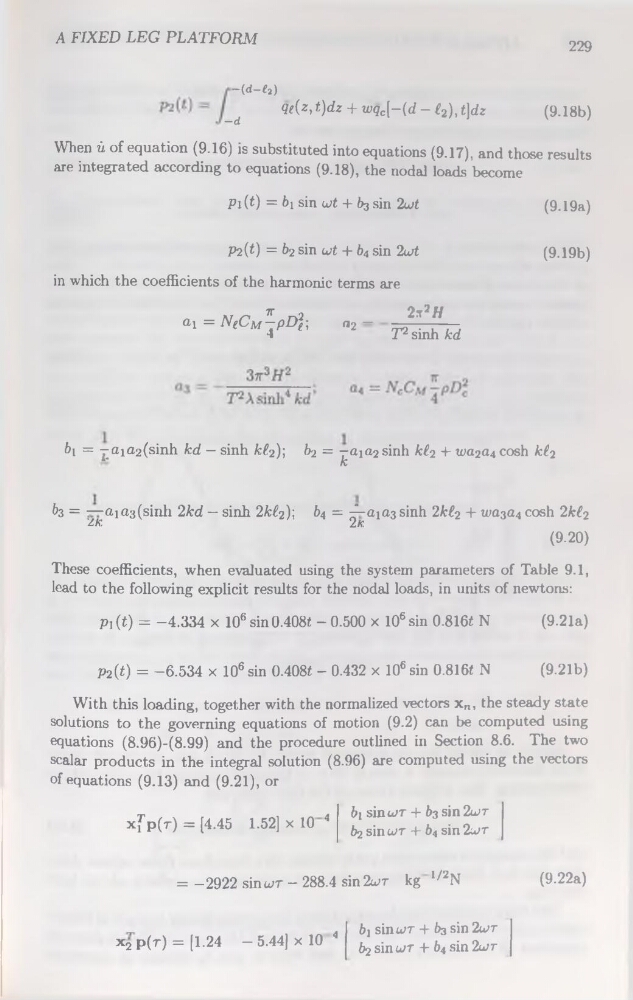
When û of équation (9.16) is substituted into équations (9.17), and those results
are integrated according to équations (9.18), the nodal loads become
P1(4) = bi sin art + 63 sin 2ujt
(9.19a)
P2(t) = 62 sin art + 64 sin 2art
(9.19b)
in which the coefficients of the harmonie terms are
„„ * r>2
2j2H
ai = NtCM-pDp,
n2- ^ ... ,
4
T* sinh kd
t>i = yai«2(sinh kd — sinh kt2\, 62 = -«102 sinh kl2 + wa2a4 cosh kl2
k
&3 = —«i«3(sinh 2kd — sinh 2kl2)-, b4 = ^-«103 sinh 2W2 + wü3a4 cosh 2kt2
AK,
2.K,
(9.20)
These coefficients, when evaluated using the System parameters of Table 9.1,
lead to the following explicit results for the nodal loads, in units of newtons:
Pi (t) = -4.334 x 10⁶ sin 0.408t - 0.500 x 10⁶ sin 0.816t N
(9.21a)
p2(4) = -6.534 x 10⁶ sin 0.4084 - 0.432 x 10⁶ sin 0.8164 N
(9.21b)
With this loading, together with the normalized vectors xn, the steady State
solutions to the governing équations of motion (9.2) can be computed using
équations (8.96)-(8.99) and the procedure outlined in Section 8.6. The two
scalar products in the intégral solution (8.96) are computed using the vectors
of équations (9.13) and (9.21), or
xfp(r) = [4.45 1.52] x 10 4
bj sin or + 63 sin 2o>r
Z>2 sin wt 4- b4 sin 2ot
= -2922 sinair -288.4 sin 2wt kg1/2N
(9.22a)
x2P(î) = [1-24 - 5.44] x 10 4
bi sin air + 63 sin 2üjt
b-2 sin oit + 64 sin 2o»r
229
-(d-6)
-d
qe(z, t)dz + wqc[—(d - £2), t]dz
(9.18b)
When û of équation (9.16) is substituted into équations (9.17), and those results
are integrated according to équations (9.18), the nodal loads become
P1(4) = bi sin art + 63 sin 2ujt
(9.19a)
P2(t) = 62 sin art + 64 sin 2art
(9.19b)
in which the coefficients of the harmonie terms are
„„ * r>2
2j2H
ai = NtCM-pDp,
n2- ^ ... ,
4
T* sinh kd
t>i = yai«2(sinh kd — sinh kt2\, 62 = -«102 sinh kl2 + wa2a4 cosh kl2
k
&3 = —«i«3(sinh 2kd — sinh 2kl2)-, b4 = ^-«103 sinh 2W2 + wü3a4 cosh 2kt2
AK,
2.K,
(9.20)
These coefficients, when evaluated using the System parameters of Table 9.1,
lead to the following explicit results for the nodal loads, in units of newtons:
Pi (t) = -4.334 x 10⁶ sin 0.408t - 0.500 x 10⁶ sin 0.816t N
(9.21a)
p2(4) = -6.534 x 10⁶ sin 0.4084 - 0.432 x 10⁶ sin 0.8164 N
(9.21b)
With this loading, together with the normalized vectors xn, the steady State
solutions to the governing équations of motion (9.2) can be computed using
équations (8.96)-(8.99) and the procedure outlined in Section 8.6. The two
scalar products in the intégral solution (8.96) are computed using the vectors
of équations (9.13) and (9.21), or
xfp(r) = [4.45 1.52] x 10 4
bj sin or + 63 sin 2o>r
Z>2 sin wt 4- b4 sin 2ot
= -2922 sinair -288.4 sin 2wt kg1/2N
(9.22a)
x2P(î) = [1-24 - 5.44] x 10 4
bi sin air + 63 sin 2üjt
b-2 sin oit + 64 sin 2o»r