

A FIXED LEG PLATFORM
227
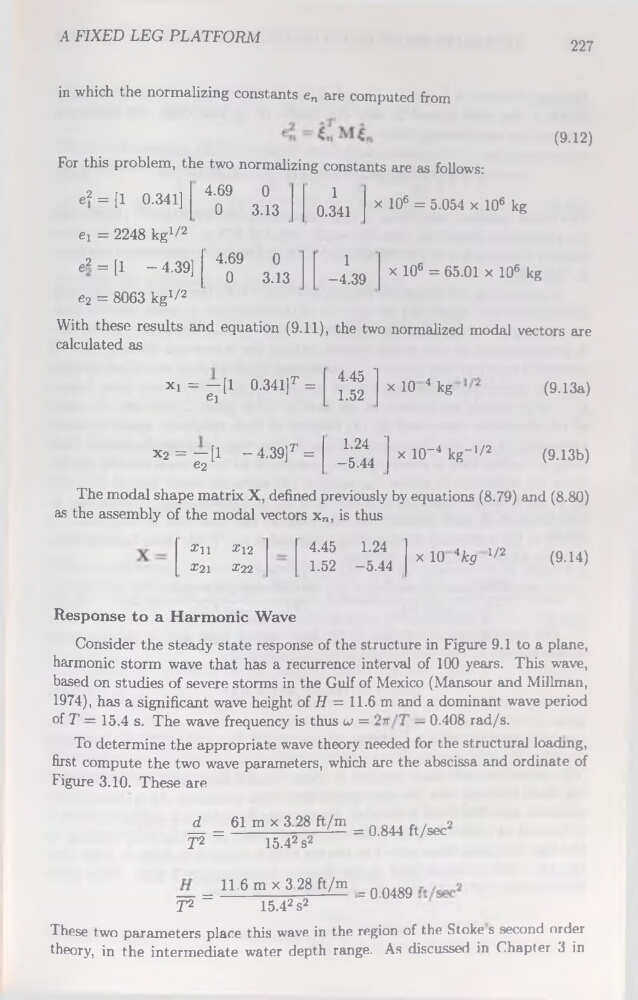
in which the normalizing constants en are computed from
0-12)
For this problem, the two normalizing constants are as follows:
e? = [1 0.341]
e! = 2248 kg1/2
e2 = [i _ 4.39]
e2 = 8063 kg1/2
4.69
0
4.69
0
0
3.13
0
3.13
1
0.341
1
-4.39
x 106 = 5.054 x 106 kg
x 106 = 65.01 x 10⁶ kg
With these results and équation (9.11), the two normalized modal vectors are
calculated as
X1 = —[1
Cl
0.341]t =
4.45 '
1.52
x 10 4 kg
(9.13a)
X2 = — [1
e2
- 4.39]t =
1.24
-5.44
■
x 10"4 kg"1/2
(9.13b)
The modal shape matrix X, defined previously by équations (8.79) and (8.80)
as the assembly of the modal vectors xn, is thus
a?n
X12
X21
3?22
4.45
1.24
1.52 -5.44
x 10 4 kg 1/2
(9-14)
Response to a Harmonie Wave
Consider the steady State response of the structure in Figure 9.1 to a plane,
harmonie storm wave that has a récurrence interval of 100 years. This wave,
based on studies of severe storms in the Gulf of Mexico (Mansour and Millman,
1974), has a significant wave height of H = 11.6 m and a dominant wave period
°f T — 15.4 s. The wave frequency is thus w =
— 0.408 rad/s.
To détermine the appropriate wave theory needed for the structural loading,
first compute the two wave parameters, which are the abscissa and ordinate of
Figure 3.10. These are
A = 61 m x 3 28 ftA = 0.844 ft/sec2
T2
15.42 s2
— = 11.6 m x 3.28 ft/m = 0 0489
T2
15.42 s2
These two parameters place this wave in the région of the Stoke s second order
theory, in the intermediate water depth range. As discussed in Chapter 3 in
227
in which the normalizing constants en are computed from
0-12)
For this problem, the two normalizing constants are as follows:
e? = [1 0.341]
e! = 2248 kg1/2
e2 = [i _ 4.39]
e2 = 8063 kg1/2
4.69
0
4.69
0
0
3.13
0
3.13
1
0.341
1
-4.39
x 106 = 5.054 x 106 kg
x 106 = 65.01 x 10⁶ kg
With these results and équation (9.11), the two normalized modal vectors are
calculated as
X1 = —[1
Cl
0.341]t =
4.45 '
1.52
x 10 4 kg
(9.13a)
X2 = — [1
e2
- 4.39]t =
1.24
-5.44
■
x 10"4 kg"1/2
(9.13b)
The modal shape matrix X, defined previously by équations (8.79) and (8.80)
as the assembly of the modal vectors xn, is thus
a?n
X12
X21
3?22
4.45
1.24
1.52 -5.44
x 10 4 kg 1/2
(9-14)
Response to a Harmonie Wave
Consider the steady State response of the structure in Figure 9.1 to a plane,
harmonie storm wave that has a récurrence interval of 100 years. This wave,
based on studies of severe storms in the Gulf of Mexico (Mansour and Millman,
1974), has a significant wave height of H = 11.6 m and a dominant wave period
°f T — 15.4 s. The wave frequency is thus w =
— 0.408 rad/s.
To détermine the appropriate wave theory needed for the structural loading,
first compute the two wave parameters, which are the abscissa and ordinate of
Figure 3.10. These are
A = 61 m x 3 28 ftA = 0.844 ft/sec2
T2
15.42 s2
— = 11.6 m x 3.28 ft/m = 0 0489
T2
15.42 s2
These two parameters place this wave in the région of the Stoke s second order
theory, in the intermediate water depth range. As discussed in Chapter 3 in