

EQUATIONS OF MOTION: LAGRANGE’S FORMULATION
211
of the system’s mass from the system’s equilibrium State. This term Vg can be
safely omitted for lumped mass frameworks in which each mass has a negligible
rise and fall along the gravity vector. (The gravity vector points toward the
mass center of the earth). However, Vg can be important in determining the
dynamic stability of a relatively rigid gravity platform rocking on an elastic
foundation, as will be demonstrated in Chapter 9.
The virtual work in the présent context is
N
N
èW = ^9i
= ^(pi - QDiMi = 1 g =
(p - qn)
(8.47)
i=l
i=l
in which p is the vector representing the externally applied loads and qp is the
vector for viscous damping, given by équation (8.22).
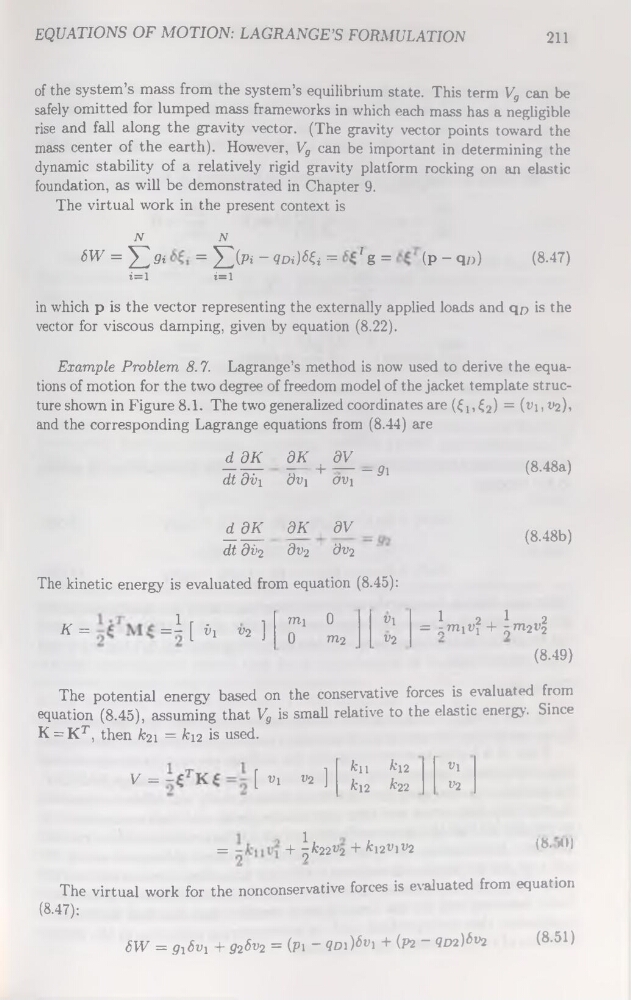
Example Problem 8.7. Lagrange’s method is now used to dérivé the équations of motion for the two degree of freedom model of the jacket template structure shown in Figure 8.1. The two generalized coordinates are (Ci,G) = (V1 > v2),
and the corresponding Lagrange équations from (8.44) are
d dK
dt di>2
d dK
dt dii
dK
—— "h
dvi
dV
-— — 51
0V1
(8.48a)
dK
dv2
dV
dv2
(8.48b)
The kinetic energy is evaluated from équation (8.45):
K =
=i [ i'i V2 ] mi 0
0
m2
t’i
v2
1
n
f
2
= À^l^f + 7,m2V2
(8.49)
The potential energy based on the conservative forces is evaluated from
équation (8.45), assuming that Vg is small relative to the elastic energy. Since
K = Kr, then k2i = k^2 is used.
V =
[ V1
V2 ]
fcn
A.’12
ki2 k22
t>i
v2
=
+ |fc22«2 + ^12V1V2
<&• »*h
The Virtual work for the nonconservative forces is evaluated from équation
(8.47):
MV = gyévi + g26v2 = (pi - 9di^vi + (P2 - 9d2><5v2
(8.51)
211
of the system’s mass from the system’s equilibrium State. This term Vg can be
safely omitted for lumped mass frameworks in which each mass has a negligible
rise and fall along the gravity vector. (The gravity vector points toward the
mass center of the earth). However, Vg can be important in determining the
dynamic stability of a relatively rigid gravity platform rocking on an elastic
foundation, as will be demonstrated in Chapter 9.
The virtual work in the présent context is
N
N
èW = ^9i
= ^(pi - QDiMi = 1 g =
(p - qn)
(8.47)
i=l
i=l
in which p is the vector representing the externally applied loads and qp is the
vector for viscous damping, given by équation (8.22).
Example Problem 8.7. Lagrange’s method is now used to dérivé the équations of motion for the two degree of freedom model of the jacket template structure shown in Figure 8.1. The two generalized coordinates are (Ci,G) = (V1 > v2),
and the corresponding Lagrange équations from (8.44) are
d dK
dt di>2
d dK
dt dii
dK
—— "h
dvi
dV
-— — 51
0V1
(8.48a)
dK
dv2
dV
dv2
(8.48b)
The kinetic energy is evaluated from équation (8.45):
K =
=i [ i'i V2 ] mi 0
0
m2
t’i
v2
1
n
f
2
= À^l^f + 7,m2V2
(8.49)
The potential energy based on the conservative forces is evaluated from
équation (8.45), assuming that Vg is small relative to the elastic energy. Since
K = Kr, then k2i = k^2 is used.
V =
[ V1
V2 ]
fcn
A.’12
ki2 k22
t>i
v2
=
+ |fc22«2 + ^12V1V2
<&• »*h
The Virtual work for the nonconservative forces is evaluated from équation
(8.47):
MV = gyévi + g26v2 = (pi - 9di^vi + (P2 - 9d2><5v2
(8.51)