

212
MULTI-DEGREE OF FREEDOM LINEAR STRUCTURES
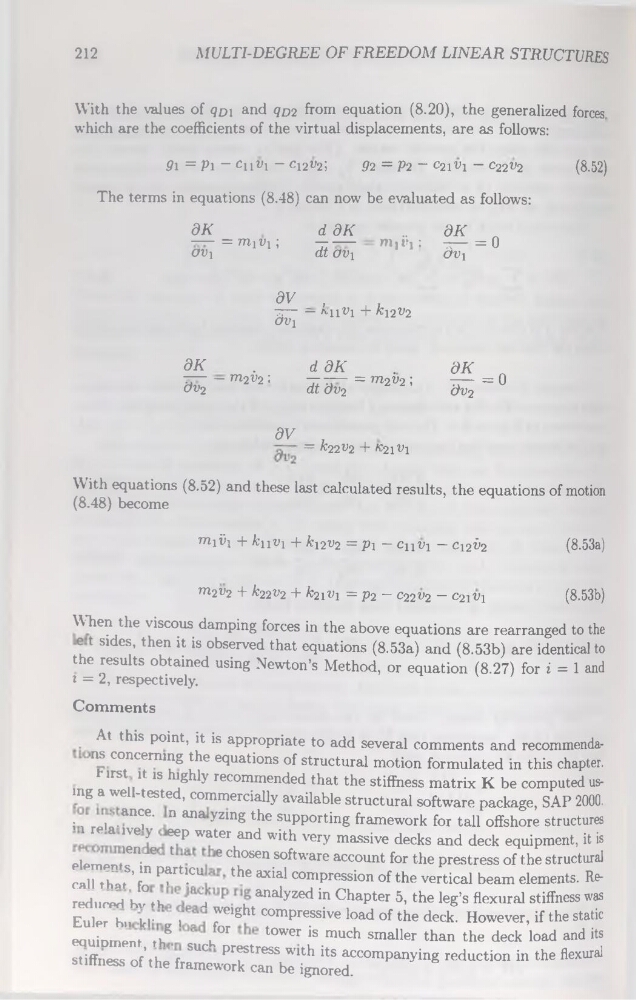
With the values of qdi and which are the coefficients of the virtual displacements, are as follows:
91 = Pi - cii^i -C12V2;
1/2 =P2 - C21V1 -c22v2
(8.52)
The terms in équations (8.48) can now be evaluated as follows:
dK
d dK
..
dK
— = m1vï;
— — "iitq: 77—= 0
ovi
dt ovi
ovi
dV
,
,
77— — Ml^l + «12^2
ovi
dK
.
d dK
.
dK
—— — m2v2 :
-7777— = m2v2 ;
---- = 0
dv2
dt dv2
i)v2
dV
1.
= K22V2 + K21V1
With équations (8.52) and these last calculated results, the équations of motion
(8.48) become
miüj 4- k^Vi + &12V2 = Pi — cntq — C12Û2
(8.53a)
m2V2 + k22V2 + fc2ivi = P2 - C22V2 ~ C21V1
(8.53b)
When the viscous damping forces in the above équations are rearranged to the
et sides, then it is observed that équations (8.53a) and (8.53b) are identical to
the results obtained using Newton’s Method, or équation (8.27) for i = 1 and
1 = 2, respectively.
Comments
At this point, it is appropriate to add several comments and recommendans concerning the équations of structural motion formulated in this chapter.
f irst it is highly recommended that the stiffness matrix K be computed using a well-tested, commercially available structural software package, SAP 2000.
;
1 ,anÇe' n ana 7z*nS the supporting framework for tall offshore structures
1 re a ive y eep water and with very massive decks and deck equipment, it is
elenwM1611, 6 1
e chosen software account for the prestress of the structural
call that8’ f*n Pfrtl.CU
the axial compression of the vertical beam éléments. Rereduced h^th
j
analyzefl in Chapter 5, the leg’s flexural stiffness was
Euler bu Hi
''æ’ght compressive load of the deck. However, if the static
Suffiment thg
J”
tOWCT ÎS much smaller than the deck load and its
stiffness of’th
SUC prfstress w*th its accompanying réduction in the flexural
stittness of the framework can be ignored.
MULTI-DEGREE OF FREEDOM LINEAR STRUCTURES
With the values of qdi and which are the coefficients of the virtual displacements, are as follows:
91 = Pi - cii^i -C12V2;
1/2 =P2 - C21V1 -c22v2
(8.52)
The terms in équations (8.48) can now be evaluated as follows:
dK
d dK
..
dK
— = m1vï;
— — "iitq: 77—= 0
ovi
dt ovi
ovi
dV
,
,
77— — Ml^l + «12^2
ovi
dK
.
d dK
.
dK
—— — m2v2 :
-7777— = m2v2 ;
---- = 0
dv2
dt dv2
i)v2
dV
1.
= K22V2 + K21V1
With équations (8.52) and these last calculated results, the équations of motion
(8.48) become
miüj 4- k^Vi + &12V2 = Pi — cntq — C12Û2
(8.53a)
m2V2 + k22V2 + fc2ivi = P2 - C22V2 ~ C21V1
(8.53b)
When the viscous damping forces in the above équations are rearranged to the
et sides, then it is observed that équations (8.53a) and (8.53b) are identical to
the results obtained using Newton’s Method, or équation (8.27) for i = 1 and
1 = 2, respectively.
Comments
At this point, it is appropriate to add several comments and recommendans concerning the équations of structural motion formulated in this chapter.
f irst it is highly recommended that the stiffness matrix K be computed using a well-tested, commercially available structural software package, SAP 2000.
;
1 ,anÇe' n ana 7z*nS the supporting framework for tall offshore structures
1 re a ive y eep water and with very massive decks and deck equipment, it is
elenwM1611, 6 1
e chosen software account for the prestress of the structural
call that8’ f*n Pfrtl.CU
the axial compression of the vertical beam éléments. Rereduced h^th
j
analyzefl in Chapter 5, the leg’s flexural stiffness was
Euler bu Hi
''æ’ght compressive load of the deck. However, if the static
Suffiment thg
J”
tOWCT ÎS much smaller than the deck load and its
stiffness of’th
SUC prfstress w*th its accompanying réduction in the flexural
stittness of the framework can be ignored.