

210
MULTI-DEGREE OF FREEDOM LINEAR STRUCTURES
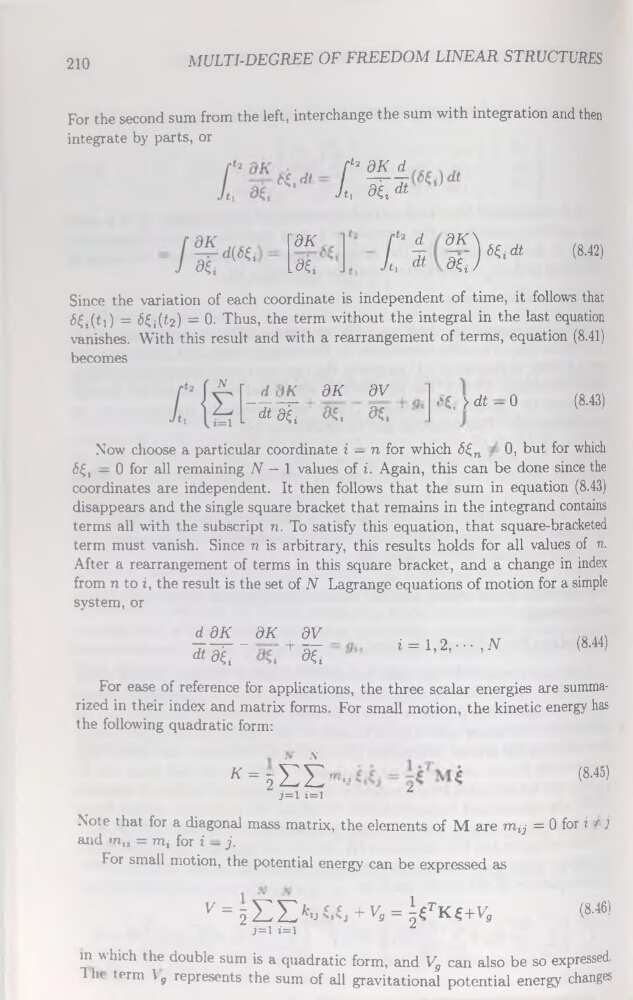
For the second sum from the left, interchange the sum with intégration and then
integrate by parts, or
t2 dK d
, d'^dt
i't d/
dJK\
dtj
6^dt
(8-42)
Since the variation of each coordinate is independent of time, it follows that
6^(11) = ôCiCts) = 0. Thus, the term without the intégral in the last équation
vanishes. With this resuit and with a rearrangement of terms, équation (8.41)
becomes
d ,)K
dK
dV
dt d'^ aç, aç,
.'i, > dt — 0
(8.43)
Now choose a particular coordinate i — n for which S(,n
0, but for which
SÇ, — 0 for ail remaining N — 1 values of i. Again, this can be done since the
coordinates are independent. It then follows that the sum in équation (8.43)
disappears and the single square bracket that remains in the integrand contains
terms ail with the subscript n. To satisfy this équation, that square-bracketed
term must vanish. Since n is arbitrary, this results holds for ail values of n.
After a rearrangement of terms in this square bracket, and a change in index
from n toi, the resuit is the set of N Lagrange équations of motion for a simple
System, or
d dK _ dK
dV
dt d^ ~
+ K
i = 1,2,-•• ,N
(8.44)
For ease of reference for applications, the three scalar energies are summarized in their index and matrix forms. For small motion, the kinetic energy has
the following quadratic form:
K=-?Éè-'(8-45)
j=l i=l
Z
Note that for a diagonal mass matrix, the éléments of M are rrtij = 0 for i / j
and >ntl = m; for i — j.
For small motion, the potential energy can be expressed as
v = 5ÈE^% + ^ = hTK£+ys
(8.46)
j=ii=i
2
in which the double sum is a quadratic form, and Vg can also be so expressed.
1 ht term lg represents the sum of ail gravitational potential energy changes
MULTI-DEGREE OF FREEDOM LINEAR STRUCTURES
For the second sum from the left, interchange the sum with intégration and then
integrate by parts, or
t2 dK d
, d'^dt
i't d/
dJK\
dtj
6^dt
(8-42)
Since the variation of each coordinate is independent of time, it follows that
6^(11) = ôCiCts) = 0. Thus, the term without the intégral in the last équation
vanishes. With this resuit and with a rearrangement of terms, équation (8.41)
becomes
d ,)K
dK
dV
dt d'^ aç, aç,
.'i, > dt — 0
(8.43)
Now choose a particular coordinate i — n for which S(,n
0, but for which
SÇ, — 0 for ail remaining N — 1 values of i. Again, this can be done since the
coordinates are independent. It then follows that the sum in équation (8.43)
disappears and the single square bracket that remains in the integrand contains
terms ail with the subscript n. To satisfy this équation, that square-bracketed
term must vanish. Since n is arbitrary, this results holds for ail values of n.
After a rearrangement of terms in this square bracket, and a change in index
from n toi, the resuit is the set of N Lagrange équations of motion for a simple
System, or
d dK _ dK
dV
dt d^ ~
+ K
i = 1,2,-•• ,N
(8.44)
For ease of reference for applications, the three scalar energies are summarized in their index and matrix forms. For small motion, the kinetic energy has
the following quadratic form:
K=-?Éè-'(8-45)
j=l i=l
Z
Note that for a diagonal mass matrix, the éléments of M are rrtij = 0 for i / j
and >ntl = m; for i — j.
For small motion, the potential energy can be expressed as
v = 5ÈE^% + ^ = hTK£+ys
(8.46)
j=ii=i
2
in which the double sum is a quadratic form, and Vg can also be so expressed.
1 ht term lg represents the sum of ail gravitational potential energy changes