

EQUATIONS OF MOTION: LAGRANGE’S FORMULATION
209
as its associated mass undergoes a virtual displacement
or
N
1=1
(8.39)
It is emphasized that each virtual or variational displacement , is a small
and arbitrary change in the coordinate 1 and that this virtual displacement
is not to be confused with the actual changes in displacement occurring in
structural motion. In the latter case, the notation is .if
Hamilton’s Principle
The scalar quantities K, V, and 6W are related through a variational équation which was originally introduced by Hamilton in 1834, and which later became known as Hamilton’s Principle in the historical texts (Synge and Griffith,
1959; Whittaker, 1989.) The form of this variational équation and its description given by Clough and Penzien (1993) are particularly appropriate in the
présent context. This équation and its description are
/*Ê2
I 6(K - V)dt + I 6Wdt = 0
Jti
(8.40)
The sum of the time variations of the différence in the kinetic and
potential energies and the work done by nonconservative forces over
any time interval ti to ^2 is zéro.
It is now shown how équation (8.40) leads to the équations of motion for structural Systems.
Dérivation for a Simple System
Lagrange’s équations are now derived for a simple dynamic System which
is defined by ail of the following characteristics: a set of N generalized coordinates is assigned, one for each degree of freedom (the System is scleronomic): an
independent variation can be given to each of the generalized coordinates without violating the System constraints (the System is holonomie)', the generalized
conservative forces, such as those due to elastic deformation and those due to
gravity, are ail derivable from a potential energy function of the form of équation
(8.38); the generalized nonconservative forces are the externally applied forces
and those forces such as viscous fiction that dissipate energy’ irreversably.
Now compute the first variations 6K and èV for équations (8.37) and (8.38).
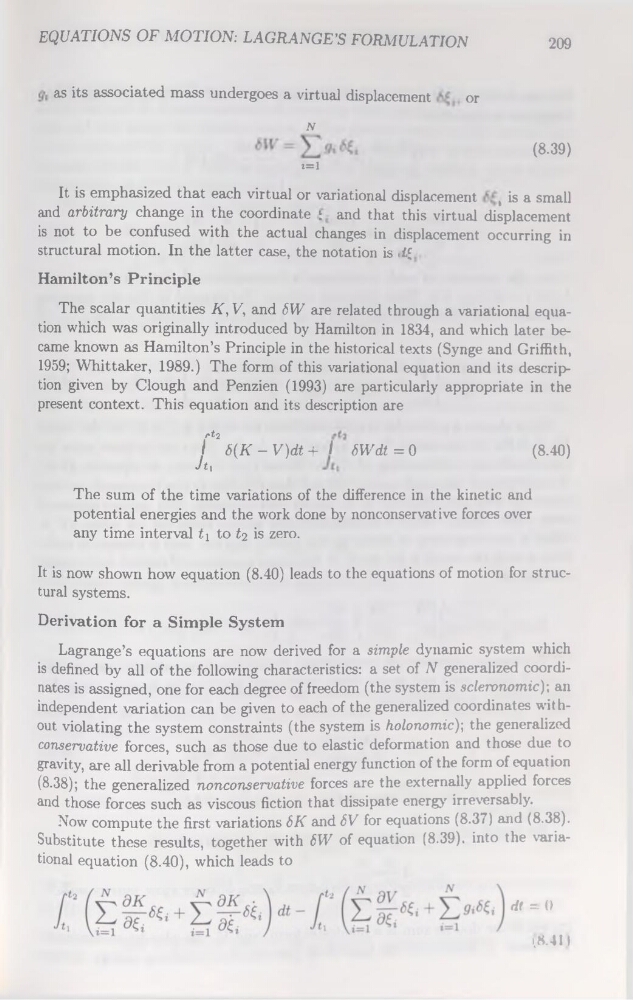
Substitute these results, together with bW of équation (8.39). into the variational équation (8.40), which leads to
dt = 0
(8.41)
209
as its associated mass undergoes a virtual displacement
or
N
1=1
(8.39)
It is emphasized that each virtual or variational displacement , is a small
and arbitrary change in the coordinate 1 and that this virtual displacement
is not to be confused with the actual changes in displacement occurring in
structural motion. In the latter case, the notation is .if
Hamilton’s Principle
The scalar quantities K, V, and 6W are related through a variational équation which was originally introduced by Hamilton in 1834, and which later became known as Hamilton’s Principle in the historical texts (Synge and Griffith,
1959; Whittaker, 1989.) The form of this variational équation and its description given by Clough and Penzien (1993) are particularly appropriate in the
présent context. This équation and its description are
/*Ê2
I 6(K - V)dt + I 6Wdt = 0
Jti
(8.40)
The sum of the time variations of the différence in the kinetic and
potential energies and the work done by nonconservative forces over
any time interval ti to ^2 is zéro.
It is now shown how équation (8.40) leads to the équations of motion for structural Systems.
Dérivation for a Simple System
Lagrange’s équations are now derived for a simple dynamic System which
is defined by ail of the following characteristics: a set of N generalized coordinates is assigned, one for each degree of freedom (the System is scleronomic): an
independent variation can be given to each of the generalized coordinates without violating the System constraints (the System is holonomie)', the generalized
conservative forces, such as those due to elastic deformation and those due to
gravity, are ail derivable from a potential energy function of the form of équation
(8.38); the generalized nonconservative forces are the externally applied forces
and those forces such as viscous fiction that dissipate energy’ irreversably.
Now compute the first variations 6K and èV for équations (8.37) and (8.38).
Substitute these results, together with bW of équation (8.39). into the variational équation (8.40), which leads to
dt = 0
(8.41)