

208
MULTI-DEGREE OF FREEDOM LINEAR STRUCTURES
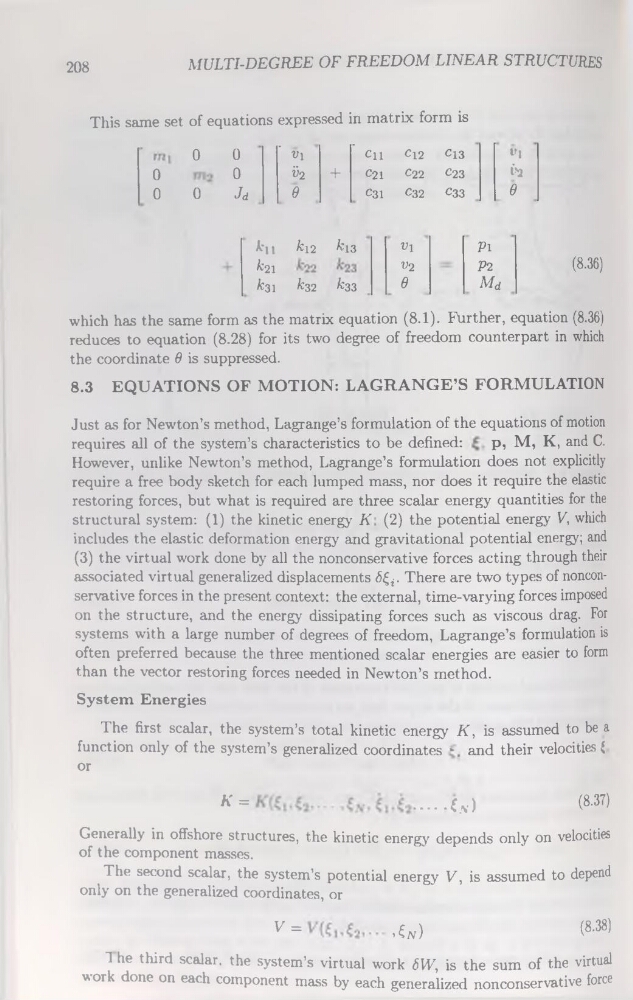
This same set of équations expressed in matrix form is
0
0
0
0
0
0
Jd
’ V1
’ en
C12
C13
Ü2
+ C21 C22 C23
e
C31
C32
C33
fcl2
^13
^32
^33
V1
ù
e
feu
^'21
^31
V1
«2
e
pi
P2
Md
(8.36)
which has the same form as the matrix équation (8.1). Further, équation (8.36)
reduces to équation (8.28) for its two degree of freedom counterpart in which
the coordinate 9 is suppressed.
8.3 EQUATIONS OF MOTION: LAGRANGE’S FORMULATION
Just as for Newton’s method, Lagrange’s formulation of the équations of motion
requires ail of the system’s characteristics to be defined:
p, M, K, and C.
However, unlike Newton’s method, Lagrange’s formulation does not explicitly
require a free body sketch for each lumped mass, nor does it require the elastic
restoring forces, but what is required are three scalar energy quantifies for the
structural System: (1) the kinetic energy K: (2) the potential energy V, which
includes the elastic deformation energy and gravitational potential energy; and
(3) the virtual work done by ail the nonconservative forces acting through their
associated virtual generalized displacements <5^. There are two types of nonconservative forces in the présent context: the external, time-varying forces imposed
on the structure, and the energy dissipating forces such as viscous drag. For
Systems with a large number of degrees of freedom, Lagrange’s formulation is
often preferred because the three mentioned scalar energies are easier to form
than the vector restoring forces needed in Newton’s method.
System Energies
The first scalar, the system’s total kinetic energy K, is assumed to be a
function only of the system’s generalized coordinates *, and their velocities 1
or
K =
..... G)
(8-37>
Generally in offshore structures, the kinetic energy dépends only on velocities
of the component masses.
The second scalar, the system’s potential energy V, is assumed to dépend
only on the generalized coordinates, or
V =
,£„)
(8.38)
1 he third scalar. the system’s virtual work 5W, is the sum of the virtual
work done on each component mass by each generalized nonconservative force
MULTI-DEGREE OF FREEDOM LINEAR STRUCTURES
This same set of équations expressed in matrix form is
0
0
0
0
0
0
Jd
’ V1
’ en
C12
C13
Ü2
+ C21 C22 C23
e
C31
C32
C33
fcl2
^13
^32
^33
V1
ù
e
feu
^'21
^31
V1
«2
e
pi
P2
Md
(8.36)
which has the same form as the matrix équation (8.1). Further, équation (8.36)
reduces to équation (8.28) for its two degree of freedom counterpart in which
the coordinate 9 is suppressed.
8.3 EQUATIONS OF MOTION: LAGRANGE’S FORMULATION
Just as for Newton’s method, Lagrange’s formulation of the équations of motion
requires ail of the system’s characteristics to be defined:
p, M, K, and C.
However, unlike Newton’s method, Lagrange’s formulation does not explicitly
require a free body sketch for each lumped mass, nor does it require the elastic
restoring forces, but what is required are three scalar energy quantifies for the
structural System: (1) the kinetic energy K: (2) the potential energy V, which
includes the elastic deformation energy and gravitational potential energy; and
(3) the virtual work done by ail the nonconservative forces acting through their
associated virtual generalized displacements <5^. There are two types of nonconservative forces in the présent context: the external, time-varying forces imposed
on the structure, and the energy dissipating forces such as viscous drag. For
Systems with a large number of degrees of freedom, Lagrange’s formulation is
often preferred because the three mentioned scalar energies are easier to form
than the vector restoring forces needed in Newton’s method.
System Energies
The first scalar, the system’s total kinetic energy K, is assumed to be a
function only of the system’s generalized coordinates *, and their velocities 1
or
K =
..... G)
(8-37>
Generally in offshore structures, the kinetic energy dépends only on velocities
of the component masses.
The second scalar, the system’s potential energy V, is assumed to dépend
only on the generalized coordinates, or
V =
,£„)
(8.38)
1 he third scalar. the system’s virtual work 5W, is the sum of the virtual
work done on each component mass by each generalized nonconservative force