

EQUATIONS OF MOTION: NEWTON’S METHOD
207
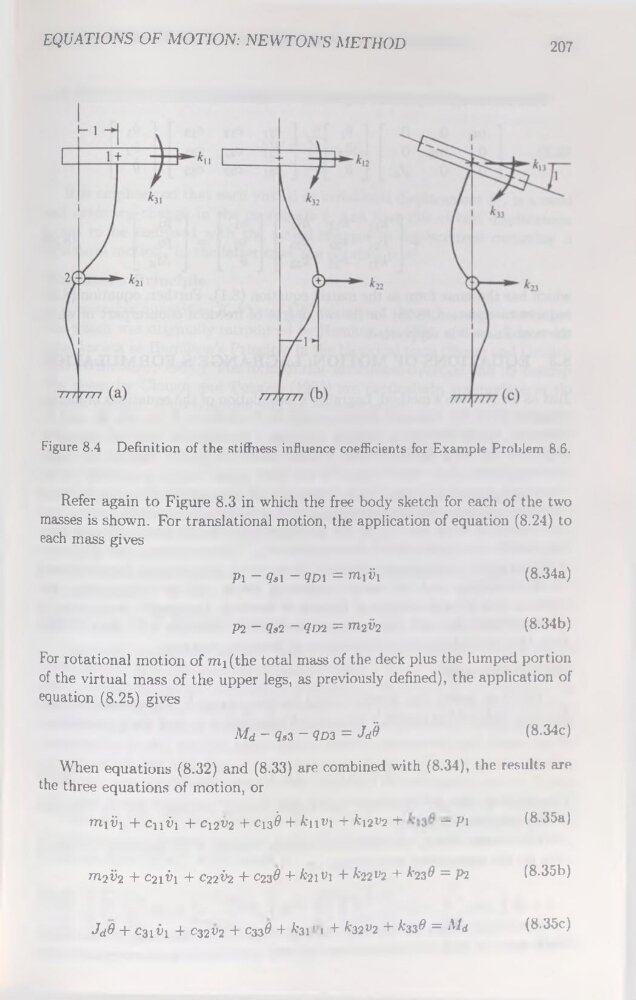
Figure 8.4 Définition of the stiffness influence coefficients for Example Problem 8.6.
Refer again to Figure 8.3 in which the free body sketch for each of the two
masses is shown. For translational motion, the application of équation (8.24) to
each mass gives
Pi - Qs\ - <7di = "iiüi
(8.34a)
P2~ Qs2 - <1D2 = HÏ2Ü2
(8.34b)
For rotational motion of mi(the total mass of the deck plus the lumped portion
of the virtual mass of the upper legs, as previously defined), the application of
équation (8.25) gives
Md - qs3 ~ QD3 = JdÔ
(8.34c)
When équations (8.32) and (8.33) are combined with (8.34), the results are
the three équations of motion, or
miüi + Cniq + C12U2 + Ci3^ + fcuvi + ki2v2 +
— Pi
(8.35a)
^2^2 + 021Û1 + 022 fo + c23@ + fol^l + fo2u2 + fo3$ = P2
(8.35b)
JdÔ + C31Û! + C32U2 + c33& + fol ' 1 + fo2u2 + fos# = Md
(8.35c)
207
Figure 8.4 Définition of the stiffness influence coefficients for Example Problem 8.6.
Refer again to Figure 8.3 in which the free body sketch for each of the two
masses is shown. For translational motion, the application of équation (8.24) to
each mass gives
Pi - Qs\ - <7di = "iiüi
(8.34a)
P2~ Qs2 - <1D2 = HÏ2Ü2
(8.34b)
For rotational motion of mi(the total mass of the deck plus the lumped portion
of the virtual mass of the upper legs, as previously defined), the application of
équation (8.25) gives
Md - qs3 ~ QD3 = JdÔ
(8.34c)
When équations (8.32) and (8.33) are combined with (8.34), the results are
the three équations of motion, or
miüi + Cniq + C12U2 + Ci3^ + fcuvi + ki2v2 +
— Pi
(8.35a)
^2^2 + 021Û1 + 022 fo + c23@ + fol^l + fo2u2 + fo3$ = P2
(8.35b)
JdÔ + C31Û! + C32U2 + c33& + fol ' 1 + fo2u2 + fos# = Md
(8.35c)