

EQUATIONS OF MOTION: NEWTON’S METHOD
205
Here, the sum on the left represents ail moments applied to that mass, moments
that are positive in the direction of ‘, and that lead to an angular accélération 4,.
Such moments arise from forces whose lines of action are not through the center
of mass of the body, moments due to structural stiflfness, structural dumping,
and environmental loading. The mass center need not be fixed.
Example Problem 8.5. Shown in Figure 8.1c are the free body sketches for
the two lumped masses of the jacket template structure. For each mass mt, and
for each corresponding coordinate £, = Vi, there are three types of in-line loads:
qsi and qol, which both oppose the positive direction of f, and the positively
directed load pi induced by wind, waves, and currents. When équation (8.19)
is applied to mass ml, the resuit is
Pi qsi qDi - miVi
(8.26)
When the forces q3i and qm of équations (8.15) and (8.20) are combined with
équations (8.26), the resuit is the set of two differential équations of motion, or
miVi + Cüiq + Ci2V2 + Àqp’i + ki2V2 = Pi,
i = l,2
(8.27)
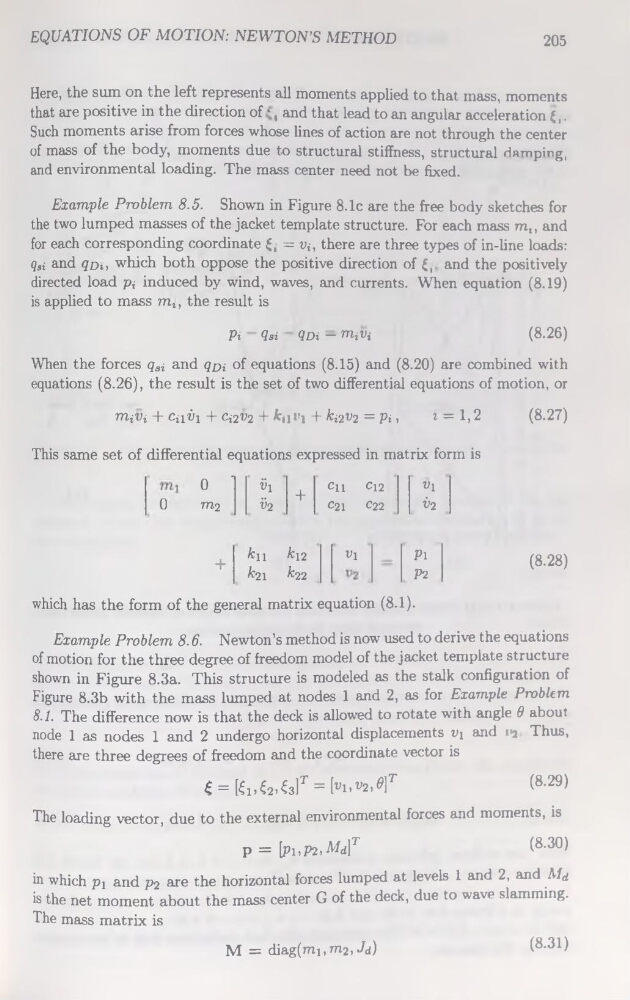
This same set of differential équations expressed in matrix form is
0 ’
Fi
+
Cil
C12
«1
0
m2
Ü2
C21
C22
Û2
+
fcll
fci2
V1
Pi
(8.28)
^21
k22
P2
which has the form of the general matrix équation (8.1).
Example Problem 8.6. Newton’s method is now used to dérivé the équations
of motion for the three degree of freedom model of the jacket template structure
shown in Figure 8.3a. This structure is modeled as the stalk configuration of
Figure 8.3b with the mass lumped at nodes 1 and 2, as for Example Problem
8.1. The différence now is that the deck is allowed to rotate with angle 0 about
node 1 as nodes 1 and 2 undergo horizontal displacements iq and ty Thus,
there are three degrees of freedom and the coordinate vector is
€ = [£1,£2,€3]T = h'i’t,2,0fr
t8-29)
The loading vector, due to the external environmental forces and moments, is
p = \pi,P2,Md]T
(8.30)
in which P1 and p2 are the horizontal forces lumped at levels 1 and 2, and Md
is the net moment about the mass center G of the deck, due to wave slamming.
The mass matrix is
M = diag(mi,m2, Jd)
(8.31)
205
Here, the sum on the left represents ail moments applied to that mass, moments
that are positive in the direction of ‘, and that lead to an angular accélération 4,.
Such moments arise from forces whose lines of action are not through the center
of mass of the body, moments due to structural stiflfness, structural dumping,
and environmental loading. The mass center need not be fixed.
Example Problem 8.5. Shown in Figure 8.1c are the free body sketches for
the two lumped masses of the jacket template structure. For each mass mt, and
for each corresponding coordinate £, = Vi, there are three types of in-line loads:
qsi and qol, which both oppose the positive direction of f, and the positively
directed load pi induced by wind, waves, and currents. When équation (8.19)
is applied to mass ml, the resuit is
Pi qsi qDi - miVi
(8.26)
When the forces q3i and qm of équations (8.15) and (8.20) are combined with
équations (8.26), the resuit is the set of two differential équations of motion, or
miVi + Cüiq + Ci2V2 + Àqp’i + ki2V2 = Pi,
i = l,2
(8.27)
This same set of differential équations expressed in matrix form is
0 ’
Fi
+
Cil
C12
«1
0
m2
Ü2
C21
C22
Û2
+
fcll
fci2
V1
Pi
(8.28)
^21
k22
P2
which has the form of the general matrix équation (8.1).
Example Problem 8.6. Newton’s method is now used to dérivé the équations
of motion for the three degree of freedom model of the jacket template structure
shown in Figure 8.3a. This structure is modeled as the stalk configuration of
Figure 8.3b with the mass lumped at nodes 1 and 2, as for Example Problem
8.1. The différence now is that the deck is allowed to rotate with angle 0 about
node 1 as nodes 1 and 2 undergo horizontal displacements iq and ty Thus,
there are three degrees of freedom and the coordinate vector is
€ = [£1,£2,€3]T = h'i’t,2,0fr
t8-29)
The loading vector, due to the external environmental forces and moments, is
p = \pi,P2,Md]T
(8.30)
in which P1 and p2 are the horizontal forces lumped at levels 1 and 2, and Md
is the net moment about the mass center G of the deck, due to wave slamming.
The mass matrix is
M = diag(mi,m2, Jd)
(8.31)