

204
MULTI-DEGREE OF FREEDOM LINEAR STRUCTURES
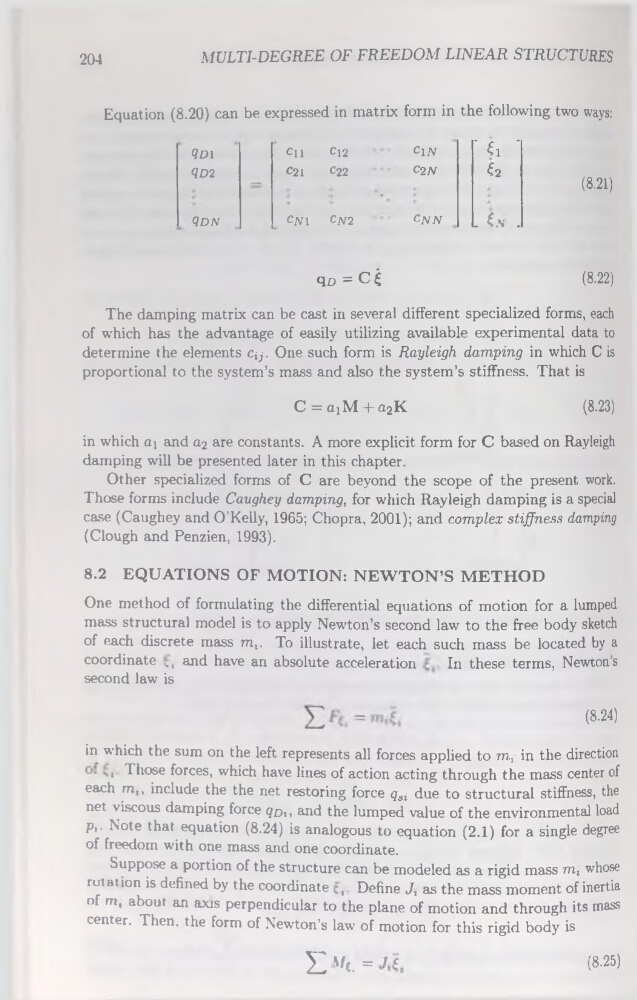
Equation (8.20) can be expressed in matrix form in the following two ways:
Qdi
Cil
C)2
QD2
C21
C22
•
qdn
CjVl
CN2
Cl N
C2N
' G ’
G
(8.21)
cnn
. G .
qo-Cé
(8.22)
The damping matrix can be cast in several different specialized forms, each
of which has the advantage of easily utilizing available experimental data to
détermine the éléments Cq. One such form is Rayleigh damping in which C is
proportional to the system’s mass and also the system’s stiffness. That is
C = ajM + a2K
(8.23)
in which ai and a2 are constants. A more explicit form for C based on Rayleigh
damping will be presented later in this chapter.
Other specialized forms of C are beyond the scope of the présent work.
Those forms include Caughey damping, for which Rayleigh damping is a spécial
case (Caughey and O'Kelly, 1965; Chopra, 2001); and complex stiffness damping
(Clough and Penzien, 1993).
8.2 EQUATIONS OF MOTION: NEWTON’S METHOD
One method of formulâting the differential équations of motion for a lumped
mass structural model is to apply New’ton’s second law to the free body sketch
of each discrète mass mz. To illustrate, let each such mass be located by a
coordinate .,, and hâve an absolute accélération
In these terms, Newton s
second law is
(8-24)
in which the sum on the left represents ail forces applied to m, in the direction
•. । Those forces, which hâve lines of action acting through the mass center of
each m,, include the the net restoring force qsi due to structural stiffness, the
net viscous damping force qp,, and the lumped value of the environmental load
p,. Note that équation (8.24) is analogous to équation (2.1) for a single degree
of freedom with one mass and one coordinate.
Suppose a portion of the structure can be modeled as a rigid mass m, whose
rut at ion is defined by the coordinate ;, Define J, as the mass moment of inertia
of m, about an axis perpendicular to the plane of motion and through its mass
center. Then. the form of Newton’s law of motion for this rigid body is
E '/t. =
(8-25)
MULTI-DEGREE OF FREEDOM LINEAR STRUCTURES
Equation (8.20) can be expressed in matrix form in the following two ways:
Qdi
Cil
C)2
QD2
C21
C22
•
qdn
CjVl
CN2
Cl N
C2N
' G ’
G
(8.21)
cnn
. G .
qo-Cé
(8.22)
The damping matrix can be cast in several different specialized forms, each
of which has the advantage of easily utilizing available experimental data to
détermine the éléments Cq. One such form is Rayleigh damping in which C is
proportional to the system’s mass and also the system’s stiffness. That is
C = ajM + a2K
(8.23)
in which ai and a2 are constants. A more explicit form for C based on Rayleigh
damping will be presented later in this chapter.
Other specialized forms of C are beyond the scope of the présent work.
Those forms include Caughey damping, for which Rayleigh damping is a spécial
case (Caughey and O'Kelly, 1965; Chopra, 2001); and complex stiffness damping
(Clough and Penzien, 1993).
8.2 EQUATIONS OF MOTION: NEWTON’S METHOD
One method of formulâting the differential équations of motion for a lumped
mass structural model is to apply New’ton’s second law to the free body sketch
of each discrète mass mz. To illustrate, let each such mass be located by a
coordinate .,, and hâve an absolute accélération
In these terms, Newton s
second law is
(8-24)
in which the sum on the left represents ail forces applied to m, in the direction
•. । Those forces, which hâve lines of action acting through the mass center of
each m,, include the the net restoring force qsi due to structural stiffness, the
net viscous damping force qp,, and the lumped value of the environmental load
p,. Note that équation (8.24) is analogous to équation (2.1) for a single degree
of freedom with one mass and one coordinate.
Suppose a portion of the structure can be modeled as a rigid mass m, whose
rut at ion is defined by the coordinate ;, Define J, as the mass moment of inertia
of m, about an axis perpendicular to the plane of motion and through its mass
center. Then. the form of Newton’s law of motion for this rigid body is
E '/t. =
(8-25)