

198
MULTI-DEGREE OF FREEDOM LINEAR STRUCTURES
with this understanding, extensions of such analyses to higher degrees of freedom
Systems become apparent.
The Loading Vector. p
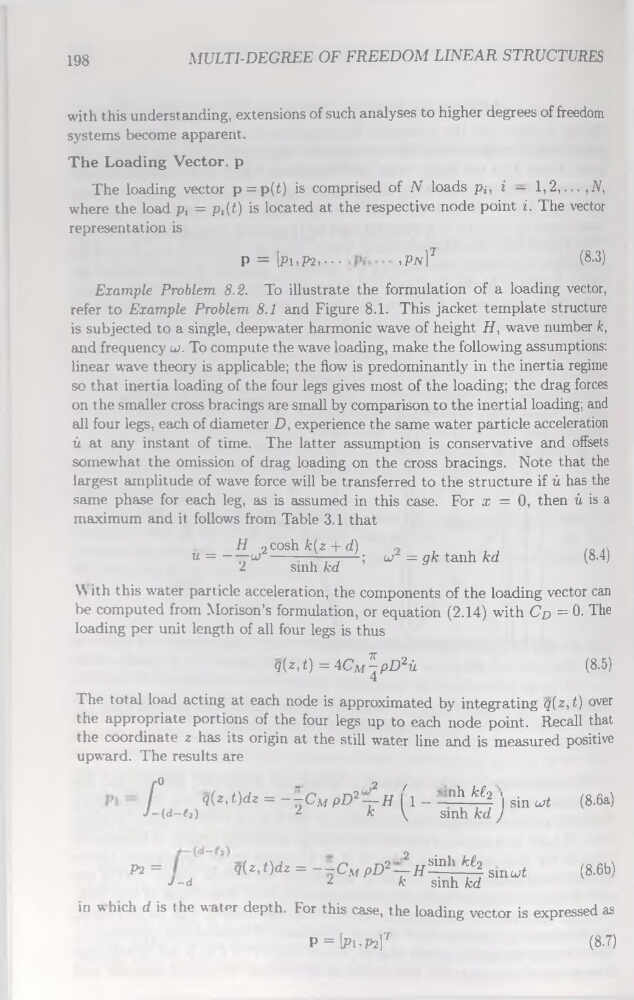
The loading vector p = p(t) is comprised of N loads pi, i — 1,2,... ,1V,
where the load p, = p,(t) is located at the respective node point i. The vector
représentation is
P = [Pi>P2,--,Pn]7
(8-3)
Example Problem 8.2. To illustrate the formulation of a loading vector,
refer to Example Problem 8.1 and Figure 8.1. This jacket template structure
is subjected to a single, deepwater harmonie wave of height H, wave number k,
and frequency w. To compute the wave loading, make the following assumptions:
linear wave theory is applicable; the flow is predominantly in the inertia régime
so that inertia loading of the four legs gives most of the loading; the drag forces
on the smaller cross bracings are small by comparison to the inertial loading; and
ail four legs, each of diameter D, expérience the same water particle accélération
û at any instant of time. The latter assumption is conservative and offsets
somewhat the omission of drag loading on the cross bracings. Note that the
largest amplitude of wave force will be transferred to the structure if ù has the
same phase for each leg, as is assumed in this case. For x = 0, then û is a
maximum and it follows from Table 3.1 that
H 2cosh k(z + d)
,
/0 .,
u = ——w ----—; or = gk tanh kd
(8.4)
2
sinh kd
W ith this water particle accélération, the components of the loading vector can
be computed from Morison’s formulation, or équation (2.14) with Cd = 0- The
loading per unit length of ail four legs is thus
q(z,t) = 4CM^pD2û
(8.5)
The total load acting at each node is approximated by integrating q(z,t) over
the appropriate portions of the four legs up to each node point. Recall that
the coordinate z has its origin at the still water line and is measured positive
upward. The results are
/
O
—
2
/
■
q(z,t)dz = -~CM pD2~H[\- -nh ™2 '| sin ujt
(8.6a)
(d-G)
2
k
\
sinh kd}
2
.
P2=
Q^>t')dz = --CMpD2~HS -^^slna}t
(8.6b)
J—d
z.
k
sinh kd
in which d is the water depth. For this case, the loading vector is expressed as
P = (Pi.P2]7
(8-7)
MULTI-DEGREE OF FREEDOM LINEAR STRUCTURES
with this understanding, extensions of such analyses to higher degrees of freedom
Systems become apparent.
The Loading Vector. p
The loading vector p = p(t) is comprised of N loads pi, i — 1,2,... ,1V,
where the load p, = p,(t) is located at the respective node point i. The vector
représentation is
P = [Pi>P2,--,Pn]7
(8-3)
Example Problem 8.2. To illustrate the formulation of a loading vector,
refer to Example Problem 8.1 and Figure 8.1. This jacket template structure
is subjected to a single, deepwater harmonie wave of height H, wave number k,
and frequency w. To compute the wave loading, make the following assumptions:
linear wave theory is applicable; the flow is predominantly in the inertia régime
so that inertia loading of the four legs gives most of the loading; the drag forces
on the smaller cross bracings are small by comparison to the inertial loading; and
ail four legs, each of diameter D, expérience the same water particle accélération
û at any instant of time. The latter assumption is conservative and offsets
somewhat the omission of drag loading on the cross bracings. Note that the
largest amplitude of wave force will be transferred to the structure if ù has the
same phase for each leg, as is assumed in this case. For x = 0, then û is a
maximum and it follows from Table 3.1 that
H 2cosh k(z + d)
,
/0 .,
u = ——w ----—; or = gk tanh kd
(8.4)
2
sinh kd
W ith this water particle accélération, the components of the loading vector can
be computed from Morison’s formulation, or équation (2.14) with Cd = 0- The
loading per unit length of ail four legs is thus
q(z,t) = 4CM^pD2û
(8.5)
The total load acting at each node is approximated by integrating q(z,t) over
the appropriate portions of the four legs up to each node point. Recall that
the coordinate z has its origin at the still water line and is measured positive
upward. The results are
/
O
—
2
/
■
q(z,t)dz = -~CM pD2~H[\- -nh ™2 '| sin ujt
(8.6a)
(d-G)
2
k
\
sinh kd}
2
.
P2=
Q^>t')dz = --CMpD2~HS -^^slna}t
(8.6b)
J—d
z.
k
sinh kd
in which d is the water depth. For this case, the loading vector is expressed as
P = (Pi.P2]7
(8-7)