

STATIONARY AND ERGODIC HYPOTHESES
171
The numerical values of équation (7.13) should be about the saine for any value
of ti and tz, as long as (<2 — ti) = t and J is very large.
The ergodic hypothesis is in two parts. The first part of this hypothesis
States: the average value of y as given by équation (7.12), based on a constant
! over an ensemble of charts, is equal to the time average of y over just one
typical chart. This must be true for ail values of tv Suppose that the typical
chart, which is représentative of the ensemble of charts, is called t/fc>(t). Suppose further that the chosen time interval over which y^(t} is considered is of
sufficient duration that it represents the behavior of y reasonably well. Then
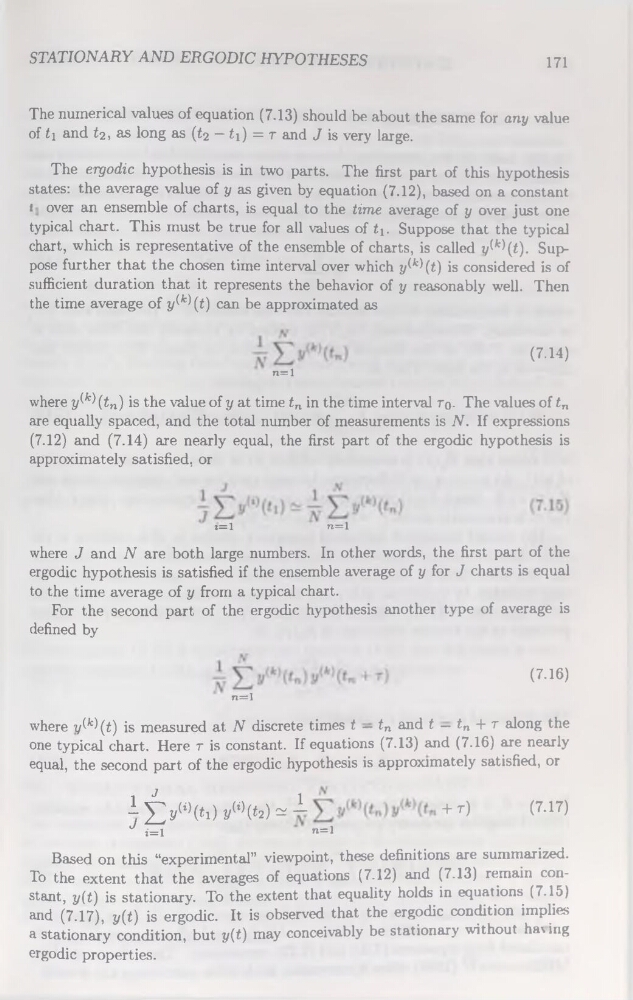
the time average of y^fc'(t) can be approximated as
(7.14)
n=l
where yW (tn} is the value of y at time tn in the time interval To- The values of tn
are equally spaced, and the total number of measurements is N. If expressions
(7.12) and (7.14) are nearly equal, the first part of the ergodic hypothesis is
approximately satisfied, or
1=1
n=l
where J and N are both large numbers. In other words, the first part of the
ergodic hypothesis is satisfied if the ensemble average of y for J charts is equal
to the time average of y from a typical chart.
For the second part of the ergodic hypothesis another type of average is
defined by
(7.16)
n=I
where t/fc\t) is measured at N discrète times t — tn and t — tn + t along the
one typical chart. Here t is constant. If équations (7.13) and (7.16) are nearly
equal, the second part of the ergodic hypothesis is approximately satisfied, or
Based on this “experimental” viewpoint, these définitions are summarized.
To the extent that the averages of équations (7.12) and (7.13) remain constant, y(t) is stationary. To the extent that equality holds in équations (7.15)
and (7.17), y(t) is ergodic. It is observed that the ergodic condition implies
a stationary condition, but y(t) may conceivably be stationary without ha\ ing
ergodic properties.
171
The numerical values of équation (7.13) should be about the saine for any value
of ti and tz, as long as (<2 — ti) = t and J is very large.
The ergodic hypothesis is in two parts. The first part of this hypothesis
States: the average value of y as given by équation (7.12), based on a constant
! over an ensemble of charts, is equal to the time average of y over just one
typical chart. This must be true for ail values of tv Suppose that the typical
chart, which is représentative of the ensemble of charts, is called t/fc>(t). Suppose further that the chosen time interval over which y^(t} is considered is of
sufficient duration that it represents the behavior of y reasonably well. Then
the time average of y^fc'(t) can be approximated as
(7.14)
n=l
where yW (tn} is the value of y at time tn in the time interval To- The values of tn
are equally spaced, and the total number of measurements is N. If expressions
(7.12) and (7.14) are nearly equal, the first part of the ergodic hypothesis is
approximately satisfied, or
1=1
n=l
where J and N are both large numbers. In other words, the first part of the
ergodic hypothesis is satisfied if the ensemble average of y for J charts is equal
to the time average of y from a typical chart.
For the second part of the ergodic hypothesis another type of average is
defined by
(7.16)
n=I
where t/fc\t) is measured at N discrète times t — tn and t — tn + t along the
one typical chart. Here t is constant. If équations (7.13) and (7.16) are nearly
equal, the second part of the ergodic hypothesis is approximately satisfied, or
Based on this “experimental” viewpoint, these définitions are summarized.
To the extent that the averages of équations (7.12) and (7.13) remain constant, y(t) is stationary. To the extent that equality holds in équations (7.15)
and (7.17), y(t) is ergodic. It is observed that the ergodic condition implies
a stationary condition, but y(t) may conceivably be stationary without ha\ ing
ergodic properties.