

172
STATISTICAL RESPONSES FOR LINEAR STRUCTURES
7.3
AUTOCORRELATION AND SPECTRAL DENSITY
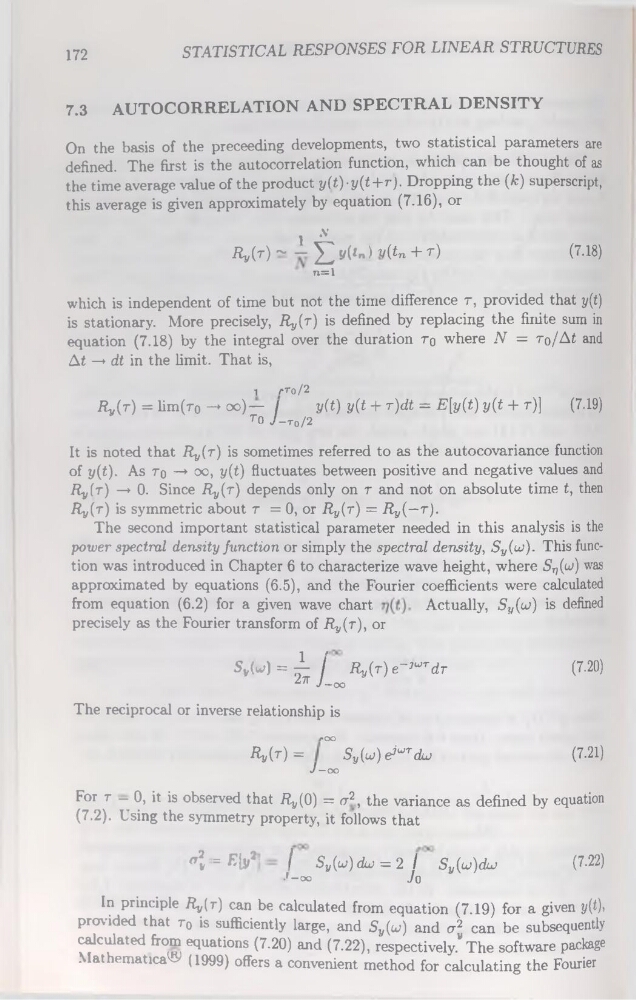
On the basis of the preceeding developments, two statistical parameters are
defined. The first is the autocorrélation function, which can be thought of as
the time average value of the product y(t)-y(t+r). Dropping the (fc) superscript,
this average is given approximately by équation (7.16), or
i A
Rj/r) ~ -52j/(U)t/(tn + r)
(7.18)
n=i
which is independent of time but not the time différence t, provided that y(t)
is stationary. More precisely, Ryfr) is defined by replacing the finite sum in
équation (7.18) by the intégral over the duration r0 where N = ro/At and
△t —♦ dt in the limit. That is,
1 rfo/1
Ry(r) = lim(T0 — oo)~ /
y(t) y(t + r)dt = E[y(t) y(t + r)]
(7.19)
T0 7—tq/2
It is noted that Ry(r) is sometimes referred to as the autocovariance function
of y(t). As tq —♦ oo, y(t) fluctuâtes between positive and négative values and
Rpfr) —» 0. Since Rîz(t) dépends only on r and not on absolute time t, then
Rj,(r) is symmetric about r = 0, or Ry(r) = Ry(—r).
The second important statistical parameter needed in this analysis is the
power spectral density function or simply the spectral density, Sy(aj). This function was introduced in Chapter 6 to characterize wave height, where S^) was
approximated by équations (6.5), and the Fourier coefficients were calculated
from équation (6.2) for a given wave chart
Actually, Sy(cu) is defined
precisely as the Fourier transform of R^(t), or
S,M = ^-/ Ry^e-’^dT
(7.20)
27r 7-œ
The reciprocal or inverse relationship is
/•OO
Rv(r)=
Sy{ü))^Tdw
(7.21)
J—oo
F°r t — 0, it is observed that R^(0) = <7$, ^.he variance as defined by équation
(7.2). Using the symmetry property, it follows that
"J = *Vl
I Sy^dw = 2 I Sy{oj)dw
(7-22)
•’-oo Jo
In principle Ry{r) can be calculated from équation (7.19) for a given y(t)>
provided that r0 is sufficiently large, and Sy(w) and a2 can be subsequentiy
calculated from équations (7.20) and (7.22), respectively?The software package
Mathematica^ (1999) offers a convenient method for calculating the Fourier
STATISTICAL RESPONSES FOR LINEAR STRUCTURES
7.3
AUTOCORRELATION AND SPECTRAL DENSITY
On the basis of the preceeding developments, two statistical parameters are
defined. The first is the autocorrélation function, which can be thought of as
the time average value of the product y(t)-y(t+r). Dropping the (fc) superscript,
this average is given approximately by équation (7.16), or
i A
Rj/r) ~ -52j/(U)t/(tn + r)
(7.18)
n=i
which is independent of time but not the time différence t, provided that y(t)
is stationary. More precisely, Ryfr) is defined by replacing the finite sum in
équation (7.18) by the intégral over the duration r0 where N = ro/At and
△t —♦ dt in the limit. That is,
1 rfo/1
Ry(r) = lim(T0 — oo)~ /
y(t) y(t + r)dt = E[y(t) y(t + r)]
(7.19)
T0 7—tq/2
It is noted that Ry(r) is sometimes referred to as the autocovariance function
of y(t). As tq —♦ oo, y(t) fluctuâtes between positive and négative values and
Rpfr) —» 0. Since Rîz(t) dépends only on r and not on absolute time t, then
Rj,(r) is symmetric about r = 0, or Ry(r) = Ry(—r).
The second important statistical parameter needed in this analysis is the
power spectral density function or simply the spectral density, Sy(aj). This function was introduced in Chapter 6 to characterize wave height, where S^) was
approximated by équations (6.5), and the Fourier coefficients were calculated
from équation (6.2) for a given wave chart
Actually, Sy(cu) is defined
precisely as the Fourier transform of R^(t), or
S,M = ^-/ Ry^e-’^dT
(7.20)
27r 7-œ
The reciprocal or inverse relationship is
/•OO
Rv(r)=
Sy{ü))^Tdw
(7.21)
J—oo
F°r t — 0, it is observed that R^(0) = <7$, ^.he variance as defined by équation
(7.2). Using the symmetry property, it follows that
"J = *Vl
I Sy^dw = 2 I Sy{oj)dw
(7-22)
•’-oo Jo
In principle Ry{r) can be calculated from équation (7.19) for a given y(t)>
provided that r0 is sufficiently large, and Sy(w) and a2 can be subsequentiy
calculated from équations (7.20) and (7.22), respectively?The software package
Mathematica^ (1999) offers a convenient method for calculating the Fourier