

152
STATISTICAL DESCRIPTIONS OF OFFSHORE WAVES
in which the empirical coefficients Ao, B, m, and n define the spectrum. In the
most widely used forms, m = 5 and n = 4. Several empirical results for the
coefficients Ao and B, including their dependence on wind speed and significant
wave height, are presented after the following alternative descriptions of wave
spectra.
6.3
DESCRIPTIONS OF WAVE ENERGY SPECTRA
There are significant and sometimes subtle différences among the analytical
descriptions of wave spectra as they appear in the open literature. Différences
exist in terminology, notation, and even in the basic définition of (<*>)• These
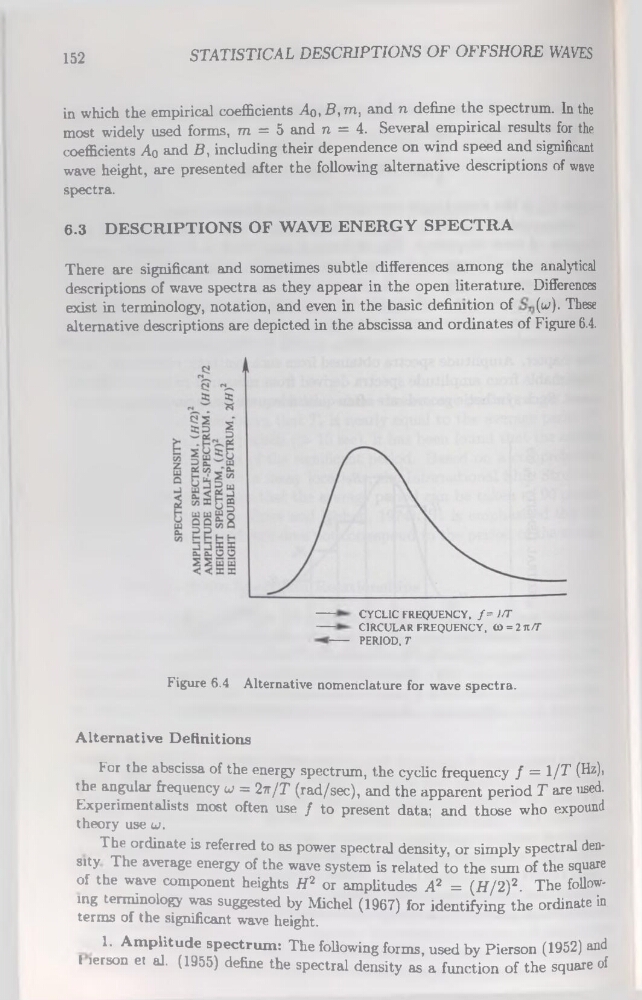
alternative descriptions are depicted in the abscissa and ordinates of Figure 6.4.
------CYCLIC FREQUENCY, /= 7/7
------CIRCULAR FREQUENCY, <£> = 2 7t/T
--------PERIOD, T
Figure 6.4 Alternative nomenclature for wave spectra.
Alternative Définitions
For the abscissa of the energy spectrum, the cyclic frequency / = 1/T (Hz)>
the angular frequency u? = 2?r/T (rad/sec), and the apparent period T are used.
Experimentalists most often use f to présent data; and those who expound
theory use a).
The ordinate is referred to as power spectral density, or simply spectral density The average energy of the wave System is related to the sum of the square
of the wave component heights H1 2 or amplitudes A2 = (H/2)2. The following terminology was suggested by Michel (1967) for identifying the ordinate in
terms of the significant wave height.
1. Amplitude spectrum: The following forms, used by Pierson (1952) and
1 lerson et al. (1955) define the spectral density as a function of the square of
STATISTICAL DESCRIPTIONS OF OFFSHORE WAVES
in which the empirical coefficients Ao, B, m, and n define the spectrum. In the
most widely used forms, m = 5 and n = 4. Several empirical results for the
coefficients Ao and B, including their dependence on wind speed and significant
wave height, are presented after the following alternative descriptions of wave
spectra.
6.3
DESCRIPTIONS OF WAVE ENERGY SPECTRA
There are significant and sometimes subtle différences among the analytical
descriptions of wave spectra as they appear in the open literature. Différences
exist in terminology, notation, and even in the basic définition of (<*>)• These
alternative descriptions are depicted in the abscissa and ordinates of Figure 6.4.
------CYCLIC FREQUENCY, /= 7/7
------CIRCULAR FREQUENCY, <£> = 2 7t/T
--------PERIOD, T
Figure 6.4 Alternative nomenclature for wave spectra.
Alternative Définitions
For the abscissa of the energy spectrum, the cyclic frequency / = 1/T (Hz)>
the angular frequency u? = 2?r/T (rad/sec), and the apparent period T are used.
Experimentalists most often use f to présent data; and those who expound
theory use a).
The ordinate is referred to as power spectral density, or simply spectral density The average energy of the wave System is related to the sum of the square
of the wave component heights H1 2 or amplitudes A2 = (H/2)2. The following terminology was suggested by Michel (1967) for identifying the ordinate in
terms of the significant wave height.
1. Amplitude spectrum: The following forms, used by Pierson (1952) and
1 lerson et al. (1955) define the spectral density as a function of the square of