

CONCEPT OF THE SIGNIFICANT WAVE
151
having discrète frequencies. Under these conditions the mean total wave energy
per unit surface area is given by
E=
+
+
+ ... + H?t+ • )
(6.15)
where Hn is the wave height associated with the frequency u)n.
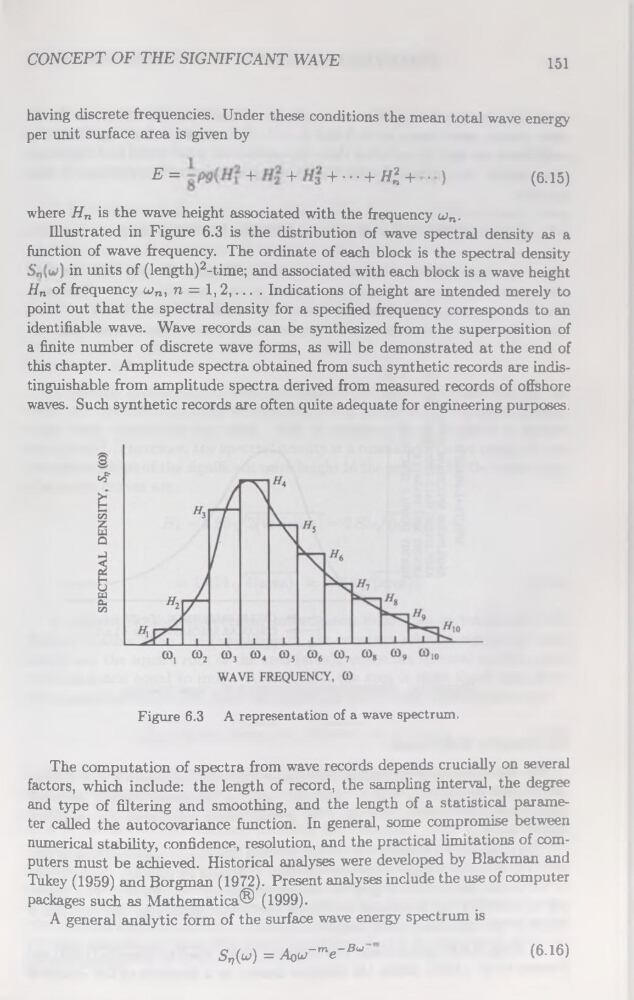
Illustrated in Figure 6.3 is the distribution of wave spectral density as a
function of wave frequency. The ordinate of each block is the spectral density
S'n(uj) in units of (length)2-time; and associated with each block is a wave height
Hn of frequency mn, n = 1,2,... . Indications of height are intended merely to
point out that the spectral density for a specified frequency corresponds to an
identifiable wave. Wave records can be synthesized from the superposition of
a finite number of discrète wave forms, as will be demonstrated at the end of
this chapter. Amplitude spectra obtained from such synthetic records are indistinguishable from amplitude spectra derived from measured records of offshore
waves. Such synthetic records are often quite adéquate for engineering purposes.
Figure 6.3 A représentation of a wave spectrum.
The computation of spectra from wave records dépends crucially on several
factors, which include: the length of record, the sampling interval, the degree
and type of filtering and smoothing, and the length of a statistical parameter called the auto covariance function. In general, sonie compromise between
numerical stability, confidence, resolution, and the practical limitations of computers must be achieved. Historical analyses were developed by Blackman and
Tukey (1959) and Borgman (1972). Présent analyses include the use of computer
packages such as Mathematica® (1999).
A general analytic form of the surface wave energy spectrum is
S^) = A0a;-rne-Bü'
(6-16)
151
having discrète frequencies. Under these conditions the mean total wave energy
per unit surface area is given by
E=
+
+
+ ... + H?t+ • )
(6.15)
where Hn is the wave height associated with the frequency u)n.
Illustrated in Figure 6.3 is the distribution of wave spectral density as a
function of wave frequency. The ordinate of each block is the spectral density
S'n(uj) in units of (length)2-time; and associated with each block is a wave height
Hn of frequency mn, n = 1,2,... . Indications of height are intended merely to
point out that the spectral density for a specified frequency corresponds to an
identifiable wave. Wave records can be synthesized from the superposition of
a finite number of discrète wave forms, as will be demonstrated at the end of
this chapter. Amplitude spectra obtained from such synthetic records are indistinguishable from amplitude spectra derived from measured records of offshore
waves. Such synthetic records are often quite adéquate for engineering purposes.
Figure 6.3 A représentation of a wave spectrum.
The computation of spectra from wave records dépends crucially on several
factors, which include: the length of record, the sampling interval, the degree
and type of filtering and smoothing, and the length of a statistical parameter called the auto covariance function. In general, sonie compromise between
numerical stability, confidence, resolution, and the practical limitations of computers must be achieved. Historical analyses were developed by Blackman and
Tukey (1959) and Borgman (1972). Présent analyses include the use of computer
packages such as Mathematica® (1999).
A general analytic form of the surface wave energy spectrum is
S^) = A0a;-rne-Bü'
(6-16)