

DESCRIPTIONS OF WAVE ENERGY SPECTRA
153
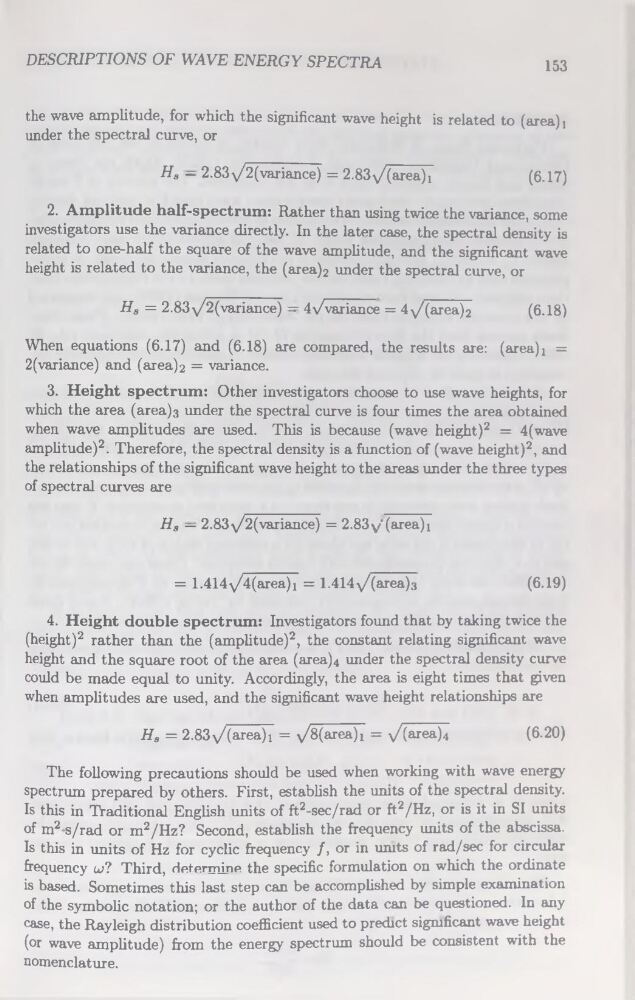
the wave amplitude, for which the significant wave height is related to (area)]
under the spectral curve, or
Ha - 2.83\/2(variance) = 2.83v/(area)1
(6.17)
2. Amplitude half-spectrum: Rather than using twice the variance, some
investigators use the variance directly. In the later case, the spectral density is
related to one-half the square of the wave amplitude, and the significant wave
height is related to the variance, the (area)2 under the spectral curve, or
Ha = 2.83\/2(variance) - 4 v7variance = 4>/(area)2
(6.18)
When équations (6.17) and (6.18) are compared, the results are: (area)! =
2(variance) and (area) 2 = variance.
3. Height spectrum: Other investigators choose to use wave heights, for
which the area (area)a under the spectral curve is four times the area obtained
when wave amplitudes are used. This is because (wave height)2 = 4(wave
amplitude)2. Therefore, the spectral density is a function of (wave height)2, and
the relationships of the significant wave height to the areas under the three types
of spectral curves are
Ha — 2.83-\/2(variance) = 2.83 y'(area) 1
= 1.414y4(area)i = 1.414i/(area)3
(6.19)
4. Height double spectrum: Investigators found that by taking twice the
(height)2 rather than the (amplitude)2, the constant relating significant wave
height and the square root of the area (area)4 under the spectral density curve
could be made equal to unity. Accordingly, the area is eight times that given
when amplitudes are used, and the significant wave height relationships are
Ha = 2.83y/(area)1 = y^area)! = y/ (area)4
(6.20)
The following précautions should be used when working with wave energy
spectrum prepared by others. First, establish the umts of the spectral density.
Is this in Traditional English units of ft2-sec/rad or ft2/Hz, or is it in SI units
of m2 s/rad or m2/Hz? Second, establish the frequency units of the abscissa.
Is this in units of Hz for cyclic frequency f, or in umts of rad/sec for circular
frequency w? Third, détermine the spécifie formulation on which the ordinate
is based. Sometimes this last step can be accomplished by simple examination
of the symbolic notation; or the author of the data can be questioned. In any
case, the Rayleigh distribution coefficient used to predict significant wave height
(or wave amplitude) from the energy spectrum should be consistent with the
nomenclature.
153
the wave amplitude, for which the significant wave height is related to (area)]
under the spectral curve, or
Ha - 2.83\/2(variance) = 2.83v/(area)1
(6.17)
2. Amplitude half-spectrum: Rather than using twice the variance, some
investigators use the variance directly. In the later case, the spectral density is
related to one-half the square of the wave amplitude, and the significant wave
height is related to the variance, the (area)2 under the spectral curve, or
Ha = 2.83\/2(variance) - 4 v7variance = 4>/(area)2
(6.18)
When équations (6.17) and (6.18) are compared, the results are: (area)! =
2(variance) and (area) 2 = variance.
3. Height spectrum: Other investigators choose to use wave heights, for
which the area (area)a under the spectral curve is four times the area obtained
when wave amplitudes are used. This is because (wave height)2 = 4(wave
amplitude)2. Therefore, the spectral density is a function of (wave height)2, and
the relationships of the significant wave height to the areas under the three types
of spectral curves are
Ha — 2.83-\/2(variance) = 2.83 y'(area) 1
= 1.414y4(area)i = 1.414i/(area)3
(6.19)
4. Height double spectrum: Investigators found that by taking twice the
(height)2 rather than the (amplitude)2, the constant relating significant wave
height and the square root of the area (area)4 under the spectral density curve
could be made equal to unity. Accordingly, the area is eight times that given
when amplitudes are used, and the significant wave height relationships are
Ha = 2.83y/(area)1 = y^area)! = y/ (area)4
(6.20)
The following précautions should be used when working with wave energy
spectrum prepared by others. First, establish the umts of the spectral density.
Is this in Traditional English units of ft2-sec/rad or ft2/Hz, or is it in SI units
of m2 s/rad or m2/Hz? Second, establish the frequency units of the abscissa.
Is this in units of Hz for cyclic frequency f, or in umts of rad/sec for circular
frequency w? Third, détermine the spécifie formulation on which the ordinate
is based. Sometimes this last step can be accomplished by simple examination
of the symbolic notation; or the author of the data can be questioned. In any
case, the Rayleigh distribution coefficient used to predict significant wave height
(or wave amplitude) from the energy spectrum should be consistent with the
nomenclature.