

120
SINGLE DEGREE OF FREEDOM STRUCTURES
For the last équation, note that the time between the application of the unit
impulse and observation of its response is (t - r) instead of t as in équation
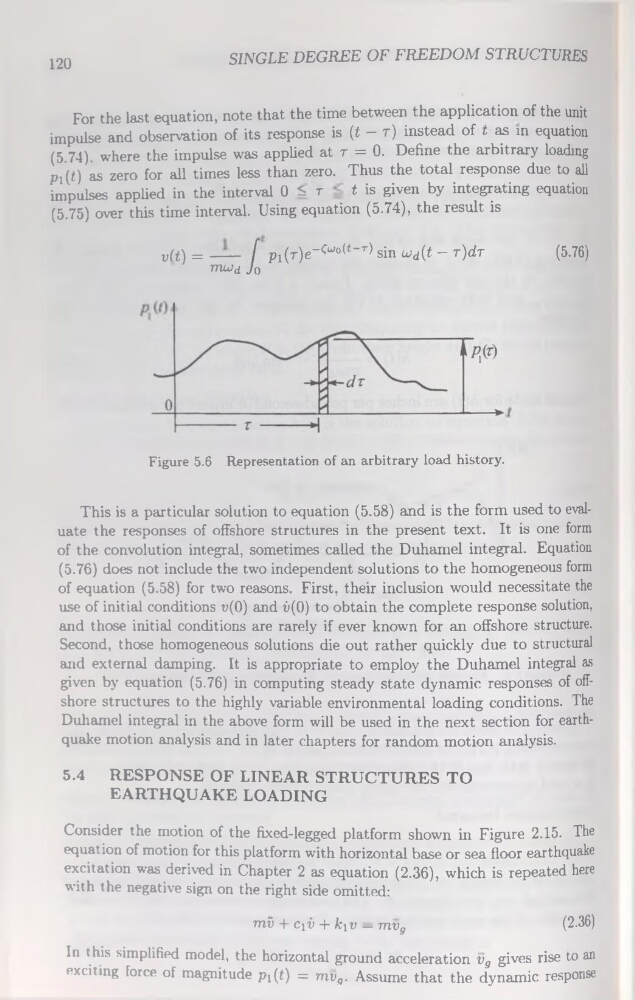
(5.74), where the impulse was applied at t = 0. Define the arbitrary loading
P1(t) as zéro for ail times less than zéro. Thus the total response due to ail
impulses applied in the interval 0 S t
t is given by integrating équation
(5.75) over this time interval. Using équation (5.74), the resuit is
u(t) = —— [ pi(r)e_
mua Jo
Figure 5.6 Représentation of an arbitrary load history.
This is a particular solution to équation (5.58) and is the form used to evaluate the responses of offshore structures in the présent text. It is one form
of the convolution intégral, sometimes called the Duhamel intégral. Equation
(5.76) does not include the two independent solutions to the homogeneous form
of équation (5.58) for two reasons. First, their inclusion would necessitate the
use of initial conditions v(0) and û(0) to obtain the complété response solution,
and those initial conditions are rarely if ever known for an offshore structure.
Second, those homogeneous solutions die out rather quickly due to structural
and external damping. It is appropriate to employ the Duhamel intégral as
given by équation (5.76) in computing steady State dynamic responses of offshore structures to the highly variable environmental loading conditions. The
Duhamel intégral in the above form will be used in the next section for earthquake motion analysis and in later chapters for random motion analysis.
5.4
RESPONSE OF LINEAR STRUCTURES TO
EARTHQUAKE LOADING
Consider the motion of the fixed-legged platform shown in Figure 2.15. The
equat ion of motion for this platform with horizontal base or sea floor earthquake
excitation was derived in Chapter 2 as équation (2.36), which is repeated here
with the négative sign on the right side omitted:
Tnï) + cjù + k\v — mvg
(2.36)
In this simplified model, the horizontal ground accélération vg gives rise to an
exciting force of magnitude Pi(t) = mvQ. Assume that the dynamic response
SINGLE DEGREE OF FREEDOM STRUCTURES
For the last équation, note that the time between the application of the unit
impulse and observation of its response is (t - r) instead of t as in équation
(5.74), where the impulse was applied at t = 0. Define the arbitrary loading
P1(t) as zéro for ail times less than zéro. Thus the total response due to ail
impulses applied in the interval 0 S t
t is given by integrating équation
(5.75) over this time interval. Using équation (5.74), the resuit is
u(t) = —— [ pi(r)e_
mua Jo
Figure 5.6 Représentation of an arbitrary load history.
This is a particular solution to équation (5.58) and is the form used to evaluate the responses of offshore structures in the présent text. It is one form
of the convolution intégral, sometimes called the Duhamel intégral. Equation
(5.76) does not include the two independent solutions to the homogeneous form
of équation (5.58) for two reasons. First, their inclusion would necessitate the
use of initial conditions v(0) and û(0) to obtain the complété response solution,
and those initial conditions are rarely if ever known for an offshore structure.
Second, those homogeneous solutions die out rather quickly due to structural
and external damping. It is appropriate to employ the Duhamel intégral as
given by équation (5.76) in computing steady State dynamic responses of offshore structures to the highly variable environmental loading conditions. The
Duhamel intégral in the above form will be used in the next section for earthquake motion analysis and in later chapters for random motion analysis.
5.4
RESPONSE OF LINEAR STRUCTURES TO
EARTHQUAKE LOADING
Consider the motion of the fixed-legged platform shown in Figure 2.15. The
equat ion of motion for this platform with horizontal base or sea floor earthquake
excitation was derived in Chapter 2 as équation (2.36), which is repeated here
with the négative sign on the right side omitted:
Tnï) + cjù + k\v — mvg
(2.36)
In this simplified model, the horizontal ground accélération vg gives rise to an
exciting force of magnitude Pi(t) = mvQ. Assume that the dynamic response