

88
WAVE FORCES ON STRUCTURES
The following relationships between cylinder diameter D, the wave height H
(peak to trough), and the wave length À serve to define the flow régimes more
precisely.
1. Drag: D/H < 0.1. In Morison’s équation the term involving CD dominâtes the term involving Cm- Wave loads on the very small diameter components of offshore structures such as conductor tubes will be drag-dominated. In
such cases q ~ qo, where qo is given by équation (2.10).
2. Inertia: 0.5 < D/H < 1.0. In Morison’s équation the term involving
Cm dominâtes the term involving Cd- The columns supporting the deck of a
gravity-type platform are designed to sustain wave forces in this régime. In such
cases q ~ qi where qj is given by équation (2.7).
3. Diffraction: D/A > 0.2. Wave forces on stationary bodies in this flow
régime were discussed in detail by Hogben (1976) and Sarpkaya and Isaacson
(1981). Generally, diffraction force calculations are based on the Froude-Krylov
pressure distributions derived from idéal, hydrodynamic flow and linear wave
theory. These forces are then modified by the experimental flow coeffcients
Ch, Cv, and Cb
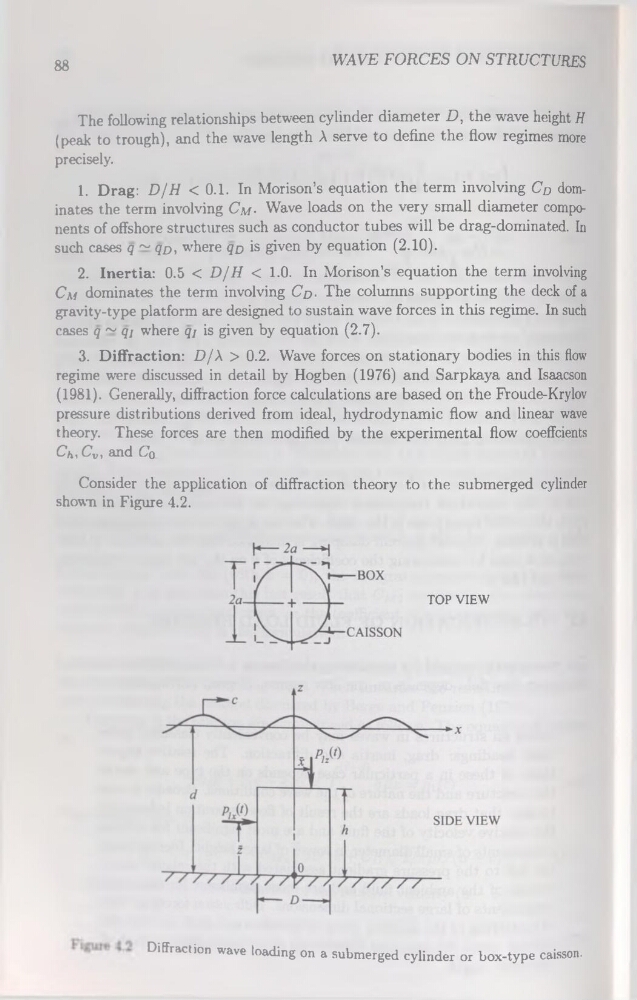
Consider the application of diffraction theory to the submerged cylinder
shown in Figure 4.2.
TOP VIEW
Diffraction wave loading on a submerged cylinder or box-type caisson.
WAVE FORCES ON STRUCTURES
The following relationships between cylinder diameter D, the wave height H
(peak to trough), and the wave length À serve to define the flow régimes more
precisely.
1. Drag: D/H < 0.1. In Morison’s équation the term involving CD dominâtes the term involving Cm- Wave loads on the very small diameter components of offshore structures such as conductor tubes will be drag-dominated. In
such cases q ~ qo, where qo is given by équation (2.10).
2. Inertia: 0.5 < D/H < 1.0. In Morison’s équation the term involving
Cm dominâtes the term involving Cd- The columns supporting the deck of a
gravity-type platform are designed to sustain wave forces in this régime. In such
cases q ~ qi where qj is given by équation (2.7).
3. Diffraction: D/A > 0.2. Wave forces on stationary bodies in this flow
régime were discussed in detail by Hogben (1976) and Sarpkaya and Isaacson
(1981). Generally, diffraction force calculations are based on the Froude-Krylov
pressure distributions derived from idéal, hydrodynamic flow and linear wave
theory. These forces are then modified by the experimental flow coeffcients
Ch, Cv, and Cb
Consider the application of diffraction theory to the submerged cylinder
shown in Figure 4.2.
TOP VIEW
Diffraction wave loading on a submerged cylinder or box-type caisson.