

CLASSIFICATION OF FLUID LOAD REGIMES
87
Here, To is the time required for several oscillations of the cylinder. When
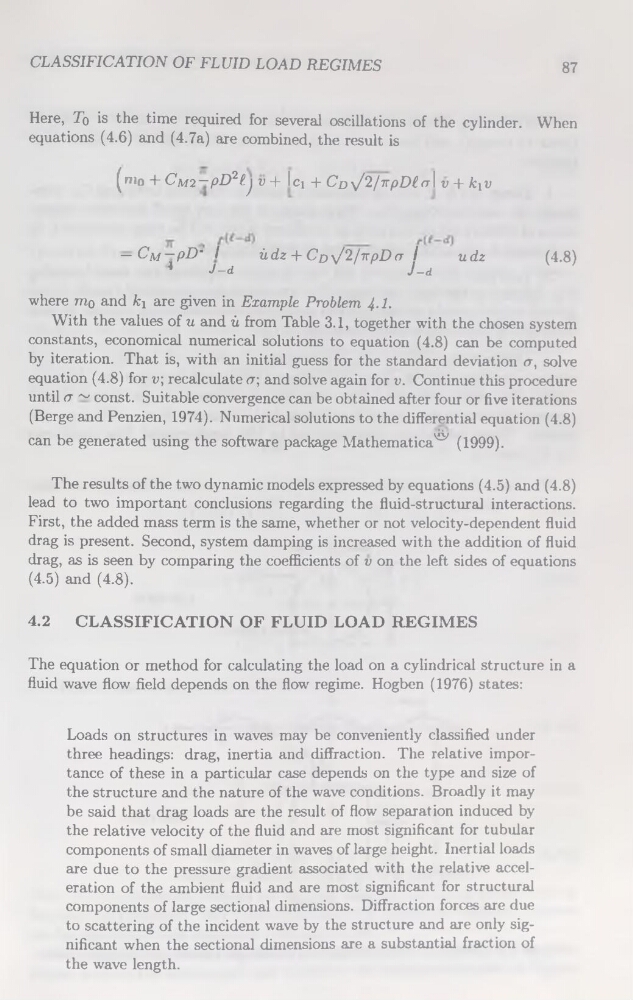
équations (4.6) and (4.7a) are combined, the resuit is
("•e + CM2~pD^l) v + ICi + Cfjy/2/irpDI rj\ v + kiv
— C\j—pD' I
ùdz + Cuy/2/frpDa I
udz
(4.8)
4
J-d
J-d
where mo and Aq are given in Example Problem 4.1.
With the values of u and il from Table 3.1, together with the chosen System
constants, economical numerical solutions to équation (4.8) can be computed
by itération. That is, with an initial guess for the standard déviation
until <7 ~ const. Suitable convergence can be obtained after four or five itérations
(Berge and Penzien, 1974). Numerical solutions to the differential équation (4.8)
■ ■
can be generated using the software package Mathematica^ (1999).
The results of the two dynamic models expressed by équations (4.5) and (4.8)
lead to two important conclusions regarding the fluid-structural interactions.
First, the added mass term is the same, whether or not velocity-dependent fluid
drag is présent. Second, System damping is increased with the addition of fluid
drag, as is seen by comparing the coefficients of v on the left sides of équations
(4.5) and (4.8).
4.2
CLASSIFICATION OF FLUID LOAD REGIMES
The équation or method for calculating the load on a cylindrical structure in a
fluid wave flow field dépends on the flow régime. Hogben (1976) States:
Loads on structures in waves may be conveniently classified under
three headings: drag, inertia and diffraction. The relative importance of these in a particular case dépends on the type and size of
the structure and the nature of the wave conditions. Broadly it may
be said that drag loads are the resuit of flow séparation induced by
the relative velocity of the fluid and are most significant for tubular
components of small diameter in waves of large height. Inertial loads
are due to the pressure gradient associated with the relative accélération of the ambient fluid and are most significant for structural
components of large sectional dimensions. Diffraction forces are due
to scattering of the incident wave by the structure and are only significant when the sectional dimensions are a substantial fraction of
the wave length.
87
Here, To is the time required for several oscillations of the cylinder. When
équations (4.6) and (4.7a) are combined, the resuit is
("•e + CM2~pD^l) v + ICi + Cfjy/2/irpDI rj\ v + kiv
— C\j—pD' I
ùdz + Cuy/2/frpDa I
udz
(4.8)
4
J-d
J-d
where mo and Aq are given in Example Problem 4.1.
With the values of u and il from Table 3.1, together with the chosen System
constants, economical numerical solutions to équation (4.8) can be computed
by itération. That is, with an initial guess for the standard déviation
until <7 ~ const. Suitable convergence can be obtained after four or five itérations
(Berge and Penzien, 1974). Numerical solutions to the differential équation (4.8)
■ ■
can be generated using the software package Mathematica^ (1999).
The results of the two dynamic models expressed by équations (4.5) and (4.8)
lead to two important conclusions regarding the fluid-structural interactions.
First, the added mass term is the same, whether or not velocity-dependent fluid
drag is présent. Second, System damping is increased with the addition of fluid
drag, as is seen by comparing the coefficients of v on the left sides of équations
(4.5) and (4.8).
4.2
CLASSIFICATION OF FLUID LOAD REGIMES
The équation or method for calculating the load on a cylindrical structure in a
fluid wave flow field dépends on the flow régime. Hogben (1976) States:
Loads on structures in waves may be conveniently classified under
three headings: drag, inertia and diffraction. The relative importance of these in a particular case dépends on the type and size of
the structure and the nature of the wave conditions. Broadly it may
be said that drag loads are the resuit of flow séparation induced by
the relative velocity of the fluid and are most significant for tubular
components of small diameter in waves of large height. Inertial loads
are due to the pressure gradient associated with the relative accélération of the ambient fluid and are most significant for structural
components of large sectional dimensions. Diffraction forces are due
to scattering of the incident wave by the structure and are only significant when the sectional dimensions are a substantial fraction of
the wave length.