

CLASSIFICATION OF FLUID LOAD REGIMES
89
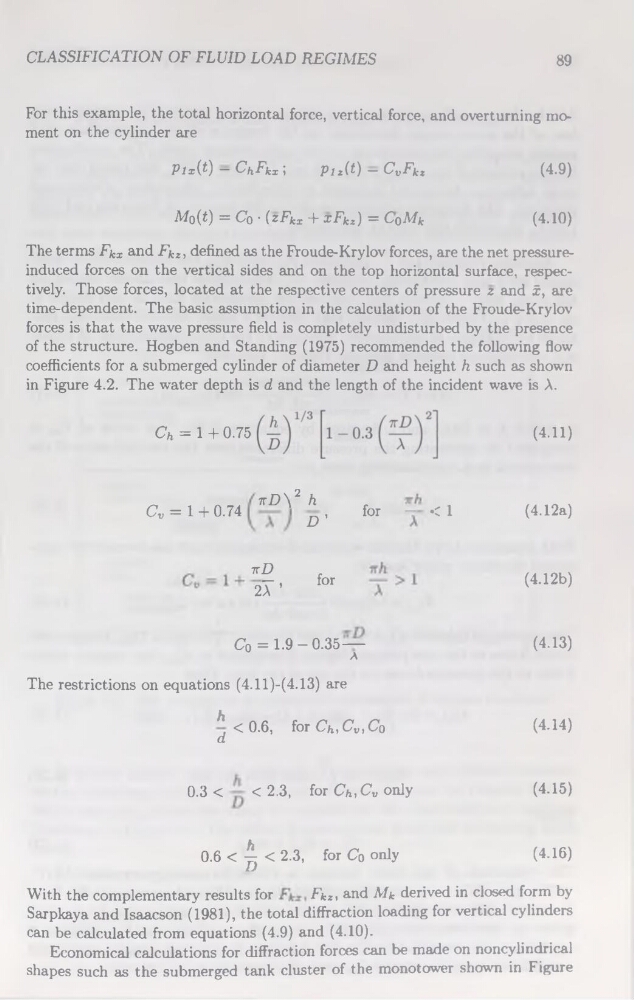
For this example, the total horizontal force, vertical force, and overturning moment on the cylinder are
Pix(t) — ChFkx\
Piz(t) — CvFkz
Mo(t) = Co • (zFkx + xFkz) = CoMfc
(4.9)
(4.10)
The terms Fkx and Fkz, defined as the Froude-Krylov forces, are the net pressureinduced forces on the vertical sides and on the top horizontal surface, respectively. Those forces, located at the respective centers of pressure z and i, are
time-dependent. The basic assumption in the calculation of the Froude-Krylov
forces is that the wave pressure field is completely undisturbed by the presence
of the structure. Hogben and Standing (1975) recommended the following flow
coefficients for a submerged cylinder of diameter D and height h such as shown
in Figure 4.2. The water depth is d and the length of the incident wave is A.
Cv = 1 + 0.74
Ch = 1 + 0.75
7rD\2
for
— < 1
(4.H)
(4.12a)
7rD
2Â’
for
(4.12b)
h
D ’
Co = 1.9 - 0.35—
A
(4.13)
The restrictions on équations (4.11 )-(4.13) are
h
d
< 0.6, for Ch,Cv,Co
(4-14)
0.3 <
<2.3, forCh,C„only
(4.15)
0.6 < ^ < 2.3, for Co only
(4.16)
With the complementary results for
Fkz, and Mk derived in closed form by
Sarpkaya and Isaacson (1981), the total diffraction loading for vertical cylinders
can be calculated from équations (4.9) and (4.10).
Economical calculations for diffraction forces can be made on noncylindrical
shapes such as the submerged tank cluster of the monotower shown in Figure
89
For this example, the total horizontal force, vertical force, and overturning moment on the cylinder are
Pix(t) — ChFkx\
Piz(t) — CvFkz
Mo(t) = Co • (zFkx + xFkz) = CoMfc
(4.9)
(4.10)
The terms Fkx and Fkz, defined as the Froude-Krylov forces, are the net pressureinduced forces on the vertical sides and on the top horizontal surface, respectively. Those forces, located at the respective centers of pressure z and i, are
time-dependent. The basic assumption in the calculation of the Froude-Krylov
forces is that the wave pressure field is completely undisturbed by the presence
of the structure. Hogben and Standing (1975) recommended the following flow
coefficients for a submerged cylinder of diameter D and height h such as shown
in Figure 4.2. The water depth is d and the length of the incident wave is A.
Cv = 1 + 0.74
Ch = 1 + 0.75
7rD\2
for
— < 1
(4.H)
(4.12a)
7rD
2Â’
for
(4.12b)
h
D ’
Co = 1.9 - 0.35—
A
(4.13)
The restrictions on équations (4.11 )-(4.13) are
h
d
< 0.6, for Ch,Cv,Co
(4-14)
0.3 <
<2.3, forCh,C„only
(4.15)
0.6 < ^ < 2.3, for Co only
(4.16)
With the complementary results for
Fkz, and Mk derived in closed form by
Sarpkaya and Isaacson (1981), the total diffraction loading for vertical cylinders
can be calculated from équations (4.9) and (4.10).
Economical calculations for diffraction forces can be made on noncylindrical
shapes such as the submerged tank cluster of the monotower shown in Figure