

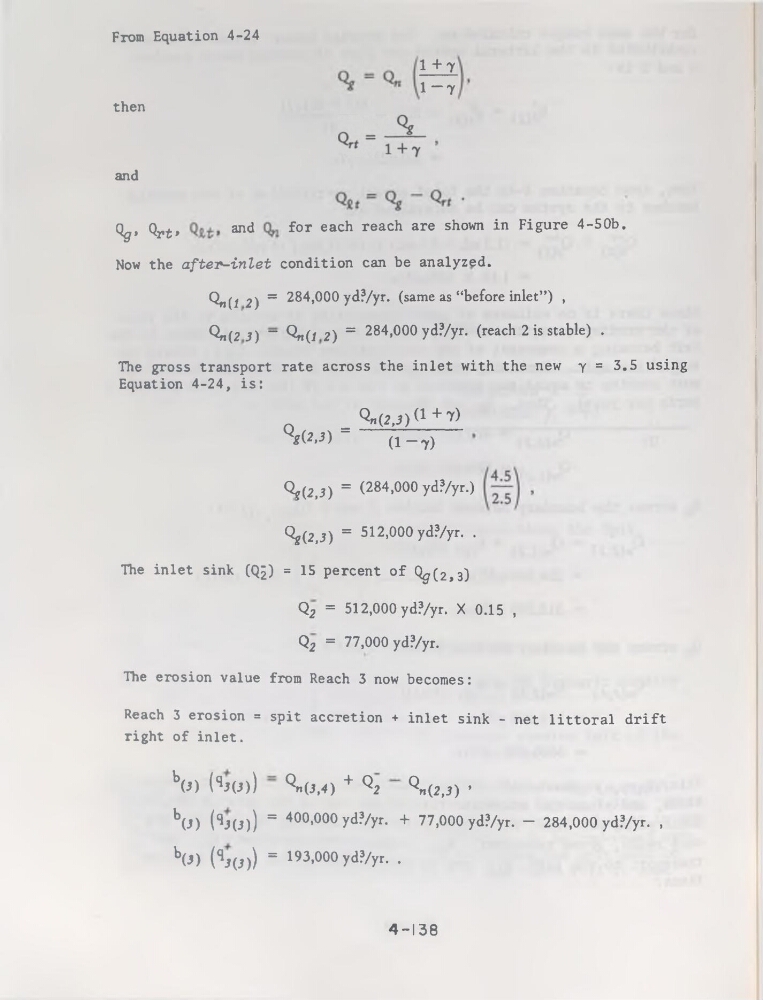
From Equation 4-24
1+7
1-7
then
and
Q^, Qrt,
and
for each reach are shown in Figure 4-50b.
Now the after-inLet condition can be analyzed.
Qr(1 2) = 284,000 yd?/yr. (same as “before inlet”) ,
^n(2 3) ~ ^n(l 2) = 284,000 yd?/yr. (reach 2 is stable) .
The gross transport rate across the inlet with the new y = 3.5 using
Equation 4-24, is:
o
_ Qn(2,5) d + T')
Q«(2,3) -
(1_7)
Os(2,3) = (284,000 yd?/yr.)
Og(2>3) = 512,000 yd?/yr. .
The inlet sink (Q£) = 15 percent of (^(2,3)
Q2 = 512,000 yd?/yr. X 0.15 ,
Q2 = 77,000 yd?/yr.
The érosion value from Reach 3 now becomes:
Reach 3 érosion = spit accretion + inlet sink - net littoral drift
right of inlet.
b(3) (q3(3))
^n(3,4) + %
$n(2,3) ’
b(3) (q3(3)) = 400’000 yd?/yr. + 77,000 yd?/yr. - 284,000 yd?/yr. ,
b(3) (q3(3)) = 193’°00 yd?/yr. .
4-138
1+7
1-7
then
and
Q^, Qrt,
and
for each reach are shown in Figure 4-50b.
Now the after-inLet condition can be analyzed.
Qr(1 2) = 284,000 yd?/yr. (same as “before inlet”) ,
^n(2 3) ~ ^n(l 2) = 284,000 yd?/yr. (reach 2 is stable) .
The gross transport rate across the inlet with the new y = 3.5 using
Equation 4-24, is:
o
_ Qn(2,5) d + T')
Q«(2,3) -
(1_7)
Os(2,3) = (284,000 yd?/yr.)
Og(2>3) = 512,000 yd?/yr. .
The inlet sink (Q£) = 15 percent of (^(2,3)
Q2 = 512,000 yd?/yr. X 0.15 ,
Q2 = 77,000 yd?/yr.
The érosion value from Reach 3 now becomes:
Reach 3 érosion = spit accretion + inlet sink - net littoral drift
right of inlet.
b(3) (q3(3))
^n(3,4) + %
$n(2,3) ’
b(3) (q3(3)) = 400’000 yd?/yr. + 77,000 yd?/yr. - 284,000 yd?/yr. ,
b(3) (q3(3)) = 193’°00 yd?/yr. .
4-138