

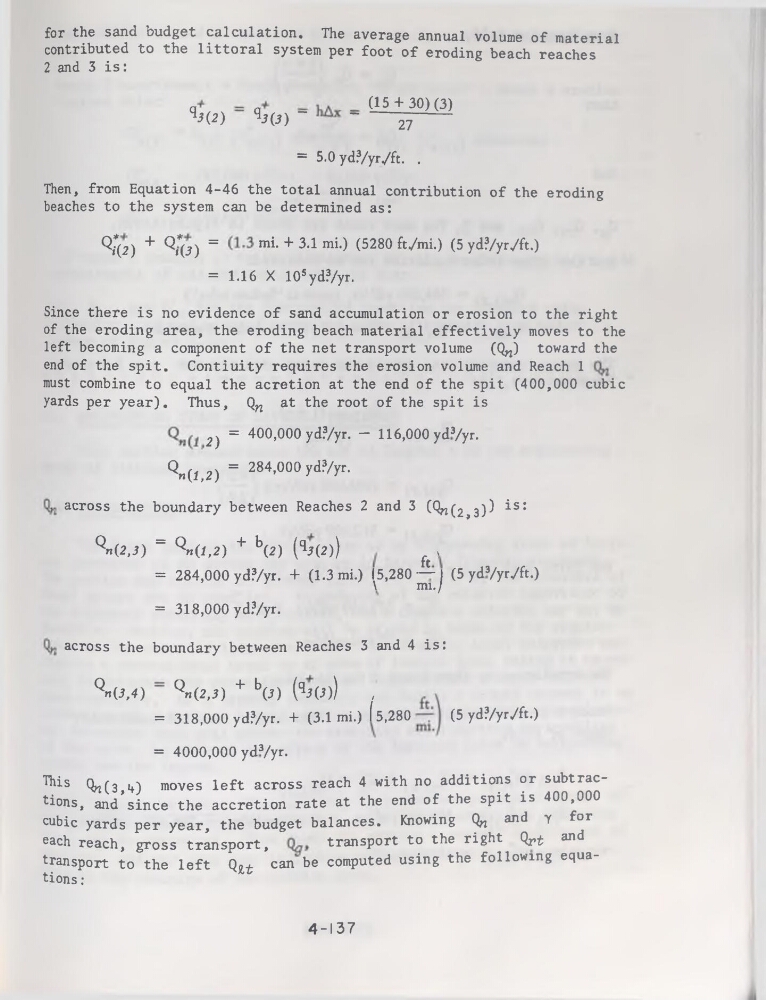
for the sand budget calculation. The average annual volume of material
contributed to the littoral System per foot of eroding beach reaches
2 and 3 is:
q3(2)
q3(5) ~
~
(15+ 30) (3)
27
= 5.0 yd?/yr/ft. .
Then, from Equation 4-46 the total annual contribution of the eroding
beaches to the System can be determined as:
Qf(2) + Qi *(3) =
mi.+ 3.1 mi.) (5280 ft/mi.) (5 yd?/yr/ft.)
= 1.16 X 10⁵yd?/yr.
Since there is no evidence of sand accumulation or érosion to the right
of the eroding area, the eroding beach material effectively moves to the
left becoming a component of the net transport volume (Q^) toward the
end of the spit. Contiuity requires the érosion volume and Reach 1
must combine to equal the acretion at the end of the spit (400,000 cubic
yards per year). Thus, Qn at the root of the spit is
2) = 400,000 yd.3/yr. — 116,000 yd3/yr.
Qn(l,2) = 284’000 yd?/yracross the boundary between Reaches 2 and 3 (Qn(2,3p ls:
Q„(2,J) = Q»G,2) + b(2) (q3(2))
ft .
= 284,000 yd?/yr. + (1.3 mi.) 15,280 ~| (5 yd3/yr/ft.)
\
mi./
= 318,000 yd.3/yr.
across the boundary between Reaches 3 and 4 is:
Qn(3,4)
Qn(2,5) + b(2) (qj(.0)
,
= 318,000 yd?/yr. + (3.1 mi.) 15,280
(5 yd?/yr/ft.)
= 4000,000 yd3/yr.
11115 0n(3,4) moves left across reach 4 with no additions or subtractions, and since the accretion rate at the end of the spit is 400,000
cubic yards per year, the budget balances. Knowing Q„ and y for
each reach, gross transport,
transport to the right Qrt and
transport to the left Qu can be computed using the following équations :
4-137
contributed to the littoral System per foot of eroding beach reaches
2 and 3 is:
q3(2)
q3(5) ~
~
(15+ 30) (3)
27
= 5.0 yd?/yr/ft. .
Then, from Equation 4-46 the total annual contribution of the eroding
beaches to the System can be determined as:
Qf(2) + Qi *(3) =
mi.+ 3.1 mi.) (5280 ft/mi.) (5 yd?/yr/ft.)
= 1.16 X 10⁵yd?/yr.
Since there is no evidence of sand accumulation or érosion to the right
of the eroding area, the eroding beach material effectively moves to the
left becoming a component of the net transport volume (Q^) toward the
end of the spit. Contiuity requires the érosion volume and Reach 1
must combine to equal the acretion at the end of the spit (400,000 cubic
yards per year). Thus, Qn at the root of the spit is
2) = 400,000 yd.3/yr. — 116,000 yd3/yr.
Qn(l,2) = 284’000 yd?/yracross the boundary between Reaches 2 and 3 (Qn(2,3p ls:
Q„(2,J) = Q»G,2) + b(2) (q3(2))
ft .
= 284,000 yd?/yr. + (1.3 mi.) 15,280 ~| (5 yd3/yr/ft.)
\
mi./
= 318,000 yd.3/yr.
across the boundary between Reaches 3 and 4 is:
Qn(3,4)
Qn(2,5) + b(2) (qj(.0)
,
= 318,000 yd?/yr. + (3.1 mi.) 15,280
(5 yd?/yr/ft.)
= 4000,000 yd3/yr.
11115 0n(3,4) moves left across reach 4 with no additions or subtractions, and since the accretion rate at the end of the spit is 400,000
cubic yards per year, the budget balances. Knowing Q„ and y for
each reach, gross transport,
transport to the right Qrt and
transport to the left Qu can be computed using the following équations :
4-137