

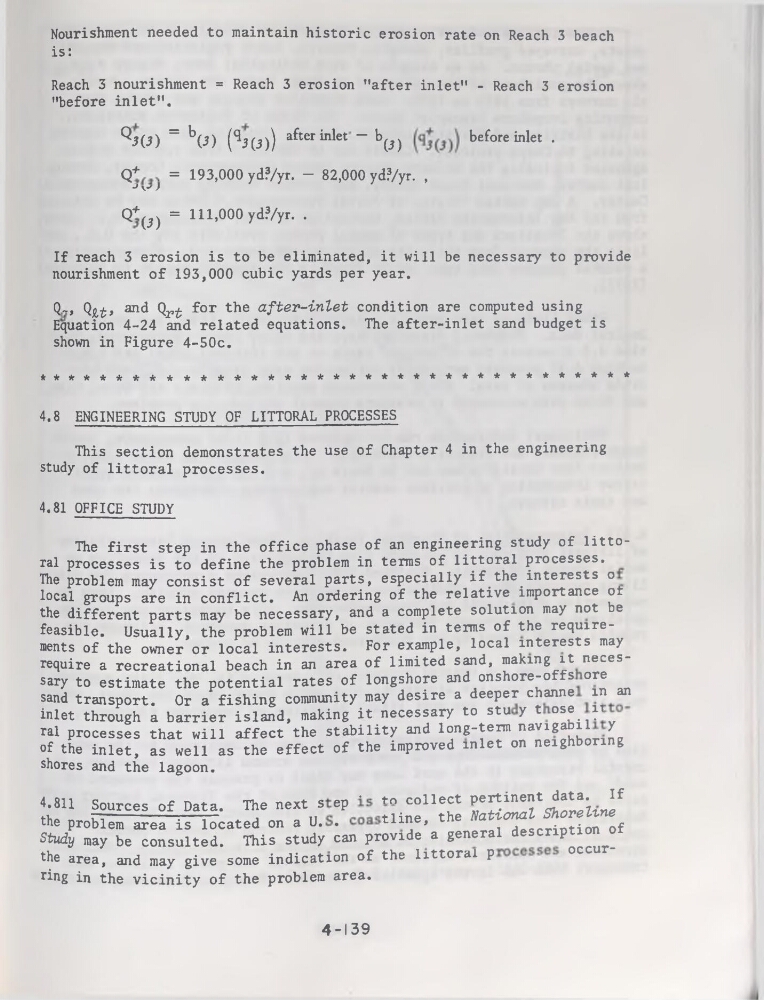
Nourishment needed to maintain historié érosion rate on Reach 3 beach
is:
Reach 3 nourishment = Reach 3 érosion ”after inlet” - Reach 3 érosion
"before inlet".
Q3(3) = b(3) (H3(3)) after inlet - b(J)
before inlet .
Q*
= 193,000 yd?/yr. - 82,000 yd?/yr. ,
J vx )
Q*(5) = 111,000 yd?/yr. ,
If reach 3 érosion is to be eliminated, it will be necessary to provide
nourishment of 193,000 cubic yards per year.
Q~, Qu, and Qp£ for the after-inlet condition are computed using
Equation 4-24 and related équations. The after-inlet sand budget is
shown in Figure 4-50c.
*************************************
4.8 ENGINEERING STUDY 0F LITTORAL PROCESSES
This section demonstrates the use of Chapter 4 in the engineering
study of littoral processes.
4.81 OFFICE STUDY
The first step in the office phase of an engineering study of littoral processes is to define the problem in terres of littoral processes.
The problem may consist of several parts, especially if the interests o
local groups are in conflict. An ordering of the relative importance of
the different parts may be necessary, and a complété solution may not be
feasible. Usually, the problem will be stated in terres of the requirements of the owner or local interests. For example, local interests may
require a recreational beach in an area of limited sand, makmg it necessary to estimate the potential rates of longshore and onshore-offs ore
sand transport. Or a fishing community may desire a deeper channe in an
inlet through a barrier island, making it necessary to stu y t os® . \
ral processes that will affect the stability and long-term navigabil y
Of the inlet, as well as the effect of the improved inlet on neighbonng
shores and the lagoon.
• tn collect pertinent data. If
4,811 Sources of Data. The next S ep
tline the National Shoreline
the problem area is located on a U. •
de*a general description of
Study may be consulted. This study can provide a ge
0CCurthe area, and may give some indication of the littoral p
ring in the vicinity of the problem area.
4-139
is:
Reach 3 nourishment = Reach 3 érosion ”after inlet” - Reach 3 érosion
"before inlet".
Q3(3) = b(3) (H3(3)) after inlet - b(J)
before inlet .
Q*
= 193,000 yd?/yr. - 82,000 yd?/yr. ,
J vx )
Q*(5) = 111,000 yd?/yr. ,
If reach 3 érosion is to be eliminated, it will be necessary to provide
nourishment of 193,000 cubic yards per year.
Q~, Qu, and Qp£ for the after-inlet condition are computed using
Equation 4-24 and related équations. The after-inlet sand budget is
shown in Figure 4-50c.
*************************************
4.8 ENGINEERING STUDY 0F LITTORAL PROCESSES
This section demonstrates the use of Chapter 4 in the engineering
study of littoral processes.
4.81 OFFICE STUDY
The first step in the office phase of an engineering study of littoral processes is to define the problem in terres of littoral processes.
The problem may consist of several parts, especially if the interests o
local groups are in conflict. An ordering of the relative importance of
the different parts may be necessary, and a complété solution may not be
feasible. Usually, the problem will be stated in terres of the requirements of the owner or local interests. For example, local interests may
require a recreational beach in an area of limited sand, makmg it necessary to estimate the potential rates of longshore and onshore-offs ore
sand transport. Or a fishing community may desire a deeper channe in an
inlet through a barrier island, making it necessary to stu y t os® . \
ral processes that will affect the stability and long-term navigabil y
Of the inlet, as well as the effect of the improved inlet on neighbonng
shores and the lagoon.
• tn collect pertinent data. If
4,811 Sources of Data. The next S ep
tline the National Shoreline
the problem area is located on a U. •
de*a general description of
Study may be consulted. This study can provide a ge
0CCurthe area, and may give some indication of the littoral p
ring in the vicinity of the problem area.
4-139