

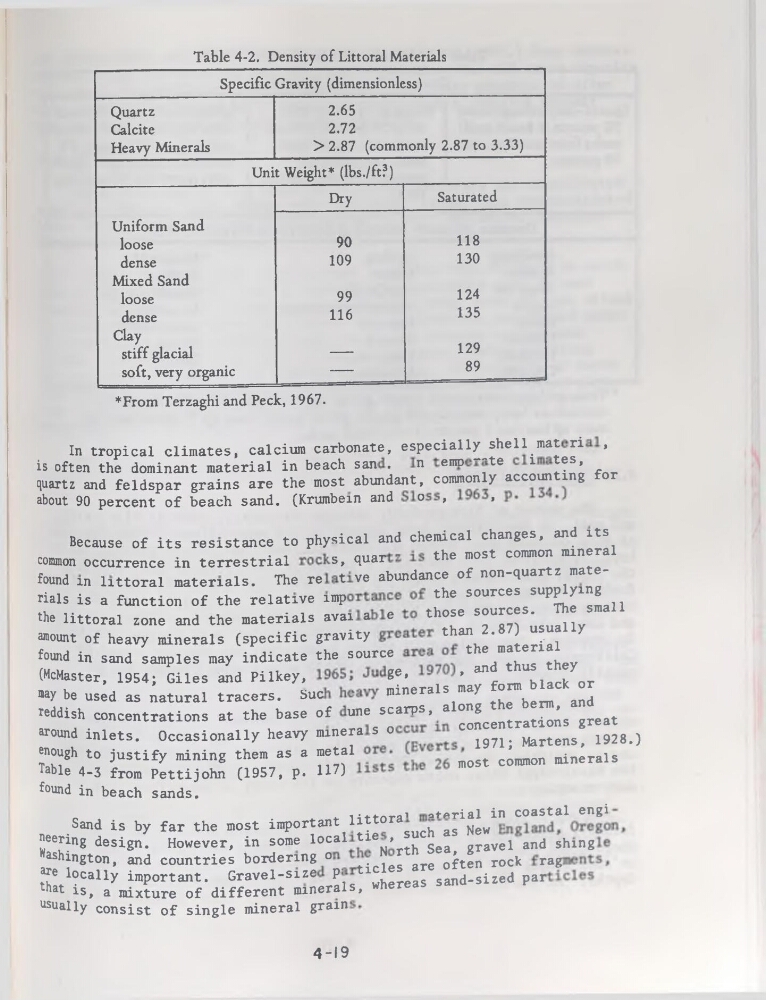
Table 4-2. Density o£ Littoral Materials
Spécifie Gravity (dimensionless)
Quartz
Calcite
Heavy Minerais
2.65
2.72
> 2.87 (commonly 2.87 to 3.33)
Unit Weight* (Ibs./ft?)
Dry
Saturated
Uniform Sand
loose
90
118
dense
109
130
Mixed Sand
loose
99
124
dense
116
135
Clay
stiff glacial
—
129
soft, very organic
—
89
*From Terzaghi and Peck, 1967.
In tropical climates, calcium carbonate, e®Pe'^’L^e“i“îe^’
is often the dominant material in beach san .
n
accounting for
quartz and feldspar grains are the most abundant, commonly account ng
about 90 percent of beach sand. (Krumbein and
o ,
>
nhvsical and Chemical changes, and its
Because of its résistance to phy
the most common minerai
common occurrence in terrestrial
S; ^^bundance of non-quartz matefound m littoral matenals. The re
the sources supplymg
riais is a function of the relative imp
those sources. The small
the littoral zone and the materials aval a ethan 2.87) usually
amount of heavy minerais (spécifie gravity
the material
found in sand samples may indicate the source
anj thus they
(McMaster, 1954; Giles and Pilkey,
^„als ^y form black or
W be used as natural tracers. bue
carps along the berm, and
reddish concentrations at the base of une s
’
concentrations great
Occasionally heavy minera s o
1971; Martens, 1928.)
enough to justify mining them as a métal
most comJnon minerais
Table 4-3 from Pettijohn (1957, p. H?)
found in beach sands.
around in 1 et s.
i atprial in coastal engi
Sand is by far the most important 1 ^°rasuch as New
neering design. However, in some local
N*rth Sea, grave 1 and shing
Washington, and countries bordering 0
ticies are often rock rag
are locally important. Gravel-size P
whereas sand-sized par
that is, a mixture of different minerais, wn
usually consist of single minerai grain
4-19
Spécifie Gravity (dimensionless)
Quartz
Calcite
Heavy Minerais
2.65
2.72
> 2.87 (commonly 2.87 to 3.33)
Unit Weight* (Ibs./ft?)
Dry
Saturated
Uniform Sand
loose
90
118
dense
109
130
Mixed Sand
loose
99
124
dense
116
135
Clay
stiff glacial
—
129
soft, very organic
—
89
*From Terzaghi and Peck, 1967.
In tropical climates, calcium carbonate, e®Pe'^’L^e“i“îe^’
is often the dominant material in beach san .
n
accounting for
quartz and feldspar grains are the most abundant, commonly account ng
about 90 percent of beach sand. (Krumbein and
o ,
>
nhvsical and Chemical changes, and its
Because of its résistance to phy
the most common minerai
common occurrence in terrestrial
S; ^^bundance of non-quartz matefound m littoral matenals. The re
the sources supplymg
riais is a function of the relative imp
those sources. The small
the littoral zone and the materials aval a ethan 2.87) usually
amount of heavy minerais (spécifie gravity
the material
found in sand samples may indicate the source
anj thus they
(McMaster, 1954; Giles and Pilkey,
^„als ^y form black or
W be used as natural tracers. bue
carps along the berm, and
reddish concentrations at the base of une s
’
concentrations great
Occasionally heavy minera s o
1971; Martens, 1928.)
enough to justify mining them as a métal
most comJnon minerais
Table 4-3 from Pettijohn (1957, p. H?)
found in beach sands.
around in 1 et s.
i atprial in coastal engi
Sand is by far the most important 1 ^°rasuch as New
neering design. However, in some local
N*rth Sea, grave 1 and shing
Washington, and countries bordering 0
ticies are often rock rag
are locally important. Gravel-size P
whereas sand-sized par
that is, a mixture of different minerais, wn
usually consist of single minerai grain
4-19