

sédiment in phi units. For perfectly sorted sédiment, 0$ = 0. For
typical well-sorted sédiments,
« 0.5.
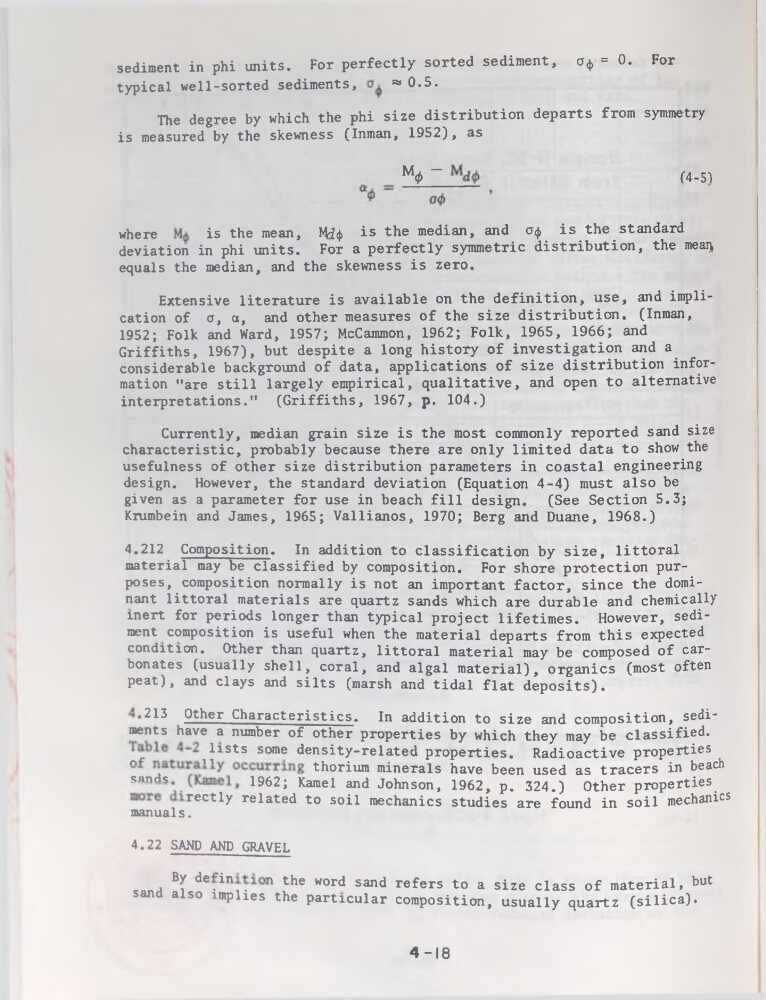
The degree by which the phi size distribution départs from symmetry
is measured by the skewness (Inman, 1952), as
M0 “
(4-5')
where
is the mean, NV<$> is the médian, and cr<| > is the standard
déviation in phi units. For a perfectly symmetric distribution, the me ai)
equals the médian, and the skewness is zéro.
Extensive literature is available on the définition, use, and implication of a, a, and other measures of the size distribution. (Inman,
1952; Folk and Ward, 1957; McCammon, 1962; Folk, 1965, 1966; and
Griffiths, 1967), but despite a long history of investigation and a
considérable background of data, applications of size distribution information "are still largely empirical, qualitative, and open to alternative
interprétations." (Griffiths, 1967, p. 104.)
Currently, médian grain size is the most commonly reported sand size
characteristic, probably because there are only limited data to show the
usefulness of other size distribution parameters in Coastal engineering
design. However, the standard déviation (Equation 4-4) must also be
given as a parameter for use in beach fill design. (See Section 5.3;
Krumbein and James, 1965; Vallianos, 1970; Berg and Duane, 1968.)
4.212 Composition. In addition to classification by size, littoral
material may be classified by composition. For shore protection purposes, composition normally is not an important factor, since the dominant littoral materials are quartz sands which are durable and chemically
mert for periods longer than typical project lifetimes. However, sédiment composition is useful when the material départs from this expected
condition. Other than quartz, littoral material may be composed of carbonates (usually shell, coral, and algal material), organics (most often
peat), and clays and silts (marsh and tidal fiat deposits) .
*213 Other Characteristics. In addition to size and composition, sédiments hâve a number of other properties by which they may be classified.
«F
iJ1StS S°me density-related properties. Radioactive properties
sanrR
t^orium minerais hâve been used as tracers in beach
1962; Kamel and Johnson, 1962, p. 324.) Other properties
■annal QTeCtly related t0 soil mechanics studies are found in soil mechanics
manual S •
4.22 SAND AND GRAVEL
sand îïs^i^H«n.Jhe WOrd Sand refers t0 a size class of material, but
plies the particular composition, usually quartz (silica).
4-18
typical well-sorted sédiments,
« 0.5.
The degree by which the phi size distribution départs from symmetry
is measured by the skewness (Inman, 1952), as
M0 “
(4-5')
where
is the mean, NV<$> is the médian, and cr<| > is the standard
déviation in phi units. For a perfectly symmetric distribution, the me ai)
equals the médian, and the skewness is zéro.
Extensive literature is available on the définition, use, and implication of a, a, and other measures of the size distribution. (Inman,
1952; Folk and Ward, 1957; McCammon, 1962; Folk, 1965, 1966; and
Griffiths, 1967), but despite a long history of investigation and a
considérable background of data, applications of size distribution information "are still largely empirical, qualitative, and open to alternative
interprétations." (Griffiths, 1967, p. 104.)
Currently, médian grain size is the most commonly reported sand size
characteristic, probably because there are only limited data to show the
usefulness of other size distribution parameters in Coastal engineering
design. However, the standard déviation (Equation 4-4) must also be
given as a parameter for use in beach fill design. (See Section 5.3;
Krumbein and James, 1965; Vallianos, 1970; Berg and Duane, 1968.)
4.212 Composition. In addition to classification by size, littoral
material may be classified by composition. For shore protection purposes, composition normally is not an important factor, since the dominant littoral materials are quartz sands which are durable and chemically
mert for periods longer than typical project lifetimes. However, sédiment composition is useful when the material départs from this expected
condition. Other than quartz, littoral material may be composed of carbonates (usually shell, coral, and algal material), organics (most often
peat), and clays and silts (marsh and tidal fiat deposits) .
*213 Other Characteristics. In addition to size and composition, sédiments hâve a number of other properties by which they may be classified.
«F
iJ1StS S°me density-related properties. Radioactive properties
sanrR
t^orium minerais hâve been used as tracers in beach
1962; Kamel and Johnson, 1962, p. 324.) Other properties
■annal QTeCtly related t0 soil mechanics studies are found in soil mechanics
manual S •
4.22 SAND AND GRAVEL
sand îïs^i^H«n.Jhe WOrd Sand refers t0 a size class of material, but
plies the particular composition, usually quartz (silica).
4-18