

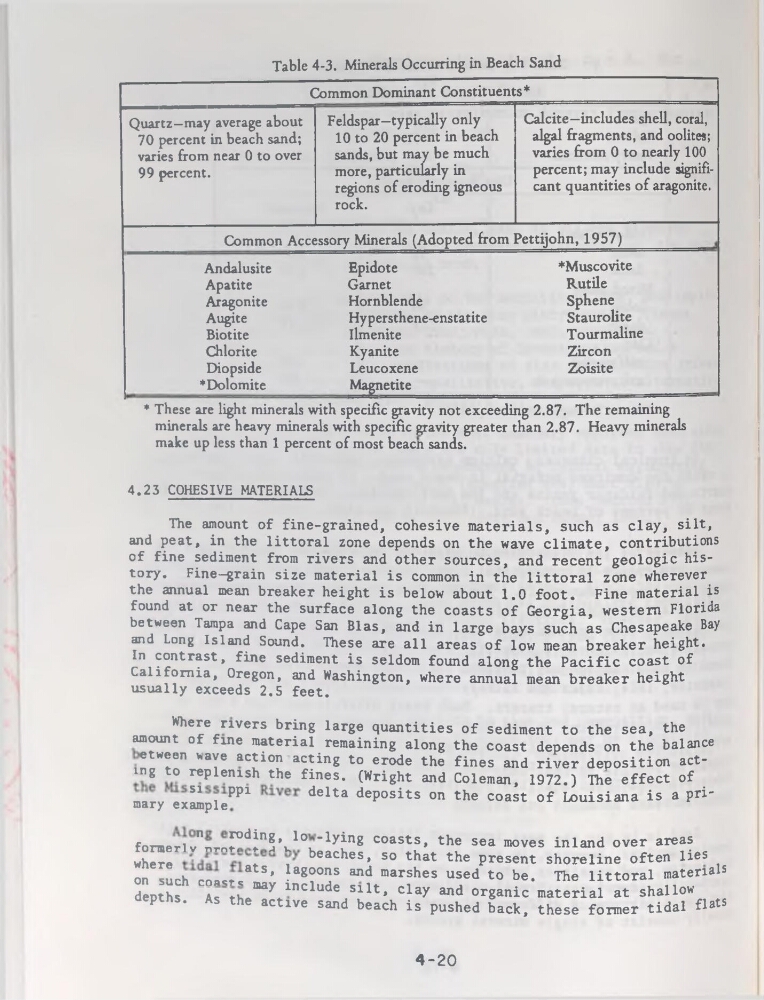
Table 4-3. Minerais Occurring in Beach Sand
Common Dominant Constituents*_______
Quartz—may average about
70 percent in beach sand;
varies from near 0 to over
99 percent.
Feldspar—typically only
10 to 20 percent in beach
sands, but may be much
more, particularly in
régions of eroding igneous
rock.
Calcite—includes shell, coral,
algal fragments, and oolites;
varies from 0 to nearly 100
percent; may include significant quantities of aragonite.
Common Accessory Minerais (Adopted from Pettijohn, 1957)
Andalusite
Epidote
♦Muscovite
Apatite
Garnet
Rutile
Aragonite
Hornblende
Sphene
Augite
Hypersthene-enstatite
Staurolite
Biotite
Ilmenite
Tourmaline
Chlorite
Kyanite
Zircon
Diopside
Leucoxene
Zoisite
* Dolomite
Magnetite
♦ These are light minerais with spécifie gravity not exceeding 2.87. The remaining
minerais are heavy minerais with spécifie gravity greater than 2.87. Heavy minerais
make up less than 1 percent of most beacn sands.
4.23 COHESIVE MATERIALS
The amount of fine-grained, cohesive materials, such as clay, silt,
and peat, in the littoral zone dépends on the wave climate, contributions
°f fine sédiment from rivers and other sources, and recent géologie history. Fine-grain size material is common in the littoral zone wherever
the annual mean breaker height is below about 1.0 foot. Fine material is
found at or near the surface along the coasts of Georgia, western Florida
between Tampa and Cape San Blas, and in large bays such as Chesapeake Bay
and Long Island Sound. These are ail areas of low mean breaker height.
In contrast, fine sédiment is seldom found along the Pacific coast of
California, Oregon, and Washington, where annual mean breaker height
usually exceeds 2.5 feet.
Where rivers bring large quantities of sédiment to the sea, the
amount of fme material remaining along the coast dépends on the balance
etween wave action acting to erode the fines and river déposition acting to replenish the fines. (Wright and Coleman, 1972.) The effect of
mary exCiple^1
delt* deposits on the coast of Louisiana is a priformerlvnn-rnr)dJn?,u1°u~lying coasts, the sea moves inland over areas
wh^e
beaches, so that the présent shoreline often lies
on such coaerc^5' ?ag°or]s 311(1 marshes used to be. The littoral materials
depths
As thpIBa\.inC1Ude Sllt* clay and organic material at shallow
epths. As the active sand beach is pushed back, these former tidal flats
4-20
Common Dominant Constituents*_______
Quartz—may average about
70 percent in beach sand;
varies from near 0 to over
99 percent.
Feldspar—typically only
10 to 20 percent in beach
sands, but may be much
more, particularly in
régions of eroding igneous
rock.
Calcite—includes shell, coral,
algal fragments, and oolites;
varies from 0 to nearly 100
percent; may include significant quantities of aragonite.
Common Accessory Minerais (Adopted from Pettijohn, 1957)
Andalusite
Epidote
♦Muscovite
Apatite
Garnet
Rutile
Aragonite
Hornblende
Sphene
Augite
Hypersthene-enstatite
Staurolite
Biotite
Ilmenite
Tourmaline
Chlorite
Kyanite
Zircon
Diopside
Leucoxene
Zoisite
* Dolomite
Magnetite
♦ These are light minerais with spécifie gravity not exceeding 2.87. The remaining
minerais are heavy minerais with spécifie gravity greater than 2.87. Heavy minerais
make up less than 1 percent of most beacn sands.
4.23 COHESIVE MATERIALS
The amount of fine-grained, cohesive materials, such as clay, silt,
and peat, in the littoral zone dépends on the wave climate, contributions
°f fine sédiment from rivers and other sources, and recent géologie history. Fine-grain size material is common in the littoral zone wherever
the annual mean breaker height is below about 1.0 foot. Fine material is
found at or near the surface along the coasts of Georgia, western Florida
between Tampa and Cape San Blas, and in large bays such as Chesapeake Bay
and Long Island Sound. These are ail areas of low mean breaker height.
In contrast, fine sédiment is seldom found along the Pacific coast of
California, Oregon, and Washington, where annual mean breaker height
usually exceeds 2.5 feet.
Where rivers bring large quantities of sédiment to the sea, the
amount of fme material remaining along the coast dépends on the balance
etween wave action acting to erode the fines and river déposition acting to replenish the fines. (Wright and Coleman, 1972.) The effect of
mary exCiple^1
delt* deposits on the coast of Louisiana is a priformerlvnn-rnr)dJn?,u1°u~lying coasts, the sea moves inland over areas
wh^e
beaches, so that the présent shoreline often lies
on such coaerc^5' ?ag°or]s 311(1 marshes used to be. The littoral materials
depths
As thpIBa\.inC1Ude Sllt* clay and organic material at shallow
epths. As the active sand beach is pushed back, these former tidal flats
4-20