

When a basin enclosed with vertical sides has a well-defined major
axis and a gradually varying cross section, it is possible to use a
dynamic one-dimensional, computational model for evaluating fluctuations
in water level resulting from a forcing mechanism such as wind stress,
and also to account for some of the effects of a varying cross section.
The validity of such a model dépends on the behavior of the storm System
and the géométrie configuration of the basin.
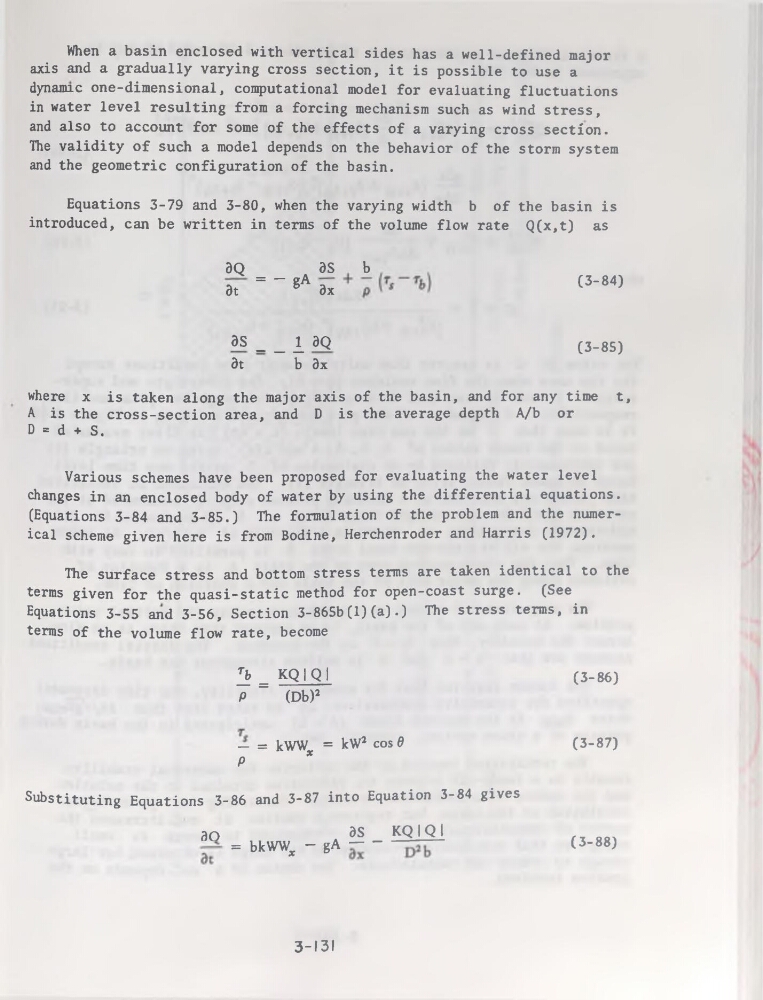
Equations 3-79 and 3-80, when the varying width b of the basin is
introduced, can be written in terms of the volume flow rate Q(x,t) as
b
9Q
dt
dS
= _ gA dx
(3-84)
dS _ _ £ dQ
dt
b dx
(3-85)
where x is taken along the major axis of the basin, and for any time t,
A is the cross-section area, and D is the average depth A/b or
D = d + S.
Various schemes hâve been proposed for evaluating the water level
changes in an enclosed body of water by using the differential équations.
(Equations 3-84 and 3-85.) The formulation of the problem and the numerical scheme given here is from Bodine, Herchenroder and Harris (1972).
The surface stress and bottom stress terms are taken identical to the
terms given for the quasi-static method for open-coast surge. (See
Equations 3-55 and 3-56, Section 3-865b(1)(a).) The stress terms, in
terms of the volume flow rate, become
lÈ = KQ । Q 1
(3-86)
P
(Db)2
— = kWW = kW2 cos 0
(3-87)
P
*
Substituting Equations 3-86 and 3-87 into Equation 3-84 gives
30
as
KQIQI
= bkWW, - gA - -
(3-88)
3-131
axis and a gradually varying cross section, it is possible to use a
dynamic one-dimensional, computational model for evaluating fluctuations
in water level resulting from a forcing mechanism such as wind stress,
and also to account for some of the effects of a varying cross section.
The validity of such a model dépends on the behavior of the storm System
and the géométrie configuration of the basin.
Equations 3-79 and 3-80, when the varying width b of the basin is
introduced, can be written in terms of the volume flow rate Q(x,t) as
b
9Q
dt
dS
= _ gA dx
(3-84)
dS _ _ £ dQ
dt
b dx
(3-85)
where x is taken along the major axis of the basin, and for any time t,
A is the cross-section area, and D is the average depth A/b or
D = d + S.
Various schemes hâve been proposed for evaluating the water level
changes in an enclosed body of water by using the differential équations.
(Equations 3-84 and 3-85.) The formulation of the problem and the numerical scheme given here is from Bodine, Herchenroder and Harris (1972).
The surface stress and bottom stress terms are taken identical to the
terms given for the quasi-static method for open-coast surge. (See
Equations 3-55 and 3-56, Section 3-865b(1)(a).) The stress terms, in
terms of the volume flow rate, become
lÈ = KQ । Q 1
(3-86)
P
(Db)2
— = kWW = kW2 cos 0
(3-87)
P
*
Substituting Equations 3-86 and 3-87 into Equation 3-84 gives
30
as
KQIQI
= bkWW, - gA - -
(3-88)
3-131