

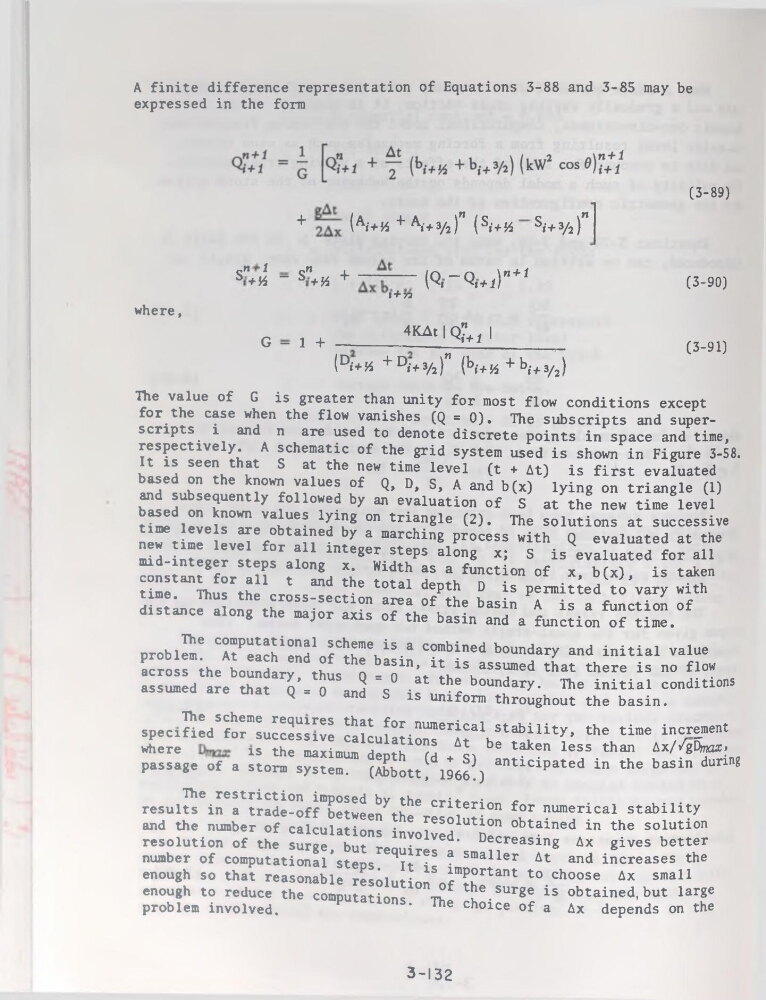
A finite différence représentation of Equations 3-88 and 3-85 may be
exprèssed in the form
(3-89)
+
(Ai+b + A.'+vJ" (S>’+« Si+Vî)”
s"+4 - S"+M +
~ (Q,-Q,+1)" + 1
(3-90)
f + 72
where,
4KAt|Q^+J|
G - 1 + —-----------—-----------1----------------(3-91)
(Dï+a + Di+3/2)” (bi+« +bi+3/2)
The value of G is
except
greater than unity for most flow conditions
for the case when the flow vanishes (Q = 0). The subscripts and superscripts i and n are used to dénoté discrète points in space and time,
respectively. A schematic of the grid System used is shown in Figure 3-58.
It is seen that S at the new time level (t + At) is first evaluated
based on the known values of Q, D, S, A and b(x) lying on triangle (1)
and subsequently followed by an évaluation of S at the new time level
based on known values lying on triangle (2). The solutions at successive
time levels are obtained by a marching process with Q evaluated at the
new time level for ail integer steps along x; S is evaluated for ail
mid-integer steps along x. Width as a function of x, b(x), is taken
constant for ail t and the total depth D is permitted to vary with
time. Thus the cross-section area of the basin A is a function of
distance along the major axis of the basin and a function of time.
The computational scheme is a combined boundary and initial value
problem. At each end of the basin, it is assumed that there is no flow
across the boundary, thus Q = 0 at the boundary. The initial conditions
assumed are that Q = 0 and S is uniform throughout the basin.
pie scheme requires that for numerical stability, the time incrément
specified for successive calculations At be taken less than àx//g^max>
where
is the maximum depth (d + S) anticipated in the basin during
passage of a storm System. (Abbott, 1966.)
The restriction imposed by the criterion for numerical stability
results in a trade-off between the resolution obtained in the solution
and the number of calculations involved. Decreasing Ax gives better
resolution of the surge, but requires a smaller At and increases the
number of computational steps. It is important to choose Ax small
enough so that reasonable resolution of the surge is obtained, but large
enough to reduce the computations. The choice of a Ax dépends on the
problem involved.
3-132
exprèssed in the form
(3-89)
+
(Ai+b + A.'+vJ" (S>’+« Si+Vî)”
s"+4 - S"+M +
~ (Q,-Q,+1)" + 1
(3-90)
f + 72
where,
4KAt|Q^+J|
G - 1 + —-----------—-----------1----------------(3-91)
(Dï+a + Di+3/2)” (bi+« +bi+3/2)
The value of G is
except
greater than unity for most flow conditions
for the case when the flow vanishes (Q = 0). The subscripts and superscripts i and n are used to dénoté discrète points in space and time,
respectively. A schematic of the grid System used is shown in Figure 3-58.
It is seen that S at the new time level (t + At) is first evaluated
based on the known values of Q, D, S, A and b(x) lying on triangle (1)
and subsequently followed by an évaluation of S at the new time level
based on known values lying on triangle (2). The solutions at successive
time levels are obtained by a marching process with Q evaluated at the
new time level for ail integer steps along x; S is evaluated for ail
mid-integer steps along x. Width as a function of x, b(x), is taken
constant for ail t and the total depth D is permitted to vary with
time. Thus the cross-section area of the basin A is a function of
distance along the major axis of the basin and a function of time.
The computational scheme is a combined boundary and initial value
problem. At each end of the basin, it is assumed that there is no flow
across the boundary, thus Q = 0 at the boundary. The initial conditions
assumed are that Q = 0 and S is uniform throughout the basin.
pie scheme requires that for numerical stability, the time incrément
specified for successive calculations At be taken less than àx//g^max>
where
is the maximum depth (d + S) anticipated in the basin during
passage of a storm System. (Abbott, 1966.)
The restriction imposed by the criterion for numerical stability
results in a trade-off between the resolution obtained in the solution
and the number of calculations involved. Decreasing Ax gives better
resolution of the surge, but requires a smaller At and increases the
number of computational steps. It is important to choose Ax small
enough so that reasonable resolution of the surge is obtained, but large
enough to reduce the computations. The choice of a Ax dépends on the
problem involved.
3-132