

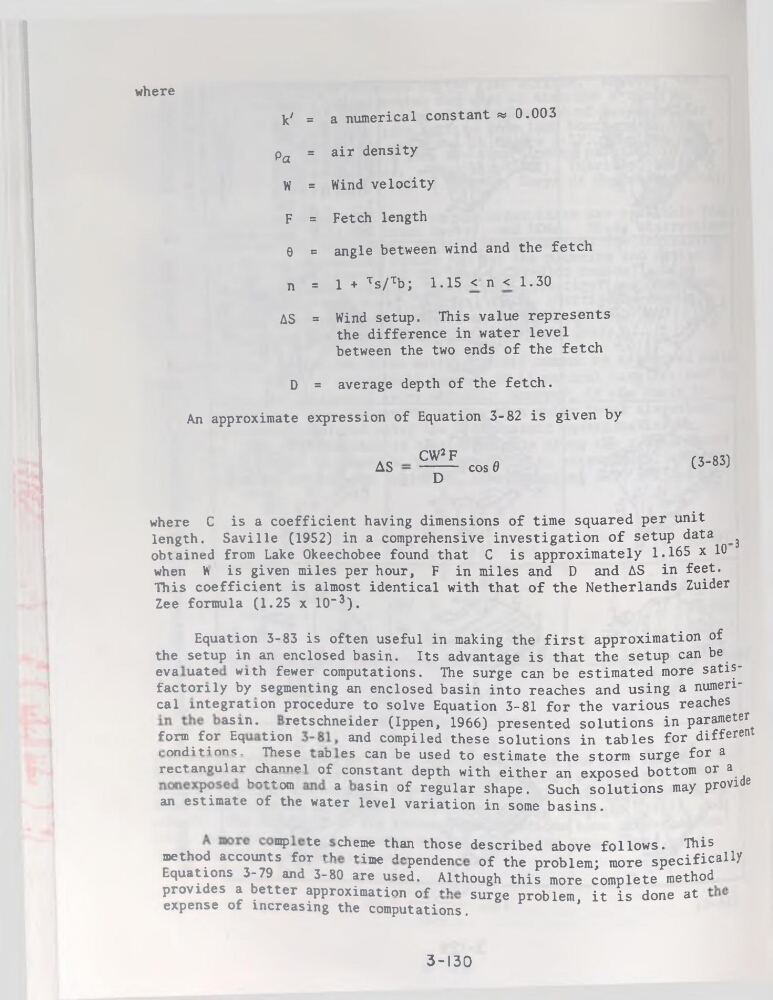
where
kz = a numerical constant « 0.003
pa = air density
W = Wind velocity
F = Fetch length
6 = angle between wind and the fetch
n = 1 + Ts/Tb; 1.15 < n < 1.30
△S = Wind setup. This value represents
the différence in water level
between the two ends of the fetch
D = average depth of the fetch.
An approximate expression of Equation 3-82 is given by
△S
CW2 F
D
cos 0
(3-83)
where C is a coefficient having dimensions of time squared per unit
length. Saville (1952) in a comprehensive investigation of setup data
obtained from Lake Okeechobee found that C is approximately 1.165 x 10 $
when h is given miles per hour, F in miles and D and AS in feet.
This coefficient is almost identical with that of the Netherlands Zuider
Zee formula (1.25 x 10⁻³).
Equation 3-83 is often useful in making the first approximation of
the setup in an enclosed basin. Its advantage is that the setup can be
eva uate with fewer computations. The surge can be estimated more satisfactorily by segmenting an enclosed basin into reaches and using a numerical intégration procedure to solve Equation 3-81 for the various reaches
fn-rm fnrTH’f re*schneider (Ippen, 1966) presented solutions in parameter
.XjXX X"
and comPiled these Solutions in tables for different
rectaneular ch X % eS Can be used to estimate the storm surge for a
,
wX
°f c°nstant depth with either an exposed bottom or a
es?imate of X
/ X" °f regular shaPe- Such solutions may provide
an estimate of the water level variation in some basins.
method account^fo^th^X tX th°Se described above follows. This
Equations 3-79 and 3-80 aXuseXXrh XX problem; more specifically
provides a better approximation Àf ^Jthough thls more complété method
expense of increasiTX^p^ti™.5^ Pr°blem- “ iS d°"e at
3-130
kz = a numerical constant « 0.003
pa = air density
W = Wind velocity
F = Fetch length
6 = angle between wind and the fetch
n = 1 + Ts/Tb; 1.15 < n < 1.30
△S = Wind setup. This value represents
the différence in water level
between the two ends of the fetch
D = average depth of the fetch.
An approximate expression of Equation 3-82 is given by
△S
CW2 F
D
cos 0
(3-83)
where C is a coefficient having dimensions of time squared per unit
length. Saville (1952) in a comprehensive investigation of setup data
obtained from Lake Okeechobee found that C is approximately 1.165 x 10 $
when h is given miles per hour, F in miles and D and AS in feet.
This coefficient is almost identical with that of the Netherlands Zuider
Zee formula (1.25 x 10⁻³).
Equation 3-83 is often useful in making the first approximation of
the setup in an enclosed basin. Its advantage is that the setup can be
eva uate with fewer computations. The surge can be estimated more satisfactorily by segmenting an enclosed basin into reaches and using a numerical intégration procedure to solve Equation 3-81 for the various reaches
fn-rm fnrTH’f re*schneider (Ippen, 1966) presented solutions in parameter
.XjXX X"
and comPiled these Solutions in tables for different
rectaneular ch X % eS Can be used to estimate the storm surge for a
,
wX
°f c°nstant depth with either an exposed bottom or a
es?imate of X
/ X" °f regular shaPe- Such solutions may provide
an estimate of the water level variation in some basins.
method account^fo^th^X tX th°Se described above follows. This
Equations 3-79 and 3-80 aXuseXXrh XX problem; more specifically
provides a better approximation Àf ^Jthough thls more complété method
expense of increasiTX^p^ti™.5^ Pr°blem- “ iS d°"e at
3-130