

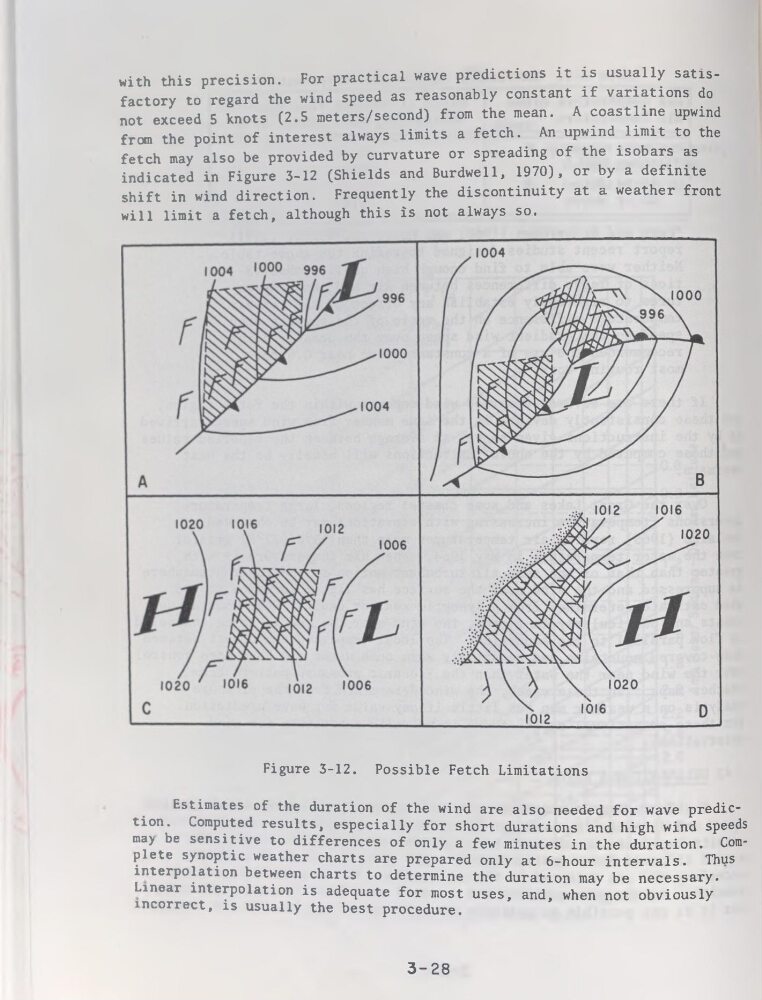
with this précision. For practical wave prédictions it is usually satisfactory to regard the wind speed as reasonably constant if variations do
not exceed 5 knots (2.5 meters/second) from the mean. A coastline upwind
from the point of interest always limits a fetch. An upwind limit to the
fetch may also be provided by curvature or spreading of the isobars as
indicated in Figure 3-12 (Shields and Burdwell, 1970), or by a definite
shift in wind direction. Frequently the discontinu!ty at a weather front
will limit a fetch, although this is not always so.
Figure 3-12. Possible Fetch Limitations
Estimâtes of the duration of the wind are also needed for wave prédiction. Computed results, especially for short durations and high wind speeds
may be sensitive to différences of only a few minutes in the duration. Complété synoptic weather charts are prepared only at 6-hour intervals. Thus
interpolation between charts to détermine the duration may be necessary.
Linear interpolation is adéquate for most uses, and, when not obviously
incorrect, is usually the best procedure.
3-28
not exceed 5 knots (2.5 meters/second) from the mean. A coastline upwind
from the point of interest always limits a fetch. An upwind limit to the
fetch may also be provided by curvature or spreading of the isobars as
indicated in Figure 3-12 (Shields and Burdwell, 1970), or by a definite
shift in wind direction. Frequently the discontinu!ty at a weather front
will limit a fetch, although this is not always so.
Figure 3-12. Possible Fetch Limitations
Estimâtes of the duration of the wind are also needed for wave prédiction. Computed results, especially for short durations and high wind speeds
may be sensitive to différences of only a few minutes in the duration. Complété synoptic weather charts are prepared only at 6-hour intervals. Thus
interpolation between charts to détermine the duration may be necessary.
Linear interpolation is adéquate for most uses, and, when not obviously
incorrect, is usually the best procedure.
3-28