

3.43 FORECASTS FOR LAKES, BAYS, AND ESTUARIES
3.431 Wind Data. The techniques referred to for détermination of wind
speeds and directions from isobaric patterns apply generally to oce«ui
areas. The friction that causes winds to spiral when Crossing isobars
and to hâve a velocity lower than geostrophic or gradient winds is more
variable over land areas. When a fetch is close to land, this variability
will alter anticipated wind directions and velocities. In enclosed or
semienclosed bodies of water, such as lakes and bays, wind speeds and
directions should be taken from actual weather station reports whenever
possible.
In enclosed bodies of water, or in other areas where the wind blows
off the land, differing frictional effects of land and water should be
considered, and indicated wind speeds should be adjusted for these effects.
Studies by Myers (1954) and Graham and Nunn (1959) indicate recommended
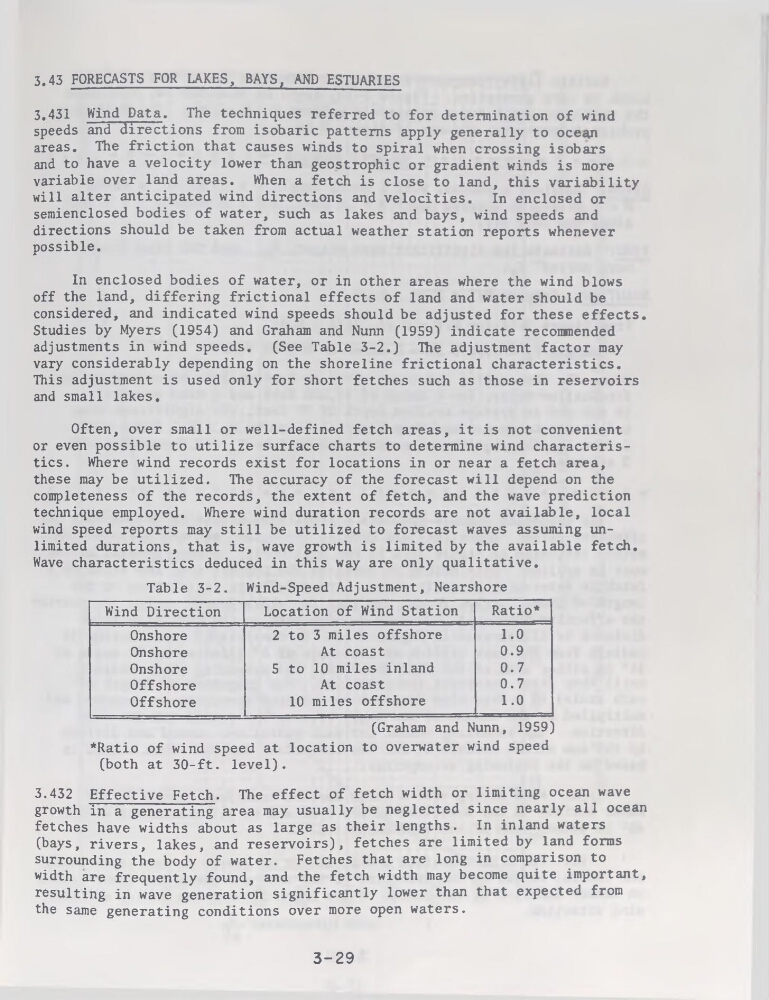
adjustments in wind speeds. (See Table 3-2.) The adjustment factor may
vary considerably depending on the shoreline frictional characteristics.
This adjustment is used only for short fetches such as those in réservoirs
and small lakes.
Often, over small or well-defined fetch areas, it is not convenient
or even possible to utilize surface charts to détermine wind characteristics. Where wind records exist for locations in or near a fetch area,
these may be utilized. The accuracy of the forecast will dépend on the
completeness of the records, the extent of fetch, and the wave prédiction
technique employed. Where wind duration records are not availabié, local
wind speed reports may still be utilized to forecast waves assuming unlimited durations, that is, wave growth is limited by the available fetch.
Wave characteristics deduced in this way are only qualitative.
Table 3-2. Wind-Speed Adjustment, Nearshore
Wind Direction
Location of Wind Station
Ratio*
Onshore
2 to 3 miles offshore
1.0
Onshore
At coast
0.9
Onshore
5 to 10 miles inland
0.7
Offshore
At coast
0.7
Offshore
10 miles offshore
1.0
(Graham and Nunn, 1959)
*Ratio of wind speed at location to overwater wind speed
(both at 30-ft. level).
3.432 Effective Fetch. The effect of fetch width or limiting océan wave
growth in a generating area may usually be neglected since nearly ail océan
fetches hâve widths about as large as their lengths. In inland waters
(bays, rivers, lakes, and réservoirs), fetches are limited by land forms
surrounding the body of water. Fetches that are long in comparison to
width are frequently found, and the fetch width may become quite important,
resulting in wave génération significantly lower than that expected from
the same generating conditions over more open waters.
3-29
3.431 Wind Data. The techniques referred to for détermination of wind
speeds and directions from isobaric patterns apply generally to oce«ui
areas. The friction that causes winds to spiral when Crossing isobars
and to hâve a velocity lower than geostrophic or gradient winds is more
variable over land areas. When a fetch is close to land, this variability
will alter anticipated wind directions and velocities. In enclosed or
semienclosed bodies of water, such as lakes and bays, wind speeds and
directions should be taken from actual weather station reports whenever
possible.
In enclosed bodies of water, or in other areas where the wind blows
off the land, differing frictional effects of land and water should be
considered, and indicated wind speeds should be adjusted for these effects.
Studies by Myers (1954) and Graham and Nunn (1959) indicate recommended
adjustments in wind speeds. (See Table 3-2.) The adjustment factor may
vary considerably depending on the shoreline frictional characteristics.
This adjustment is used only for short fetches such as those in réservoirs
and small lakes.
Often, over small or well-defined fetch areas, it is not convenient
or even possible to utilize surface charts to détermine wind characteristics. Where wind records exist for locations in or near a fetch area,
these may be utilized. The accuracy of the forecast will dépend on the
completeness of the records, the extent of fetch, and the wave prédiction
technique employed. Where wind duration records are not availabié, local
wind speed reports may still be utilized to forecast waves assuming unlimited durations, that is, wave growth is limited by the available fetch.
Wave characteristics deduced in this way are only qualitative.
Table 3-2. Wind-Speed Adjustment, Nearshore
Wind Direction
Location of Wind Station
Ratio*
Onshore
2 to 3 miles offshore
1.0
Onshore
At coast
0.9
Onshore
5 to 10 miles inland
0.7
Offshore
At coast
0.7
Offshore
10 miles offshore
1.0
(Graham and Nunn, 1959)
*Ratio of wind speed at location to overwater wind speed
(both at 30-ft. level).
3.432 Effective Fetch. The effect of fetch width or limiting océan wave
growth in a generating area may usually be neglected since nearly ail océan
fetches hâve widths about as large as their lengths. In inland waters
(bays, rivers, lakes, and réservoirs), fetches are limited by land forms
surrounding the body of water. Fetches that are long in comparison to
width are frequently found, and the fetch width may become quite important,
resulting in wave génération significantly lower than that expected from
the same generating conditions over more open waters.
3-29