

The différence between this number and the 18.38 ft/sec calculated
under (b) above is the resuit of small errors in reading the
curves.
******************************** * * * * *
2.27 SOLITARY WAVE THEORY
Waves considered in the previous sections were oscillatory or nearly
oscillatory waves. The water particles move backward and forward with the
passage of each wave, and a distinct wave crest and wave trough are évident
A solitary wave is neither oscillatory nor does it exhibit a trough. In
the pure sense, the solitary wave form lies entirely above the stillwater
level. The solitary wave is a wave of translation relative to the water
mass.
Russell (1838, 1845) first recognized the existence of a solitary
wave. The original theoretical developments were made by Boussinesq
(1872), Lord Rayleigh (1876), and McCowan (1891), and more recently by
Keulegan and Patterson (1940), Keulegan (1948), and Iwasa (1955).
In nature it is difficult to form a truly solitary wave, because at
the trailing edge of the wave there are usually small dispersive waves.
However, long waves such as tsunamis and waves resulting from large displacements of water caused by such phenomena as landslides, and earthquakes
sometimes behave approximately like solitary waves. When an oscillatory
wave moves into shallow water, it may often be approximated by a solitary
wave, (Munk, 1949). As an oscillatory wave moves into shoaling water, the
wave amplitude becomes progressively higher; the crests become shorter and
more pointed, and the trough becomes longer and flatter.
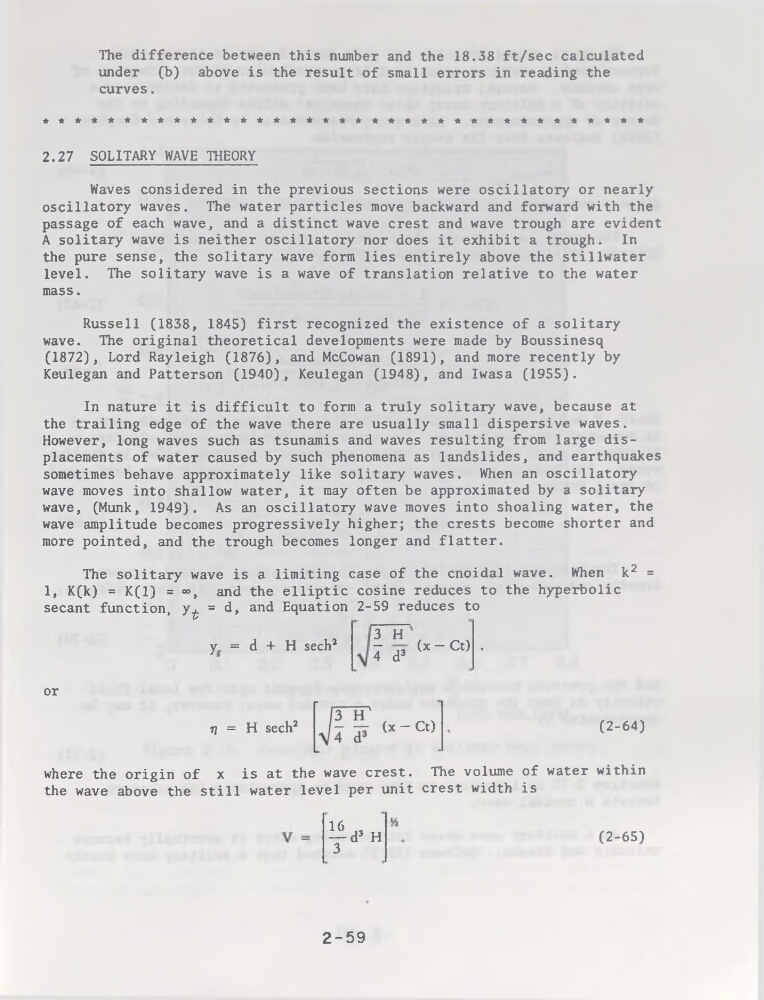
The solitary wave is a limiting case of the cnoidal wave. When k2 =
1, K(k) = K(l) = », and the elliptic cosine reduces to the hyperbolic
sécant function, y^ = d, and Equation 2-59 reduces to
3 H
7 J3
y = d + H sech2
or
n = H sech2
(x - Ct)
(2-64)
where the origin of x is at the wave crest. The volume of water within
the wave above the still water level per unit crest width is
16 „
— d3 H
3
(2-65)
2-59
under (b) above is the resuit of small errors in reading the
curves.
******************************** * * * * *
2.27 SOLITARY WAVE THEORY
Waves considered in the previous sections were oscillatory or nearly
oscillatory waves. The water particles move backward and forward with the
passage of each wave, and a distinct wave crest and wave trough are évident
A solitary wave is neither oscillatory nor does it exhibit a trough. In
the pure sense, the solitary wave form lies entirely above the stillwater
level. The solitary wave is a wave of translation relative to the water
mass.
Russell (1838, 1845) first recognized the existence of a solitary
wave. The original theoretical developments were made by Boussinesq
(1872), Lord Rayleigh (1876), and McCowan (1891), and more recently by
Keulegan and Patterson (1940), Keulegan (1948), and Iwasa (1955).
In nature it is difficult to form a truly solitary wave, because at
the trailing edge of the wave there are usually small dispersive waves.
However, long waves such as tsunamis and waves resulting from large displacements of water caused by such phenomena as landslides, and earthquakes
sometimes behave approximately like solitary waves. When an oscillatory
wave moves into shallow water, it may often be approximated by a solitary
wave, (Munk, 1949). As an oscillatory wave moves into shoaling water, the
wave amplitude becomes progressively higher; the crests become shorter and
more pointed, and the trough becomes longer and flatter.
The solitary wave is a limiting case of the cnoidal wave. When k2 =
1, K(k) = K(l) = », and the elliptic cosine reduces to the hyperbolic
sécant function, y^ = d, and Equation 2-59 reduces to
3 H
7 J3
y = d + H sech2
or
n = H sech2
(x - Ct)
(2-64)
where the origin of x is at the wave crest. The volume of water within
the wave above the still water level per unit crest width is
16 „
— d3 H
3
(2-65)
2-59