

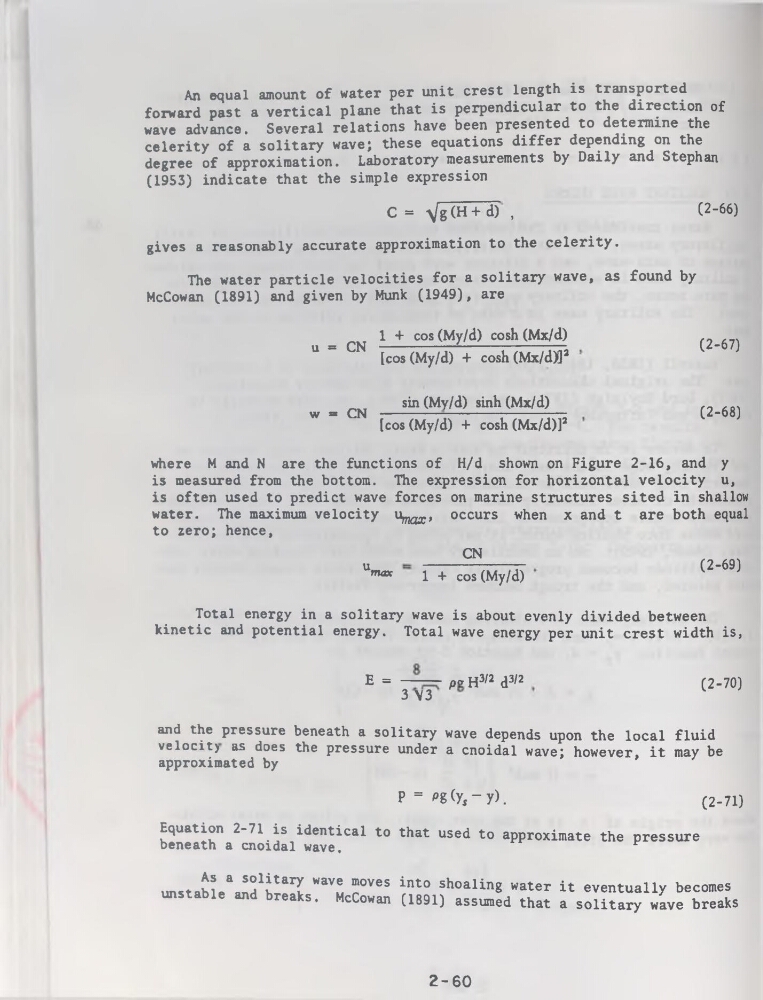
An equal amount of water per unit crest length is transportée!
forward past a vertical plane that is perpendicular to the direction of
wave advance. Several relations hâve been presented to détermine the
celerity of a solitary wave; these équations differ depending on the
degree of approximation. Laboratory measurements by Daily and Stephan
(1953) indicate that the simple expression
C = -^g(H+ d) ,
(2-66)
gives a reasonably accurate approximation to the celerity.
The water particle velocities for a solitary wave, as found by
McCowan (1891) and given by Munk (1949), are
u = CN
1 4- cos (My/d) cosh (Mx/d)
[cos (My/d) + cosh (Mx/d)02
(2-67)
sin (My/d) sinh (Mx/d)
w = CN ------------ ------------------------[cos (My/d) + cosh (Mx/d)]2
(2-68)
where M and N are the functions of H/d shown on Figure 2-16, and y
is measured from the bottom. The expression for horizontal velocity u,
is often used to predict wave forces on marine structures sited in shallow
water. The maximum velocity u^^, occurs when x and t are both equal
to zéro; hence,
CN
umax
i 4. cos (My/d)
(2-69)
Total energy in a solitary wave is about evenly divided between
kinetic and potential energy. Total wave energy per unit crest width is,
E = ——- po h3/2 d3^2
3 V3
(2-70)
and the pressure beneath a solitary wave dépends upon the local fluid
velocit) as does the pressure under a cnoidal wave; however, it may be
approximated by
P = Pg (y, “ y).
(2-71)
Equation 2-71 is identical to
beneath a cnoidal wave.
that used to approximate the pressure
As a solitary wave moves
unstable and breaks. McCowan
into shoaling water it eventually becomes
(1891) assumed that a solitary wave breaks
2-60
forward past a vertical plane that is perpendicular to the direction of
wave advance. Several relations hâve been presented to détermine the
celerity of a solitary wave; these équations differ depending on the
degree of approximation. Laboratory measurements by Daily and Stephan
(1953) indicate that the simple expression
C = -^g(H+ d) ,
(2-66)
gives a reasonably accurate approximation to the celerity.
The water particle velocities for a solitary wave, as found by
McCowan (1891) and given by Munk (1949), are
u = CN
1 4- cos (My/d) cosh (Mx/d)
[cos (My/d) + cosh (Mx/d)02
(2-67)
sin (My/d) sinh (Mx/d)
w = CN ------------ ------------------------[cos (My/d) + cosh (Mx/d)]2
(2-68)
where M and N are the functions of H/d shown on Figure 2-16, and y
is measured from the bottom. The expression for horizontal velocity u,
is often used to predict wave forces on marine structures sited in shallow
water. The maximum velocity u^^, occurs when x and t are both equal
to zéro; hence,
CN
umax
i 4. cos (My/d)
(2-69)
Total energy in a solitary wave is about evenly divided between
kinetic and potential energy. Total wave energy per unit crest width is,
E = ——- po h3/2 d3^2
3 V3
(2-70)
and the pressure beneath a solitary wave dépends upon the local fluid
velocit) as does the pressure under a cnoidal wave; however, it may be
approximated by
P = Pg (y, “ y).
(2-71)
Equation 2-71 is identical to
beneath a cnoidal wave.
that used to approximate the pressure
As a solitary wave moves
unstable and breaks. McCowan
into shoaling water it eventually becomes
(1891) assumed that a solitary wave breaks
2-60