

p. 27
: í µí² í µí² = í µí²í µí²í µí²í µí²í µí²í µí²í µí²í µí²í µí² : Loi de Bernoulli
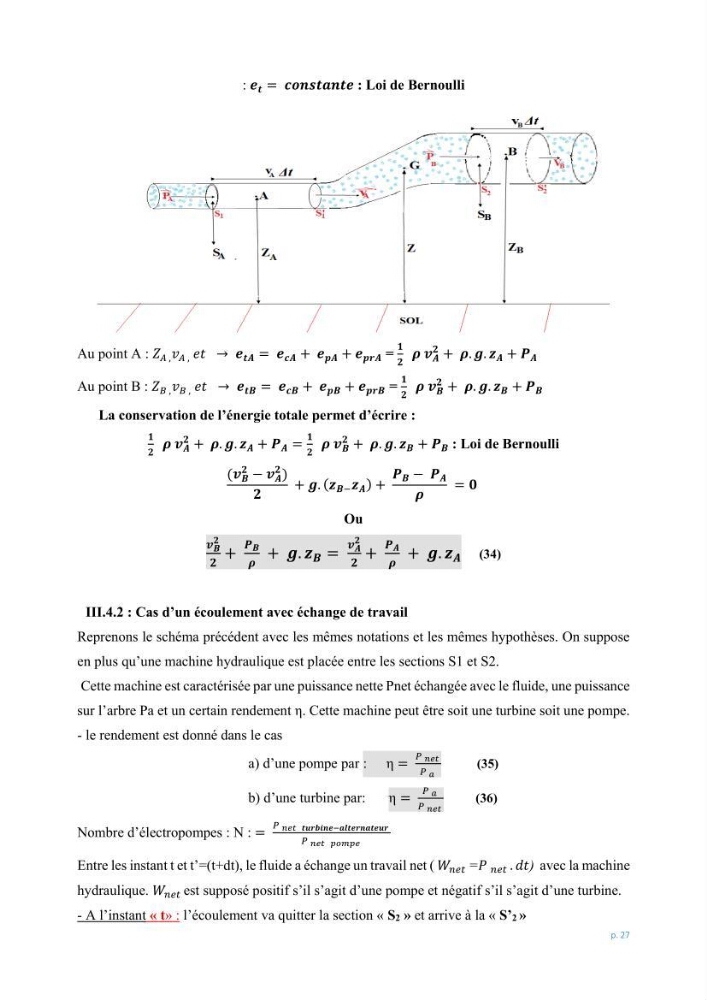
Au point A : í µí± í µí°´ , í µí±£ í µí°´ , í µí±í µí±¡ → í µí² í µí²í µí±¨ = í µí² í µí²í µí±¨ + í µí² í µí²í µí±¨ + í µí² í µí²í µí²í µí±¨ =
í µí¿
í µí¿
í µí½ í µí² í µí±¨
í µí¿ + í µí½. í µí². í µí² í µí±¨ + í µí±· í µí±¨
Au point B : í µí± í µí°µ , í µí±£ í µí°µ , í µí±í µí±¡ → í µí² í µí²í µí±© = í µí² í µí²í µí±© + í µí² í µí²í µí±© + í µí² í µí²í µí²í µí±© =
í µí¿
í µí¿
í µí½ í µí² í µí±©
í µí¿ + í µí½. í µí². í µí² í µí±© + í µí±· í µí±©
La conservation de l’énergie totale permet d’écrire :
í µí¿
í µí¿
í µí½ í µí² í µí±¨
í µí¿ + í µí½. í µí². í µí² í µí±¨ + í µí±· í µí±¨ =
í µí¿
í µí¿
í µí½ í µí² í µí±©
í µí¿ + í µí½. í µí². í µí² í µí±© + í µí±· í µí±© : Loi de Bernoulli
(í µí² í µí±©
í µí¿ − í µí² í µí±¨
í µí¿ )
í µí¿
+ í µí². (í µí² í µí±©− í µí² í µí±¨ ) +
í µí±· í µí±© − í µí±· í µí±¨
í µí½
= í µí¿
Ou
í µí² í µí±©
í µí¿
í µí¿
+
í µí±· í µí±©
í µí½
+ í µí². í µí² í µí±© =
í µí² í µí±¨
í µí¿
í µí¿
+
í µí±· í µí±¨
í µí½
+ í µí². í µí² í µí±¨ (34)
III.4.2 : Cas d’un écoulement avec échange de travail
Reprenons le schéma précédent avec les mêmes notations et les mêmes hypothèses. On suppose
en plus qu’une machine hydraulique est placée entre les sections S1 et S2.
Cette machine est caractérisée par une puissance nette Pnet échangée avec le fluide, une puissance
sur l’arbre Pa et un certain rendement η. Cette machine peut être soit une turbine soit une pompe.
- le rendement est donné dans le cas
a) d’une pompe par : η =
í µí± í µí±í µí±í µíí µí± í µí±
(35)
b) d’une turbine par:
η =
í µí± í µí±
í µí± í µí±í µí±í µí(36)
Nombre d’électropompes : N : =
í µí± í µí±í µí±í µí±¡ í µí²í µí²í µí²í µí²í µí²í µí²í µí²−í µí²í µí²í µí²í µí²í µí²í µí²í µí²í µí²í µí²í µí²í µí²
í µí± í µí±í µí±í µí±¡ í µí±í µí±í µí±í µí±í µí±
Entre les instant t et t’=(t+dt), le fluide a échange un travail net ( í µí± í µí±í µí±í µí±¡ =í µí± í µí±í µí±í µí±¡ . í µí±í µí±¡) avec la machine
hydraulique. í µí± í µí±í µí±í µí±¡ est supposé positif s’il s’agit d’une pompe et négatif s’il s’agit d’une turbine.
- A l’instant « t» : l’écoulement va quitter la section « S 2 » et arrive à la « S’ 2 »
: í µí² í µí² = í µí²í µí²í µí²í µí²í µí²í µí²í µí²í µí²í µí² : Loi de Bernoulli
Au point A : í µí± í µí°´ , í µí±£ í µí°´ , í µí±í µí±¡ → í µí² í µí²í µí±¨ = í µí² í µí²í µí±¨ + í µí² í µí²í µí±¨ + í µí² í µí²í µí²í µí±¨ =
í µí¿
í µí¿
í µí½ í µí² í µí±¨
í µí¿ + í µí½. í µí². í µí² í µí±¨ + í µí±· í µí±¨
Au point B : í µí± í µí°µ , í µí±£ í µí°µ , í µí±í µí±¡ → í µí² í µí²í µí±© = í µí² í µí²í µí±© + í µí² í µí²í µí±© + í µí² í µí²í µí²í µí±© =
í µí¿
í µí¿
í µí½ í µí² í µí±©
í µí¿ + í µí½. í µí². í µí² í µí±© + í µí±· í µí±©
La conservation de l’énergie totale permet d’écrire :
í µí¿
í µí¿
í µí½ í µí² í µí±¨
í µí¿ + í µí½. í µí². í µí² í µí±¨ + í µí±· í µí±¨ =
í µí¿
í µí¿
í µí½ í µí² í µí±©
í µí¿ + í µí½. í µí². í µí² í µí±© + í µí±· í µí±© : Loi de Bernoulli
(í µí² í µí±©
í µí¿ − í µí² í µí±¨
í µí¿ )
í µí¿
+ í µí². (í µí² í µí±©− í µí² í µí±¨ ) +
í µí±· í µí±© − í µí±· í µí±¨
í µí½
= í µí¿
Ou
í µí² í µí±©
í µí¿
í µí¿
+
í µí±· í µí±©
í µí½
+ í µí². í µí² í µí±© =
í µí² í µí±¨
í µí¿
í µí¿
+
í µí±· í µí±¨
í µí½
+ í µí². í µí² í µí±¨ (34)
III.4.2 : Cas d’un écoulement avec échange de travail
Reprenons le schéma précédent avec les mêmes notations et les mêmes hypothèses. On suppose
en plus qu’une machine hydraulique est placée entre les sections S1 et S2.
Cette machine est caractérisée par une puissance nette Pnet échangée avec le fluide, une puissance
sur l’arbre Pa et un certain rendement η. Cette machine peut être soit une turbine soit une pompe.
- le rendement est donné dans le cas
a) d’une pompe par : η =
í µí± í µí±í µí±í µíí µí± í µí±
(35)
b) d’une turbine par:
η =
í µí± í µí±
í µí± í µí±í µí±í µí(36)
Nombre d’électropompes : N : =
í µí± í µí±í µí±í µí±¡ í µí²í µí²í µí²í µí²í µí²í µí²í µí²−í µí²í µí²í µí²í µí²í µí²í µí²í µí²í µí²í µí²í µí²í µí²
í µí± í µí±í µí±í µí±¡ í µí±í µí±í µí±í µí±í µí±
Entre les instant t et t’=(t+dt), le fluide a échange un travail net ( í µí± í µí±í µí±í µí±¡ =í µí± í µí±í µí±í µí±¡ . í µí±í µí±¡) avec la machine
hydraulique. í µí± í µí±í µí±í µí±¡ est supposé positif s’il s’agit d’une pompe et négatif s’il s’agit d’une turbine.
- A l’instant « t» : l’écoulement va quitter la section « S 2 » et arrive à la « S’ 2 »