

57
Composition of the Major Components of Seawater
conservative in its behavior. A conservative component of seawater is one that is unreactive and for which the changes from place to place are due to the addition or loss of
water. The constituent originally selected to characterize a given sample of seawater or
other natural waters was the chlorinity, Cl(‰). The chlorinity was originally defined as
the chlorine equivalent to the total halide concentration in parts per thousand by weight
(grams of Cl/ kilogram of seawater) measured by titration with AgNO 3 . Since changes can
occur in the atomic weights of Ag and Cl, chlorinity was redefined in 1937 by Jacobsen and
Knudsen: “The chlorinity is the mass in grams of pure silver necessary to precipitate the
halogens in 328.5233 grams of seawater” (Riley and Chester, 1971). This definition gives
the value of Cl(‰) as 0.3285233 Ag(‰), where Ag(‰) is the grams of silver per kilogram of
seawater. The 1992 atomic weights yield ATW(Cl)/ATW(Ag) = 35.4527/107.8682 = 0.328667.
Thus, the true chlorinity or chlorinity equivalent is equal to 0.328667/0.3285233 = 1.00044
times the Cl(‰).
2.2 The Concept of Salinity
Salinity was originally conceived as a measure of the mass of dissolved salts in a given
mass of seawater (the weight fraction). The experimental determination of the salt content
of seawater by drying and weighing presents some difficulties. At the temperatures necessary to drive off the last traces of H 2 O, the bicarbonates and carbonates are decomposed to
oxides (MO 2 , where M = Na or K).
2HCO 3
– → [MO 2 ] + H 2 O + 2CO 2
(2.1)
CO 3
2– → [MO 2 ] + CO 2
(2.2)
Br 2 , some Cl 2 gas, and B(OH) 3 are also vaporized. For example, heating MgCl 2 solutions to
dryness yields HCl gas. The Cl 2 and Br 2 lost can be determined by titrating with AgNO 3
before and after heating. Earlier workers (Marcet, Forchhammer, and Dittmar) found difficulty in determining the salinity by evaporation. A complete chemical analysis of seawater
is the only reliable way to determine the true or absolute salinity of seawater (S A , in parts
per thousand). This method, however, is time consuming for routine studies and has a
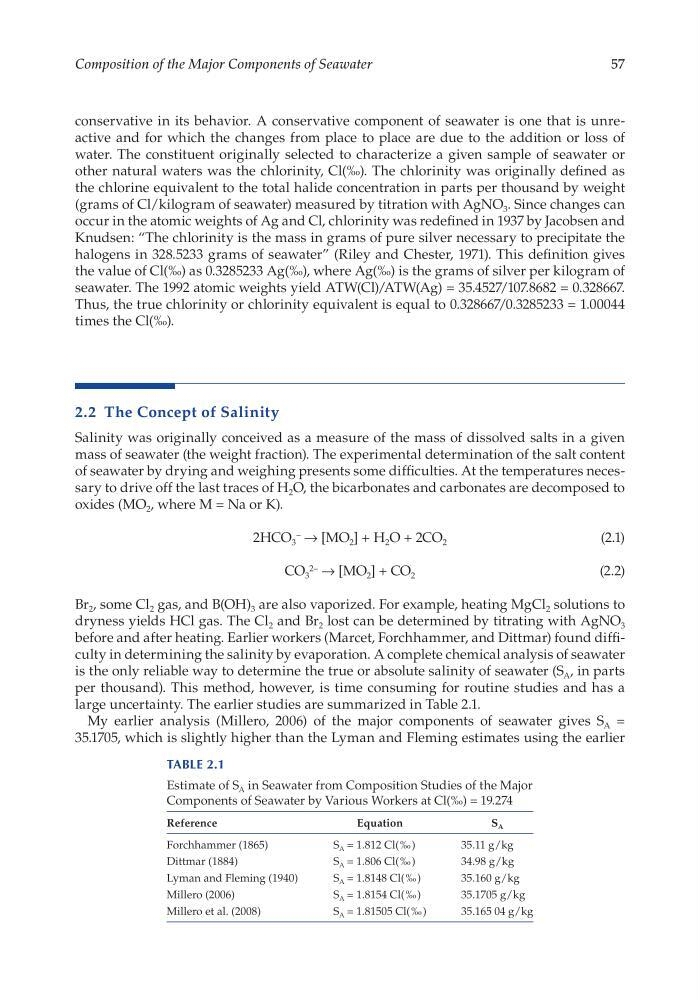
large uncertainty. The earlier studies are summarized in Table 2.1.
My earlier analysis (Millero, 2006) of the major components of seawater gives S A =
35.1705, which is slightly higher than the Lyman and Fleming estimates using the earlier
Table 2.1
Estimate of S A in Seawater from Composition Studies of the Major
Components of Seawater by Various Workers at Cl(‰) = 19.274
Reference
Equation
S A
Forchhammer (1865)
S A = 1.812 Cl(‰)
35.11 g/ kg
Dittmar (1884)
S A = 1.806 Cl(‰)
34.98 g/ kg
Lyman and Fleming (1940)
S A = 1.8148 Cl(‰)
35.160 g/ kg
Millero (2006)
S A = 1.8154 Cl(‰)
35.1705 g/ kg
Millero et al. (2008)
S A = 1.81505 Cl(‰)
35.165 04 g/ kg
Composition of the Major Components of Seawater
conservative in its behavior. A conservative component of seawater is one that is unreactive and for which the changes from place to place are due to the addition or loss of
water. The constituent originally selected to characterize a given sample of seawater or
other natural waters was the chlorinity, Cl(‰). The chlorinity was originally defined as
the chlorine equivalent to the total halide concentration in parts per thousand by weight
(grams of Cl/ kilogram of seawater) measured by titration with AgNO 3 . Since changes can
occur in the atomic weights of Ag and Cl, chlorinity was redefined in 1937 by Jacobsen and
Knudsen: “The chlorinity is the mass in grams of pure silver necessary to precipitate the
halogens in 328.5233 grams of seawater” (Riley and Chester, 1971). This definition gives
the value of Cl(‰) as 0.3285233 Ag(‰), where Ag(‰) is the grams of silver per kilogram of
seawater. The 1992 atomic weights yield ATW(Cl)/ATW(Ag) = 35.4527/107.8682 = 0.328667.
Thus, the true chlorinity or chlorinity equivalent is equal to 0.328667/0.3285233 = 1.00044
times the Cl(‰).
2.2 The Concept of Salinity
Salinity was originally conceived as a measure of the mass of dissolved salts in a given
mass of seawater (the weight fraction). The experimental determination of the salt content
of seawater by drying and weighing presents some difficulties. At the temperatures necessary to drive off the last traces of H 2 O, the bicarbonates and carbonates are decomposed to
oxides (MO 2 , where M = Na or K).
2HCO 3
– → [MO 2 ] + H 2 O + 2CO 2
(2.1)
CO 3
2– → [MO 2 ] + CO 2
(2.2)
Br 2 , some Cl 2 gas, and B(OH) 3 are also vaporized. For example, heating MgCl 2 solutions to
dryness yields HCl gas. The Cl 2 and Br 2 lost can be determined by titrating with AgNO 3
before and after heating. Earlier workers (Marcet, Forchhammer, and Dittmar) found difficulty in determining the salinity by evaporation. A complete chemical analysis of seawater
is the only reliable way to determine the true or absolute salinity of seawater (S A , in parts
per thousand). This method, however, is time consuming for routine studies and has a
large uncertainty. The earlier studies are summarized in Table 2.1.
My earlier analysis (Millero, 2006) of the major components of seawater gives S A =
35.1705, which is slightly higher than the Lyman and Fleming estimates using the earlier
Table 2.1
Estimate of S A in Seawater from Composition Studies of the Major
Components of Seawater by Various Workers at Cl(‰) = 19.274
Reference
Equation
S A
Forchhammer (1865)
S A = 1.812 Cl(‰)
35.11 g/ kg
Dittmar (1884)
S A = 1.806 Cl(‰)
34.98 g/ kg
Lyman and Fleming (1940)
S A = 1.8148 Cl(‰)
35.160 g/ kg
Millero (2006)
S A = 1.8154 Cl(‰)
35.1705 g/ kg
Millero et al. (2008)
S A = 1.81505 Cl(‰)
35.165 04 g/ kg