

56
Chemical Oceanography, 4th Edition
(Riley and Chester, 1971). Dana Kester (University of Rhode Island) called this simple suggestion the first law of chemical oceanography. Other earlier workers analyzed seawaters.
The first extensive investigations of the major inorganic components of seawater
were made by Forchhammer in 1865. He determined the concentrations of Cl – , SO 4
2– ,
Mg 2+ , Ca 2+ , and K + directly and Na + by difference. He made these measurements on
several hundred surface waters from all parts of the world. He noted that the ratios
of the major constituents (greater than 1 ppm by weight) were nearly constant, with
only very slight variations. These major dissolved components make up 99.9% of the
soluble ionic species of seawater. His results have been criticized on the grounds that
he used only surface samples and that his analytical methods were inaccurate. In 1884,
Dittmar analyzed 70 seawater samples collected at various depths for the major oceans
during the cruise of the H.M.S. Challenger (1873–1876). Although his results are not as
extensive as one might wish and the samples were stored for as long as 2 yr, he did
adopt analytical techniques that are still used today. He also checked his experimental
techniques on synthetic samples to examine the reliability of his measurements. His
results agreed fairly well with the work of Forchhammer. He did find small variations
in Mg 2+ , K + , SO 4
2– , Ca 2+ , and Na + . He found the values of Ca 2+ for deep waters to be
0.3% higher than surface waters, which was five times higher than the analytical error.
The results of Dittmar were recalculated in 1940 by Lyman and Fleming using modern
atomic weights.
Since the work of Dittmar, many workers have studied the composition of natural
waters. In 1965, Culkin made a thorough review of all the measurements made on the
major components of seawater since the work of Dittmar. About the same time as this
review appeared, an extensive study of the major components was being carried out by
Cox, Culkin, and Riley (1967; Culkin, 1965; Culkin and Cox, 1966; Morris and Riley, 1966;
Riley and Tongudai, 1967) as part of an international study of the salinity of seawater.
Since the relative composition of ocean waters is nearly constant, it is possible to characterize the composition by measuring only one component that is easy to measure and is
Pseudomonas
diminuta
(0.28 µm)
Staphylococcus
Bacteria
(1 µm)
H 2 O
(2Å)
Na
+
(3.74Å)
Sucrose
(10Å)
Hemoglobin
(70Å)
Influenza
Virus
(1000Å)
Microfiltration
Conventional
filtration
Ultrafiltration
Reverse
Osmosis
1 Å
10 Å
100 Å
1000 Å
1 µm
10 µm
100 µm
Pore Diameter
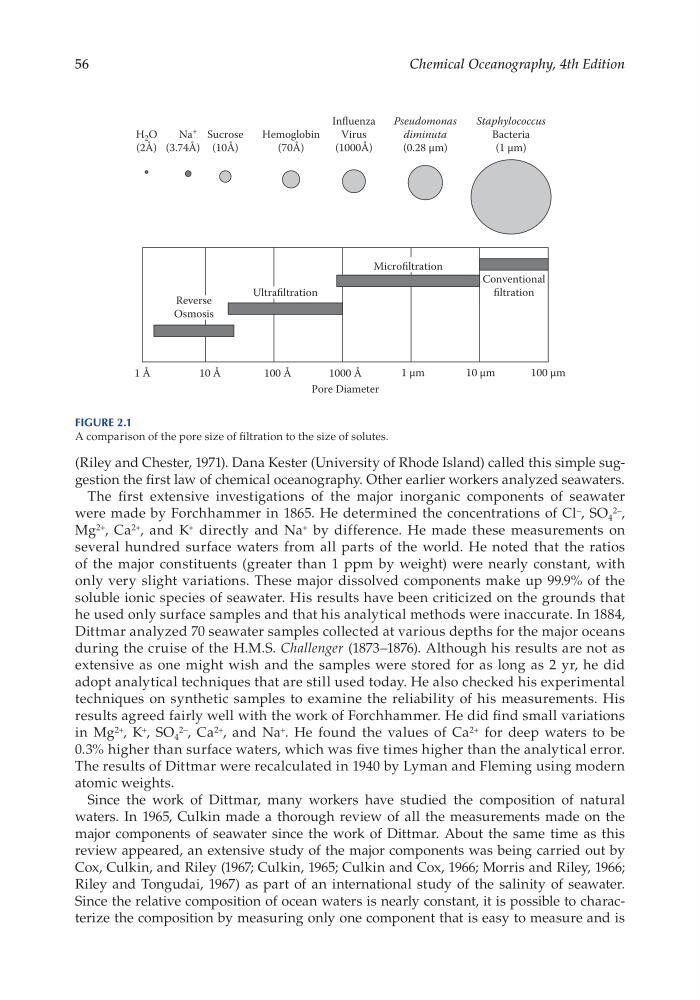
Figure 2.1
A comparison of the pore size of filtration to the size of solutes.
Chemical Oceanography, 4th Edition
(Riley and Chester, 1971). Dana Kester (University of Rhode Island) called this simple suggestion the first law of chemical oceanography. Other earlier workers analyzed seawaters.
The first extensive investigations of the major inorganic components of seawater
were made by Forchhammer in 1865. He determined the concentrations of Cl – , SO 4
2– ,
Mg 2+ , Ca 2+ , and K + directly and Na + by difference. He made these measurements on
several hundred surface waters from all parts of the world. He noted that the ratios
of the major constituents (greater than 1 ppm by weight) were nearly constant, with
only very slight variations. These major dissolved components make up 99.9% of the
soluble ionic species of seawater. His results have been criticized on the grounds that
he used only surface samples and that his analytical methods were inaccurate. In 1884,
Dittmar analyzed 70 seawater samples collected at various depths for the major oceans
during the cruise of the H.M.S. Challenger (1873–1876). Although his results are not as
extensive as one might wish and the samples were stored for as long as 2 yr, he did
adopt analytical techniques that are still used today. He also checked his experimental
techniques on synthetic samples to examine the reliability of his measurements. His
results agreed fairly well with the work of Forchhammer. He did find small variations
in Mg 2+ , K + , SO 4
2– , Ca 2+ , and Na + . He found the values of Ca 2+ for deep waters to be
0.3% higher than surface waters, which was five times higher than the analytical error.
The results of Dittmar were recalculated in 1940 by Lyman and Fleming using modern
atomic weights.
Since the work of Dittmar, many workers have studied the composition of natural
waters. In 1965, Culkin made a thorough review of all the measurements made on the
major components of seawater since the work of Dittmar. About the same time as this
review appeared, an extensive study of the major components was being carried out by
Cox, Culkin, and Riley (1967; Culkin, 1965; Culkin and Cox, 1966; Morris and Riley, 1966;
Riley and Tongudai, 1967) as part of an international study of the salinity of seawater.
Since the relative composition of ocean waters is nearly constant, it is possible to characterize the composition by measuring only one component that is easy to measure and is
Pseudomonas
diminuta
(0.28 µm)
Staphylococcus
Bacteria
(1 µm)
H 2 O
(2Å)
Na
+
(3.74Å)
Sucrose
(10Å)
Hemoglobin
(70Å)
Influenza
Virus
(1000Å)
Microfiltration
Conventional
filtration
Ultrafiltration
Reverse
Osmosis
1 Å
10 Å
100 Å
1000 Å
1 µm
10 µm
100 µm
Pore Diameter
Figure 2.1
A comparison of the pore size of filtration to the size of solutes.